The eight scariest scientific discoveries of 2026 will make you think you're watching a horror movie
Executive Briefing
Synthesized and verified with gemini-2.0-flash-thinking-exp
“**Science and horror are both passionate about uncovering the mysteries that lie beneath the surface”
Key Takeaways
- 1.**Science and horror are both passionate about uncovering the mysteries that lie beneath the surface.
- 2.In 2026, researchers exposed a series of macabre truths: from flesh that refuses death, to vampire tombs, to invisible sounds that manipulate the human mind.** The natural world always contains laws that are beyond our understanding.
- 3.Sometimes, finding the answer to a mystery opens up even more haunting phenomena.
Science and horror are both passionate about uncovering the mysteries that lie beneath the surface. In 2026, researchers exposed a series of macabre truths: from flesh that refuses death, to vampire tombs, to invisible sounds that manipulate the human mind.
The natural world always contains laws that are beyond our understanding. Sometimes, finding the answer to a mystery opens up even more haunting phenomena. In 2026, the scientific community announced findings that could easily become scripts for horror movie adaptations.
In the insect world, the cruelty of nature is pushed to a new level. A study in the journal Phytotaxa in April revealed that even zombie fungi - famous mind manipulators - can fall victim.
In the Danum Valley of Borneo, scientists found a new species of fungus of the genus Pleurocordyceps growing and absorbing nutrients from the same parasitic fungus on the body of an ant. This super-parasitic phenomenon shatters the image of absolute power of the zombie fungus, proving that even when one creature has claimed another's body, there are still darker things waiting to drain it.
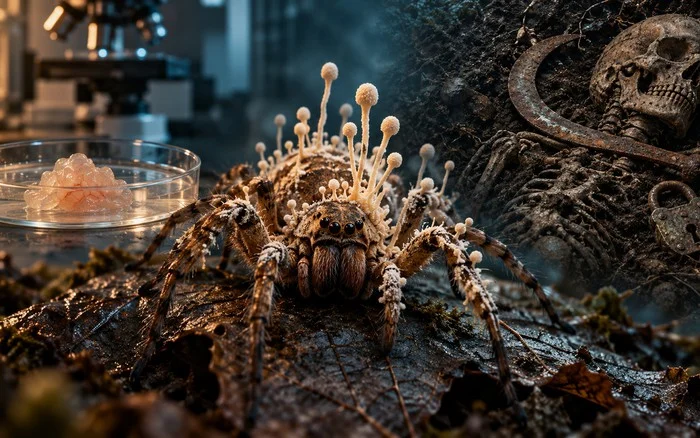
Strange survival is also a topic that attracts attention. In the Amazon region of Ecuador, a new species of spider named Taczanowskia waska has chosen the scariest disguise to survive. Research in the journal Zootaxa describes the abdomen of this spider as having long structures identical to the fruiting bodies of the Gibellula fungus - a fungus that specializes in killing and growing on spider corpses. Instead of being eaten, this spider pretends to be a corpse that has been taken over by fungi to fool the predator.
Meanwhile, the flesh tissue of the red sea cucumber Psolus fabricii shows amazing immortality. Science Advances magazine has documented that the tentacles and severed tissue of sea cucumbers can heal themselves, divide cells and absorb nutrients to survive independently for more than three years in natural seawater. The discovery raises the chilling question of how much of an organism is needed to sustain itself.
The boundary between life and death becomes even more blurred through the experiments of German scientists. The report in PNAS said they used vitrification to cryopreserve mouse brain tissue. What's shocking is that after rewarming, neurons in the hippocampus became active again, continuing to signal and strengthen connections related to memories. Although the mouse did not come back to life, the recovery of complex brain functions after complete biological suspension opens up terrifying scenarios of a Frankenstein mouse.
Besides the animal world, human ruins also bring many equally scary stories. In Pień, Poland, archaeologists found the 17th-century tomb of a young girl with her toes locked in a padlock and her neck blocked by a sickle. Even more terrifying, documents show that this grave appeared to have been dug up after the first burial to place additional sickles - an anti-vampire measure to slit the throats of the dead if they tried to get up.
Further into the past, the Journal of Archaeological Science analyzed nearly 1,000 human bone and tooth fragments from three caves in southern Spain, including Carigüela cave. Marks of cutting, breaking, chewing and boiling show that the practice of cannibalism was not an isolated event but was repeated over many centuries, and the skull was even turned into a container.
Modern crimes also leave indelible physical consequences. A forensic forensic report in January analyzed the concrete floor in a basement where a killer hid his roommate's body for 57 days before dismembering and disposing of it.
Even though the body was gone, the decomposition process had soaked six volatile organic compounds into the porous concrete. The room silently stored chemical traces of death that could not be seen with the naked eye.
Finally, the chilling feeling in haunted houses has been partially decoded by science. Research in the journal Frontiers in Behavioral Neuroscience found that infrasound waves at a frequency of 18 hertz - a low threshold that the human ear cannot hear clearly - have a strong impact on the brain.
Test participants exposed to these waves became irritable and had spikes in levels of the stress hormone cortisol.
Ventilation systems, machinery or groaning pipes in old buildings can unintentionally create this sound, psychologically manipulating people and making people believe that a supernatural force is present in the room.