The first AI poem from TPU in orbit: 60 years of the journey to bring computers to space
Executive Briefing
Synthesized and verified with gemini-2.0-flash-thinking-exp
“A haiku sounds like fun, but to run it, the chip must survive the things that have tormented space e”
Key Takeaways
- 1.A haiku sounds like fun, but to run it, the chip must survive the things that have tormented space engineers for 60 years: radiation, temperature and power limits.
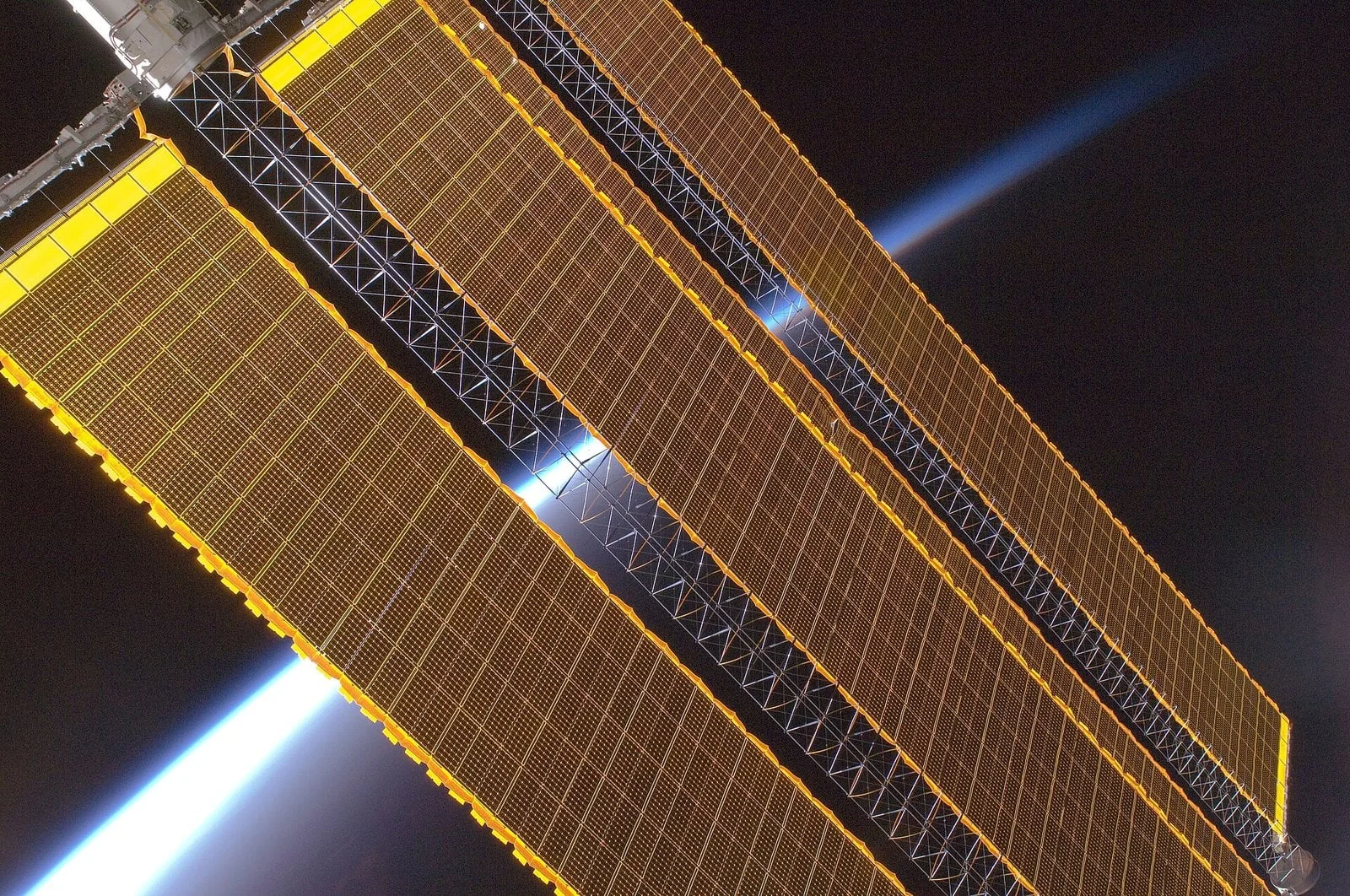
- 2.*Solar panels of the International Space Station (ISS) against the Earth's horizon, photo taken by the Expedition 17 crew in August 2008.
- 3.In the right orbit, the panels are almost always sunny, which is why technology companies are targeting space to power AI* ## **What can the Suncatcher satellite do** Google announced Project Suncatcher in November 2025.
A haiku sounds like fun, but to run it, the chip must survive the things that have tormented space engineers for 60 years: radiation, temperature and power limits.
Solar panels of the International Space Station (ISS) against the Earth's horizon, photo taken by the Expedition 17 crew in August 2008. In the right orbit, the panels are almost always sunny, which is why technology companies are targeting space to power AI
What can the Suncatcher satellite do
Google announced Project Suncatcher in November 2025. The idea is described in a scientific article: instead of building more data centers on the ground, satellite clusters carrying TPU chips, powered by solar cells and connected to each other by lasers, can be put into orbit. In the illustrative example, a cluster of 81 satellites fly close together within a radius of 1 km, in a "dawn-sunset" sun-synchronous orbit, where the panels almost never fall into darkness. According to Google, in the right orbit, a panel can receive up to 8 times more solar energy per year than a panel located at mid-latitudes on Earth.
On October 1, 2026, the prototype satellite made by Google with Planet company was launched on SpaceX's Transporter-18, sharing a Falcon 9 rocket with more than 100 other spacecraft. According to TechCrunch, the satellite carries 4 TPU chips and generates a maximum of 1 kW of power, but due to power limits, only one chip can be turned on at a time, for about 20 minutes. After about three weeks of testing the systems, the engineering team submitted their first command: write a haiku about being in space. Next are some funny space-themed poems and commands to report device status.
The poem is just a test. The main thing in the coming weeks will be to measure how TPU withstands heat and radiation in orbit. If all goes well, Google will launch the next pair of satellites in 2027, with greater capacity, and test the optical link between the two satellites.
1966: the first computer using integrated circuits went to space
To see how big a deal it is for a data center-sized AI chip to reach orbit, let's go back to the 1960s. The Apollo Guidance Computer (AGC) was designed by MIT's Instrumentation Laboratory, manufactured by Raytheon, and first flew in 1966. This was the first computer based on silicon integrated circuits. The Block II version that sent people to the Moon used about 2,800 Fairchild chips, each chip containing only two NOR logic gates.
Apollo navigation computer (AGC) on display at the US National Air and Space Museum (Smithsonian). Each flight to the Moon carries two, one on the command deck, one on the lander
AGC's specifications sound almost joking compared to today: 2,048 words of writeable memory and 36,864 words of read-only memory, each word 16 bits. Read-only memory is "core rope", made by threading copper wire through or around magnetic cores, so the software is literally woven by hand. Quartz clock runs at 2.048 MHz. However, AGC is still just a secondary machine, the main navigation calculations are still undertaken by mainframe computers in Houston.
Invisible enemy: bit-flipping cosmic particle
The biggest problem with computers in space is not speed, but radiation. A high-energy particle from a cosmic ray or from the Van Allen belt can pass through the chip and change a bit from 0 to 1 or vice versa. This phenomenon is called single-event upset (SEU), or "soft error": the chip is not damaged, but the data is wrong without anyone noticing.
Advertisement
In 1972, a Hughes satellite lost contact for 96 seconds and then reconnected itself. In 1975, three scientists Dan Binder, Edward C. Smith and Al Holman explained this incident as SEU and published the first article about the phenomenon in the journal IEEE Transactions on Nuclear Science. By 1978, Timothy May and M.H. Intel's Woods found that even alpha particles from chip packaging materials on the ground caused the same error.
The traditional response is a "radiation-hardened" chip. Typically, BAE Systems' RAD750, launched in 2001, was present on more than 150 spacecraft by 2010, then also used on the Curiosity rover, Perseverance and the James Webb telescope. It withstands very high radiation doses but only runs at 110 - 200 MHz (on James Webb it is 118 MHz). The predecessor RAD6000 was listed for about 200,000 USD per set in 2002.
The dream of solar power from orbit
The idea of getting solar energy from space is older than AGC. The Suncatcher article reminds itself that it first appeared in the short story "Reason" by Isaac Asimov, published in 1941: a space station beams energy to the planets using microwave beams, operated by robots. In November 1968, engineer Peter Glaser described a real solar satellite, and in 1973 he patented a way to transmit electricity from the satellite to the ground using microwaves.
NASA's 1976 illustration of a solar satellite with a microwave antenna installed, placed in geostationary orbit 35,786 km above the ground
From 1978 to 1986, the US Department of Energy and NASA spent about $50 million researching this concept, but the project stopped after the 1980 election, with the conclusion that too little was understood to make a decision. The biggest barriers are launch costs and the problem of bringing electricity to the ground.
Suncatcher turns that problem upside down: it no longer sends electricity back to Earth, but takes the calculation to where there is electricity. What needs to be sent back is just the result, that is, data, which is much more compact than energy.
Advertisement
When commercial chips start to take off
In the last two decades, the space industry has gradually tried a different direction: using normal commercial chips, then protecting them with software and redundancy. In August 2017, HPE sent to the ISS the Spaceborne Computer, a commercial server system without hardware modifications. Monitoring software will lower performance or safely shutdown when there are abnormalities in radiation or power supply. The machine reaches more than 1 teraflop and operates for 615 days; 9 out of 20 SSDs failed but no data was lost thanks to the redundancy mechanism.
Ingenuity helicopter on Mars, photo taken on April 5, 2021 with the Mastcam-Z camera of the Perseverance rover. Its brain is the Snapdragon 801 chip, used in smartphones
In 2021, NASA's Ingenuity helicopter is even more daring: it flies on Mars using a Qualcomm Snapdragon 801 chip running Linux, with two radiation-resistant microcontrollers for flight control. Expected to fly 5 times, Ingenuity flies up to 72 flights. In November 2025, startup Starcloud launched the Starcloud-1 satellite with an NVIDIA H100 GPU, then used it to train Andrej Karpathy's NanoGPT model using all of Shakespeare's works and run the Gemma model in orbit. So Google is careful to call its milestone the first AI response from an orbiting data center-sized TPU, not the first time AI runs in space.
With the Suncatcher, Google tried it first on the ground: the Trillium TPU chip was exposed to a proton beam at UC Davis's Crocker nuclear laboratory. According to the article, the chip can withstand a total radiation dose equivalent to a 5-year mission without permanent damage. Testing also shows that bit flipping has little impact on model running (inference) but is a bigger problem when training. Now it's time to test it in a real environment.
Still a long way from becoming a data center
We need to look at the right scale: a 1 kW satellite, turning on a chip for 20 minutes at a time, is very far from data centers that consume hundreds of megawatts. According to Google analysis, launch costs must fall below about $200/kg by the mid-2030s for space computing to match the energy costs of ground data centers. That depends on SpaceX's Starship, which is still in development, must be completely reusable and fly continuously. TechCrunch cites a new analysis by the Suncatcher team that estimates SpaceX needs to fly Starship about 1,800 times to achieve the same cost reduction through experience as with previous rockets. Heat dissipation in a vacuum, where there is no air for cooling, and the chip's durability over many years are also unanswered questions.
However, the journey has been long enough to see the trend. In 1966, the computer that sent humans to the Moon had 2,048 words of recorded memory and hand-woven software. Sixty years later, a chip that was born for data centers is orbiting the Earth and writing poetry. The idea that Asimov wrote in 1941 and Glaser drew in 1968 is being tried again, this time not to send electricity to the ground but to run AI right in orbit.
Source:
,
TechCrunch
,
The Verge
,
Google Research
,
arXiv
,
CNBC
,
ISS National Lab
,
Wikipedia