The first AI robot is about to fly to the Moon
Executive Briefing
Synthesized and verified with gemini-2.0-flash-thinking-exp
“# The first AI robot is about to fly to the Moon Astrolab will launch an autonomous robot, integrat”
Key Takeaways
- 1.# The first AI robot is about to fly to the Moon Astrolab will launch an autonomous robot, integrated with a computer running a large language model, to support the search for water ice at the Moon's south pole.
- 2.According to *MIT Technology Review* on October 20, the Astrolab company in California (USA) will launch the FLIP unmanned robot to the Moon's south pole during the Griffin 1 mission later this year.
- 3.This is one of two companies chosen by NASA to develop autonomous robots for the Artemis program.
Astrolab will launch an autonomous robot, integrated with a computer running a large language model, to support the search for water ice at the Moon's south pole.
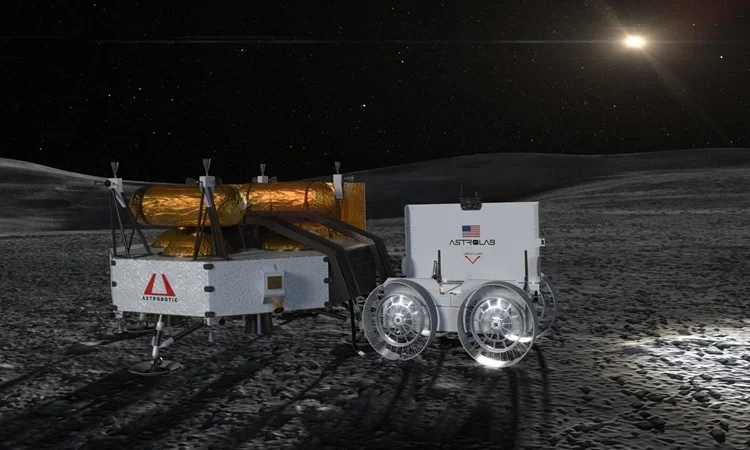
According to MIT Technology Review on October 20, the Astrolab company in California (USA) will launch the FLIP unmanned robot to the Moon's south pole during the Griffin 1 mission later this year. This is one of two companies chosen by NASA to develop autonomous robots for the Artemis program. FLIP will be equipped with Spaceborne Computer-4 (SBC4) space computers from Hewlett Packard Enterprise (HPE).
FLIP is America's largest autonomous robot since the Apollo program. With a length of 2.13 meters and a weight of 480 kg, the FLIP weighs 480 kg, is equipped with deformable wheels, is dedicated to rough terrain and can withstand cold nights on the Moon for at least 150 hours. FLIP will carry 20 scientific instruments, including 3D laser mappers and sensors that measure helium-3 isotope concentrations in soil.
According to Space, the Griffin 1 mission will mark the first time high-performance computing and artificial intelligence are tested on the lunar surface. As NASA moves closer to its goal of returning humans to the Moon with the Artemis program, such an achievement could support human habitation as well as future economic activity.
The Register describes, SBC4 has a light, compact, convenient design, without the need for a cooling fan. The machine uses a low-power 64-bit CPU central processing unit and GPU graphics processing unit. The computer is attached to FLIP's cooling system, powered by a combination of power from the battery pack and solar panels on the rover. The SBC4 also integrates a solid-state drive from the company KIOXIA for memory storage.
Griffin 1 will test how computers perform in the harsh space environment. SBC4 is made of thermally conductive aluminum with a design suitable for conditions at the Moon's south pole. Although the machine can pass simulation testing, the upcoming mission will prove that this advanced technology actually works well.
The large language model will help enhance autonomy and real-time intelligent decision-making in future missions, eliminating time delays and limited bandwidth common in remote communications between control centers on the ground and robots elsewhere in the solar system.
According to Mark Fernandez, Chief Science Officer at HPE, the time delay on Mars can be up to 44 minutes for the journey to transmit data from the red planet to Earth and vice versa. "On the Moon, the delay is less, but you're still looking at outdated data. In fact, the Soviet Union lost two rovers in the past due to control errors caused by time delays," he said.
During the FLIP mission, the large language model will perform a series of experiments to prove the technology can operate reliably in the harsh lunar environment. It will analyze data from cameras on autonomous robots and mapping machines to support safe navigation on terrain, distilling information to reduce the amount of information that needs to be transmitted back to Earth.
Previously, China's Chang'e 6 autonomous robot, which landed on the far side of the Moon in 2024, used basic AI algorithms and neural networks for automatic navigation. Similarly, NASA's Curiosity and Perseverance robots on Mars have moved semi-automatically using pre-programmed paths for many years, but the computer brains on these machines are quite weak, equivalent to laptop computers of the late 1990s.
HPE once sent three Spaceborne computers to the International Space Station (ISS) to test technology in the milder and more controllable environment of low Earth orbit. The Spaceborne-2 and Spaceborne-3 computers launched in 2021 and 2024, respectively, run Meta's Llama 3.2 model on the ISS under the "Space Llama" initiative in 2025, helping astronauts optimize research missions and make faster decisions.
Instead of spending years creating hardware that can withstand the harsh environment of space, HPE uses software that monitors systems and detects problems caused by charged cosmic particles. When radiation spikes, the software can reduce computer power and speed to reduce risks to electronic equipment, ensuring reliable system operation over long periods of time.
While temperatures on the ISS fluctuate around 20 degrees Celsius, FLIP will land near the Moon's south pole, where temperatures fluctuate between 80 degrees Celsius in sunlight areas and -200 degrees Celsius in shaded areas that may contain water ice. Cosmic radiation impacts on the Moon's surface nearly three times stronger than inside the ISS.
"We expect the computer to last throughout the mission," Scott Wiest, HPE's chief technology officer, said of the rover's 10-day endurance.
An Khang summary

