The hard-to-solve mystery of the Asian elephant that likes to toss lizard carcasses as toys
Executive Briefing
Synthesized and verified with gemini-2.0-flash-thinking-exp
“**A female elephant in India surprised scientists by repeatedly wearing a turtle carcass and tossing”
Key Takeaways
- 1.**A female elephant in India surprised scientists by repeatedly wearing a turtle carcass and tossing lizards around as a game.
- 2.For decades, three photographers witnessed this bizarre scene, opening up interesting questions about intelligence and boredom in animals.** The natural world always contains behaviors that go beyond all normal biological norms.
- 3.In the book "Elephants - Sacred Mysteries", Indian naturalist Rajesh Bedi recounted an unforgettable experience in the early 90s at Corbett National Park.
A female elephant in India surprised scientists by repeatedly wearing a turtle carcass and tossing lizards around as a game. For decades, three photographers witnessed this bizarre scene, opening up interesting questions about intelligence and boredom in animals.
The natural world always contains behaviors that go beyond all normal biological norms. In the book "Elephants - Sacred Mysteries", Indian naturalist Rajesh Bedi recounted an unforgettable experience in the early 90s at Corbett National Park.
The main character in his discovery was a female Asian elephant named Madhuri. This elephant possesses the most bizarre hobby in the wild: picking up dead turtles or lizards and placing them neatly on top of his head to parade.
Rajesh Bedi's lens captured the moment Madhuri wore a decomposing iguana corpse for many hours. The incident only ended when other members of the herd expressed their aloof attitude and actively kept their distance because of the foul smell, forcing Madhuri to lower her head and throw away the strange toy.
At that time, the author only considered this an unusual spontaneous expression of a highly intelligent primate, but did not expect that this behavior had become its inherent hobby.
Madhuri's strangeness continued to be attested through the lens of two other Indian photographers in the following decades.
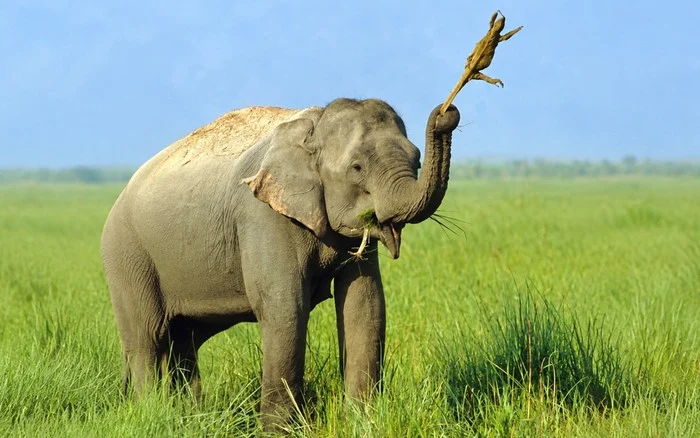
In 2001, wildlife photographer Hira Punjabi won first prize at a photography contest organized by the Sanctuary Nature Foundation. The photo captures the scene of an Asian elephant using its trunk to grasp the head of an iguana and then swinging it around in the air like a windmill.
During the interview after the award, people were surprised to learn that the naughty elephant's identity was none other than Madhuri.
In 2010, veteran photographer Jagdeep Rajput - who has been involved in nature photography for 20 years - proactively went to Corbett National Park to hunt for Madhuri after hearing rumors about the animal's ferocious temperament. The patient ambush gave Rajput a series of shocking images.
He witnessed with his own eyes Madhuri using his trunk to lift a lizard that was crawling by, threw it violently and then placed it on the ground. Seeing her prey motionless, the elephant continued to pick it up and shake it.
Rajput followed the elephant herd for many days and discovered that Madhuri always carried the iguana with her, grazing and playing until the animal shriveled up like a piece of dried meat.
Currently, Madhuri's fate cannot be determined with certainty. Publicly available photographic data only records its presence at Corbett in the 1990s and around 2010.
Although an interview in 2025 still mentioned this elephant, observers have not had more direct monitoring data recently.
However, Asian elephants have a lifespan of 50 to 70 years in the natural environment, meaning that Madhuri is quite possibly still walking freely and maintaining this strange game in some corner of the jungle.
To date, no in-depth behavioral learning studies have been conducted to decipher the real motives behind Madhuri's actions. Observers say that for a species as intelligent as the elephant, this behavior most likely comes from boredom and the need to find pure joy.
In fact, many highly intelligent marine mammals also have similar strange entertainment behaviors. In the summer of 1987, the southern resident killer whale population in Puget Sound Bay in Washington state had a trend of wearing dead salmon carcasses on top of their heads like a hat.
This innocuous habit spread from the K pod to the J and L pods before settling down, but on October 25, 2024, a male killer whale with the symbol J27 was again spotted carrying a salmon on his head.
Another case is the dolphin Billie, who after being temporarily raised at the aquarium in January 1988, learned the skill of standing up and using her tail to glide on the water surface. When released into the wild, Billie demonstrated this technique and caused other wild individuals to follow suit before disappearing like a temporary trend.
Unlike other marine mammals, Madhuri's iguana tossing has never become a trend among Asian elephants. It seems that the companions all considered it a strange act, refused to copy it and made this hobby a unique feature associated with the name Madhuri.

