The shocking mystery of the prehistoric giant crane turned out to never really exist
Executive Briefing
Synthesized and verified with gemini-2.0-flash-thinking-exp
“**For more than a century, scientists believed that there was once a giant crane that dominated Euro”
Key Takeaways
- 1.**For more than a century, scientists believed that there was once a giant crane that dominated Europe during the ice age.
- 2.However, recent shocking genetic analysis results have revealed an unexpected truth, erasing this creature's name.** Looking back at the history of archeology in the 19th century, excavations in caves and swamps across northern Europe opened the door to a fascinating prehistoric world.
- 3.A series of remains of ice age beasts were revealed one after another, from mammoths and rhinoceroses to cave lions and bears.
For more than a century, scientists believed that there was once a giant crane that dominated Europe during the ice age. However, recent shocking genetic analysis results have revealed an unexpected truth, erasing this creature's name.
Looking back at the history of archeology in the 19th century, excavations in caves and swamps across northern Europe opened the door to a fascinating prehistoric world. A series of remains of ice age beasts were revealed one after another, from mammoths and rhinoceroses to cave lions and bears. What they have in common is that their physique is much superior to their modern relatives living in these areas.
In that cascade of discoveries, the appearance of crane bones of unusual size immediately attracted special attention. French biologist Alphonse Milne-Edwards, when approaching these remains, found that they were much larger than the common gray crane - a familiar bird in wetlands and flooded forests across Europe.
Believing he had touched upon an ancient, previously unknown creature, Milne-Edwards officially named the creature Grus primigenia, or the primitive giant crane.
However, a groundbreaking study just published in the scientific journal Geobios has completely overturned the hypothesis that has existed for more than a hundred years. Led by Dr. John Stewart, professor of evolutionary paleoecology at Bournemouth University, scientists have re-examined all ancient skeletal evidence.
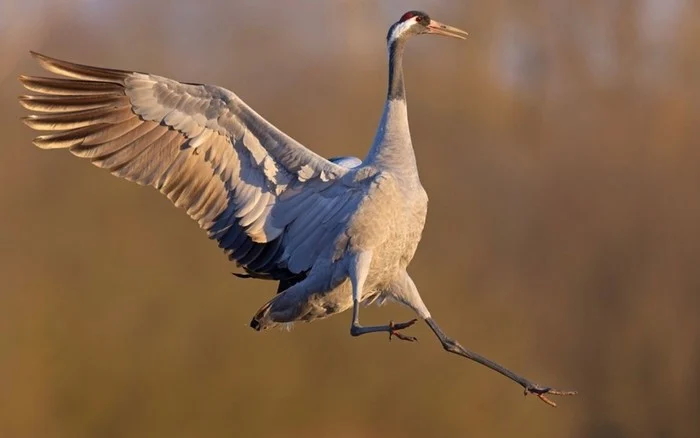
The final conclusion shocked the researchers: the giant crane Grus primigenia has never actually existed in the world. The giant bones that seemed to belong to an extinct species turned out to belong to the familiar gray crane that we still see today.
To reveal the mystery, the research team applied the outstanding advances of modern technology instead of just stopping at the traditional method of comparing size and morphology. They successfully extracted genetic material from 18 ancient crane bone samples dating from 20,000 years to several thousand years ago, collected from caves and bogs across England, Wales, France, Germany and the Balearic Islands.
Ancient DNA analysis has provided a definitive solution: all of the large skeletons carry the genetic code of living common cranes. Dr. Stewart commented that previous studies had made the mistake of relying solely on bone morphology, while genetic analysis was the key to providing the most accurate view.
The origin of this century's confusion stems from the crane's natural biological characteristics: the obvious physique difference between the two sexes. In nature, male cranes always have a larger body than female cranes.
Genetic data reveals that cranes in the past were significantly larger in size than they are today. Specifically, prehistoric male cranes were much larger than modern males, while ancient female cranes were similar in stature to today's male cranes.
When 19th-century scientists compared the bones of large ancient males with modern crane populations, they hastily speculated that they were two separate species - one extinct and one living - rather than recognizing sexual differences within the same species.
Gray cranes are still distributed throughout much of Eastern Europe with a few scattered populations in France, Spain and England. They are easily recognizable birds with heights of up to 1.2 meters (about 3.9 feet) and noisy mating dances every spring.
Ancient remains prove that their ancestors were once widely distributed throughout Western Europe. Proving that giant cranes do not exist has ended a myth, but at the same time opened a new difficult question: what causes the cranes' stature to gradually shrink over time?
Scientists believe that humans are most likely part of the reason for this decline in size. According to Dr. Stewart, the current leading hypothesis focuses on wetland drainage activities and human-caused land use changes, which are altering and shrinking the cranes' natural habitat.
However, the research team affirms that more in-depth work is still needed in the future to fully clarify the impact of humans on the size change process of this bird.