Vietnam's digital technology journey reaches out to conquer the world
Executive Briefing
Synthesized and verified with gemini-2.0-flash-thinking-exp
“**Continuing the industry's leading tradition** Developing virtual assistants to support civil serv”
Key Takeaways
- 1.**Continuing the industry's leading tradition** Developing virtual assistants to support civil servants and "Made in Vietnam" 5G base station equipment are two new achievements that the Ministry of Information and Communications has just reported and demoed to retired officials in the Information and Communications industry over time, at a recent meeting with representatives of retired officials in the Northern region.
- 2.With the method of harmoniously combining the trends of the times with Vietnamese practice and culture as directed by Minister Nguyen Manh Hung, the Ministry of Information and Communications is piloting a virtual assistant to support civil servants and public employees with questions and answers in specialized fields to 34 agencies and units in the Ministry.
- 3.The virtual assistant of the Ministry of Information and Communications is a combination of a human-built knowledge system and a large language model of artificial intelligence.
Continuing the industry's leading tradition
Developing virtual assistants to support civil servants and "Made in Vietnam" 5G base station equipment are two new achievements that the Ministry of Information and Communications has just reported and demoed to retired officials in the Information and Communications industry over time, at a recent meeting with representatives of retired officials in the Northern region.
With the method of harmoniously combining the trends of the times with Vietnamese practice and culture as directed by Minister Nguyen Manh Hung, the Ministry of Information and Communications is piloting a virtual assistant to support civil servants and public employees with questions and answers in specialized fields to 34 agencies and units in the Ministry.
The virtual assistant of the Ministry of Information and Communications is a combination of a human-built knowledge system and a large language model of artificial intelligence. With virtual assistants, the work of officials and employees in the Ministry of Information and Communications will be lighter; and from successfully testing the virtual assistant of the Ministry of Information and Communications, moving on to becoming a virtual assistant for each individual.
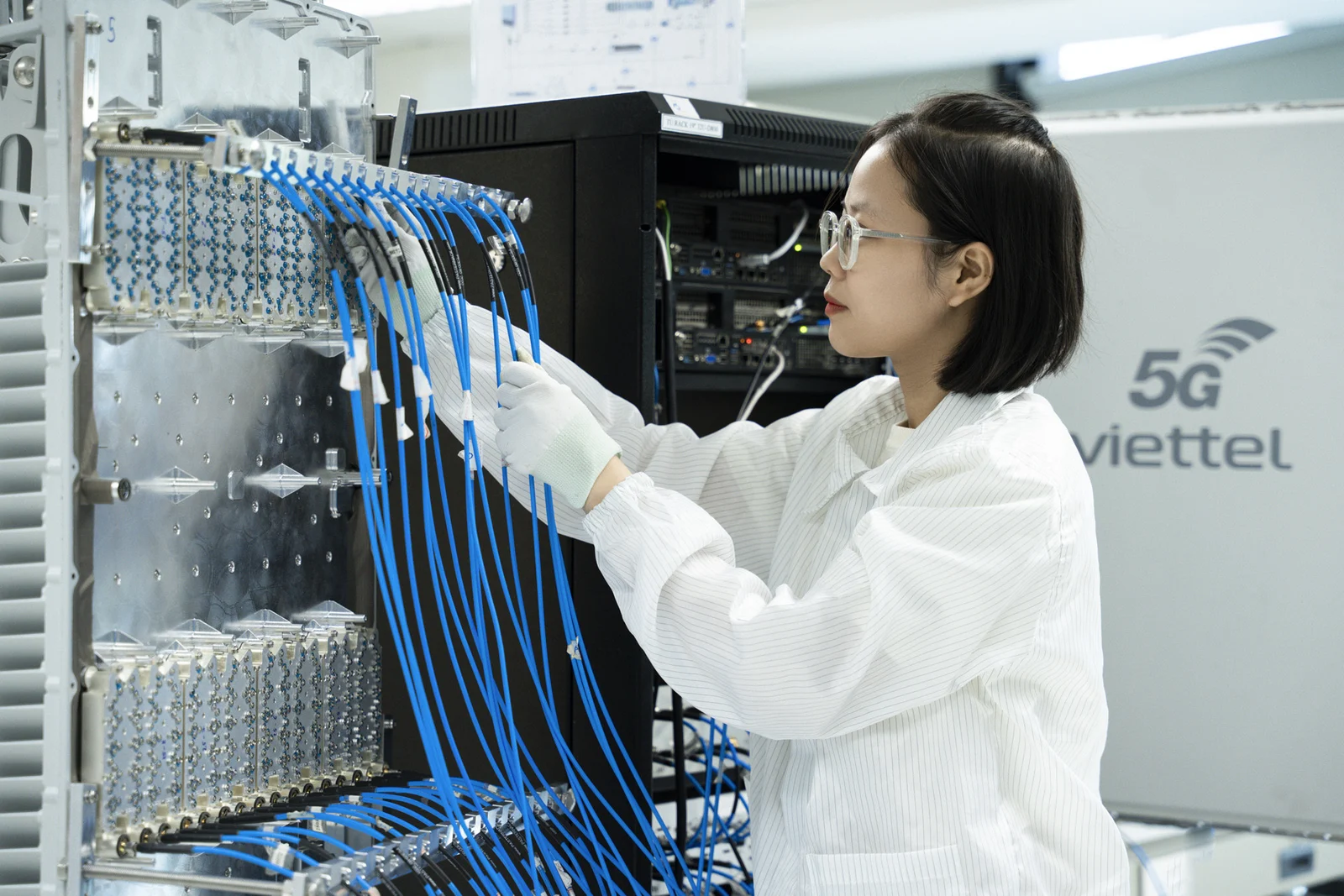
As one of the typical digital technology products, 5G base station equipment is manufactured and developed by Viettel based on the Open Ran open standard, which is also a testament to Vietnam's technological autonomy.
Currently, 5G base stations manufactured by Vietnamese enterprises have been installed in Hanoi, Ha Nam, Ninh Thuan and are expected to expand to Ho Chi Minh City and Da Nang by the end of this year.
Viettel has also signed a contract to sell this equipment to India. With this new achievement, Vietnam is the 5th country in the world to produce 5G equipment, after Sweden, Finland, South Korea and China.
The two new achievements mentioned above and many other important results that the Ministry and the Information and Communications sector have achieved in the digital transformation era have shown that the current generation is worthy of continuing the tradition of the two words "Courage" and "Creativity" in the 10 golden words "Loyalty - Courage - Devotion - Creativity - Gratitude" of the industry, which is an effort to promote the spirit of daring to think, daring to do, always pioneering, going straight into the new technologies of our time. live.
Nearly 40 years ago, while the industry faced countless difficulties, former General Director Dang Van Than and the leadership of the General Department of Post and Telecommunications at that time made bold decisions, which was to skip intermediary technology to go straight to digital technology; Ask for financial autonomy, self-borrowing and self-payment, ask for a mechanism to use foreign currency to reinvest, do not ask for state budget.
Thanks to that, from being a backward industry, the Post Office has made a strong breakthrough, becoming one of the leading industries in the country's innovation process; Postal workers have made a living by working as a postal worker and moreover, the industry has made a great contribution to the country's socio-economic development.
Commenting that the current generation is worthy of continuing the industry's tradition, former Minister of Posts and Telecommunications Do Trung Ta expressed his peace of mind and confidence in the development of the industry, when seeing the progress and new achievements that the current leadership team and employees of the Ministry and the Information and Communications industry have achieved.
New developments
At the meeting with representatives of retired officials of the Information and Communications industry in the Northern region, former Minister of Posts and Telecommunications Do Trung Ta also recounted the reminder that the industry still uses many foreign equipment by the late General Secretary Do Muoi when he visited and worked with Vietnam Posts and Telecommunications Corporation in 1991.
“Chúng ta rất mừng là điều nhiều thế hệ lãnh đạo đất nước và ngành trăn trở - sự tự chủ về công nghệ, đang được thế hệ hiện nay thực hiện, xây dựng nền công nghiệp công nghệ số Việt Nam”, ông Đỗ Trung Tá chia sẻ.
With the mindset that the best way to show gratitude to the previous generation is to help the Ministry and industry develop, contributing to the country's reputation, in recent times, the leaders of the Ministry of Information and Communications have oriented and led to promote the development of all management areas of the industry.
Throughout the national digital transformation program and in-depth industry strategies such as strategies for developing digital government, digital economy and digital society, network security, postal services, digital transformation of newspapers..., technological autonomy and the role of Vietnamese digital technology products and enterprises have always been emphasized.
For example, the dual goal that the national digital transformation program is aiming for is to develop the digital government, digital economy, digital society, and form Vietnamese digital technology enterprises with the capacity to go global.
Along with advising the Prime Minister to issue directives on promoting the development of Vietnamese digital technology businesses, from 2019 up to now, the Ministry of Information and Communications has also periodically organized the Make in Vietnam forum to raise aspirations and encourage the country's digital technology business community to develop products and solutions to solve Vietnamese problems as well as reach out to conquer the world.
In particular, the Ministry of Information and Communications has also published a map of digital technology in the fields of the industry to serve as a tool to support management, forecasting, guidance, and deciding to accept applications and invest in technology research and development; and implementing the Program to support digital technology businesses going abroad, with the goal of expanding development space and contributing knowledge to the world.
From a series of promotional activities, up to now, Vietnamese digital technology products have not only strongly participated in the national digital transformation process, but also made their mark in many international markets.
According to statistics, by the end of July 2024, the total number of active digital technology businesses is estimated at 51,038, an increase of nearly 6,000 businesses compared to August 2023. In particular, there are currently 1,500 digital technology businesses with revenue from foreign markets.
Revenue from foreign markets in 2023 is 7.5 billion USD, and this year is expected to be approximately 10 billion USD, a growth rate of about 30%.
According to Minister Nguyen Manh Hung, the amount of 10 billion USD that Vietnamese digital technology businesses brought back from abroad is many times larger than the amount of money that Vietnamese telecommunications businesses spent to buy telecommunications equipment.
"Previously, the West came to us, now we go to the West, compete with the West and bring money back to build the country. The goal of the Ministry of Information and Communications is that the international revenue of businesses in the Information and Communications industry by 2035 must exceed the export of agricultural products. Only then can Vietnam be called an industrial country", Minister Nguyen Manh Hung emphasized.
The aspiration for technological autonomy and the creation of Vietnam's digital technology industry is still being gradually realized by the current generation of the information and communication industry.
Taking on the leading role and promoting the development of the digital technology industry, the Ministry of Information and Communications has established the Department of Information and Communications Industry.
The Ministry of Information and Communications is also continuing to perfect mechanisms and policies, typically developing the Law on Digital Technology Industry, Vietnam's Semiconductor Industry Development Strategy to 2030 and vision to 2050, with the aim of creating the development of this foundation industry, thereby contributing to turning Vietnam into a developed country in the near future.
