What happens when a satellite runs out of fuel?
Executive Briefing
Synthesized and verified with gemini-2.0-flash-thinking-exp
“# What happens when a satellite runs out of fuel?”
Key Takeaways
- 1.# What happens when a satellite runs out of fuel?
- 2.When it runs out of fuel, the satellite can continue to orbit the Earth for a long time or gradually fall back into the atmosphere, depending on the altitude and the operator's decision.
- 3.According to *Interesting Engineering*, forward motion sends the satellite orbiting Earth while gravity pulls it toward the planet.
When it runs out of fuel, the satellite can continue to orbit the Earth for a long time or gradually fall back into the atmosphere, depending on the altitude and the operator's decision.
According to Interesting Engineering, forward motion sends the satellite orbiting Earth while gravity pulls it toward the planet. The ship continuously falls, but moves sideways fast enough to avoid collision with the ground. Thrusters can raise or lower orbit, allowing the satellite to adjust position or avoid anticipated collisions. If there is no more fuel, the vehicle loses the ability to perform the above operations, unless assisted by another propulsion system or maintenance vessel.
However, the electronics on the satellite continued to operate despite the empty fuel tank. Most satellites orbiting the Earth get their power from solar panels and energy storage batteries. Some may also use electric jetwheels or magnetic devices to control direction.
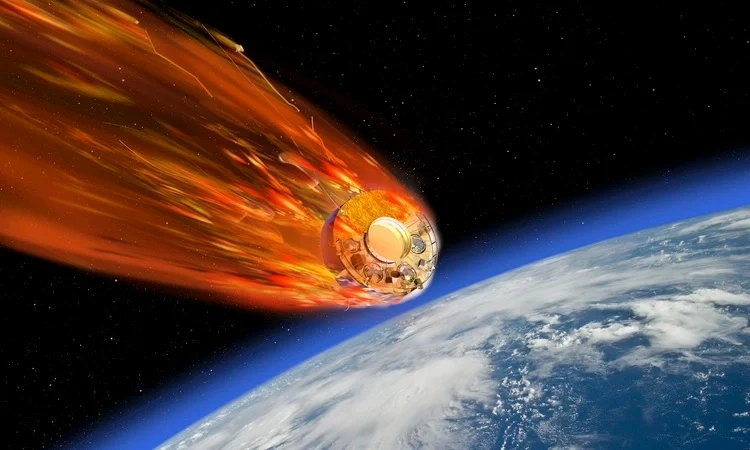
In low Earth orbit, satellites are still exposed to thin air, gradually losing energy due to drag and flying lower and lower. If there is no thruster to stop it, the ship will fall into a denser atmosphere. According to Space Atlas, a dead satellite can plunge into the Earth's upper atmosphere at a speed of nearly 27,300 km/h, fast enough to cross the entire continental United States in just 10 minutes. Within a few short minutes, solar panels could be ripped off, metal parts would melt or vaporize, and the ship would crumble at an altitude of tens of kilometers.
In the case of a geostationary satellite operating at an altitude of about 35,786 km above the equator, atmospheric drag there is negligible, so the vehicle does not quickly fall back to Earth after running out of fuel but floats in space for decades or longer.
Normally, the operator does not wait until the fuel tank is completely empty before processing the satellite. For spacecraft operating close to Earth, they can use leftover propellant to lower orbit and increase reentry speed. Some missions may land vehicles in remote ocean areas through controlled descent.
Aerospace Global News said that expired geostationary satellites are often pushed into "graveyard orbits" that are higher than the active zone. This operation requires a separate reserve of fuel before normal operations eat up the supply. For example, when NASA's TDRS-1 communications satellite "retired" after more than 26 years of operation, controllers raised it 350 km above geostationary orbit, releasing remaining propellant and shutting down stored energy.
The process of removing stored energy that could cause a spacecraft to explode later is called deactivation. According to the European Space Agency (ESA), deactivation could include draining the fuel, compressing the gas and disconnecting the battery to reduce the risk of creating more debris. For example, NASA's GRACE-FO mission termination plan includes depleting the propellant, disconnecting the solar cells from the battery storage system, and completely turning off the spacecraft's transmitter. ESA took similar steps with the ERS-2 Earth observation satellite. In 2011, controllers lowered its orbit and used up remaining fuel, reducing its orbital lifespan from more than 200 years as expected to less than 15 years.
In some cases, the operator can use another spacecraft to approach the dead satellite, hold on and change its orbit. ESA is developing space debris removal technology and a self-destructing design for satellites that cannot be disposed of on their own when they expire, including standardizing connection ports and positioning devices, making it easier for debris removal ships to access and collect in the future.
The final fuel reserve of the satellite plays a very important role in the processing system. This is a difficult problem for the operator. If too much fuel is used to prolong operation, the satellite will not have enough reserves left to perform the "death" process safely. Properly balancing fuel consumption will contribute to freeing up space in orbit for new satellites.
An Khang summary

