Why did the wheel not exist until 3500 BC: the difficulty lies in the axle, not the wheel
Executive Briefing
Synthesized and verified with gemini-2.0-flash-thinking-exp
“People have been making pottery since the ice age and cultivating crops more than 10,000 years ago,”
Key Takeaways
- 1.People have been making pottery since the ice age and cultivating crops more than 10,000 years ago, but the first wheeled vehicle only appeared around the middle of the 4th millennium BC, or about 3500 BC.
- 2.Why is something so seemingly simple coming so late?
- 3.According to anthropologist David Anthony, the answer lies not in the pie but in the axis.
People have been making pottery since the ice age and cultivating crops more than 10,000 years ago, but the first wheeled vehicle only appeared around the middle of the 4th millennium BC, or about 3500 BC. Why is something so seemingly simple coming so late? According to anthropologist David Anthony, the answer lies not in the pie but in the axis.
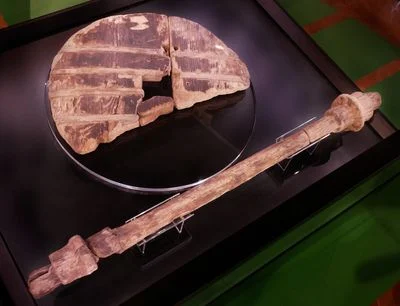
The Ljubljana (Slovenia) swamp wheel with axle, about 5,100 to 5,350 years old, is the oldest wooden wheel ever found. Cake made from two ash wood panels joined together, oak shaft
The difficult thing is connecting the wheel to the vehicle body
Visualizing a round log rolling on the ground is not difficult. Ancient people probably used rollers made of tree trunks to pull heavy objects for a long time. But the roller must constantly be picked up from the back and placed on the front, so it is not yet a means. The real difficulty is attaching a stationary platform to the rotating wheels. Talking to Live Science, Anthony, professor of anthropology at Hartwick University (USA) and author of The Horse, the Wheel, and Language, said that the idea of a wheel with an axle is a breakthrough, and manufacturing it is equally difficult.
In order for the wheel to rotate around a fixed axis, the two ends of the shaft and the hole in the middle of the wheel must be almost perfectly round and smooth, otherwise friction will prevent the wheel from rotating. The shaft must fit tightly into the hole to prevent the wheel from shaking, but not so tight that it jams. Axle size is also a balance problem:
- Slender shaft reduces friction but is weak and easily breaks when carrying heavy loads.
- Thick axle can withstand the load but friction increases sharply, making the vehicle difficult to pull.
- Ancient solution: make the car body narrow so the axle is short. The short shaft does not need to be thick but is still stiff enough.
According to Anthony, because every detail depends so closely on each other, the wheel and axle set cannot be gradually improved through many unfinished versions. It must be correct at the same time in every part to work.
Have to wait for fields and big trees to be carved
The maker of the first vehicle needed three things: wide wooden planks from large tree trunks to carve the wheels, metal tools to bore holes and trim the axles to fit, and the need to carry heavy goods over land. Anthony believes that carpentry was what slowed this invention down, because it was not until about 4000 BC that cast bronze chisels and gouges became widespread in the Near East. From that point to the first wheeled vehicle was only about five centuries.
So the first wheels were all solid wooden discs. Britannica describes the oldest known wheel as consisting of three hewn boards joined together, held together by horizontal braces. The wheel in the Ljubljana swamp (Slovenia), found in 2002, has a diameter of 72 cm, made mainly from two ash wood panels held by four braces. The 124 cm long shaft is made of oak, tightly attached to the wheel so it rotates with the wheel.
Bronocice ceramic vase (Poland) dated to the mid-4th millennium BC, engraved with a four-wheeled chariot with forks, one of the oldest clearly dated wheeled vehicle drawings
Appears almost at the same time in many places
Evidence of wheeled vehicles appears abundantly from the middle of the 4th millennium BC. In the Sumerian city of Uruk (present-day Iraq), clay tablets have hieroglyphs depicting wheeled sleds, dating from about 3500 to 3350 BC. In the village of Bronocice in southern Poland, a ceramic vase engraved with the image of a four-wheeled vehicle with a fork and animal bones buried with it dates back to about 3635 to 3370 BC.
Researchers still disagree on where to start. Anthony believes that the invention is so difficult that it probably only happened once and then spread very quickly throughout the Eurasian continent. But the classic cars in the two regions have different techniques: cars in the east use fixed axles and rotating wheels, while cars found in Switzerland and Germany have rotating axles and wheels like the Ljubljana wheel. Therefore, there is also an opinion that it was thought up independently in many places.
Advertisement
The "War" side of the Ur Banner (c. 2600 BC, British Museum). The bottom row are four solid-wheeled chariots, each drawn by four equine animals
From solid cake to spoke cake
For about 1,500 years, the wheel was still a heavy solid wooden disc. The Ur standard, a wooden box inlaid with seashells and lapis lazuli about 4,600 years old, shows that Sumerian war chariots still ran on solid wheels. Spoke wheels appeared around 2000 BC with the Sintashta culture in the steppes, making vehicles lighter and faster, paving the way for horse-drawn war chariots. Later, the Celts added an iron rim around the wooden wheel in the 1st millennium BC.
In the Americas, wheeled children's toys have been found in Mexico, but wheels were not used to transport goods before the arrival of Europeans, possibly because of a lack of large domesticated animals to pull carts. In addition to carpentry techniques, wheels also require draft animals and the need to carry goods.
Source:
Live Science
,
Britannica
,
Wikipedia: Wheel
,
Wikipedia: Ljubljana Marshes Wooden Wheel
,
Wikipedia: Bronocice pot
,
Discover Magazine

