Without making any robots, a Chinese company wants to become the 'operating system' of the tens of billions of dollars in robotics industry
Executive Briefing
Synthesized and verified with gemini-2.0-flash-thinking-exp
“**Choosing to stay out of the hardware race, Zhuoshi does not make the body, but sells the...”
Key Takeaways
- 1.**Choosing to stay out of the hardware race, Zhuoshi does not make the body, but sells the...
- 2.**Choosing to stay out of the hardware race, Zhuoshi does not make the body, but sells the...
- 3.**Choosing to stay out of the hardware race, Zhuoshi does not make the body, but sells the...
Choosing to stay out of the hardware race, Zhuoshi does not make the body, but sells the 'brain' to those who make the body. They took the robot out onto the lawn, up the stairs and into the fields to 'teach' in real conditions.
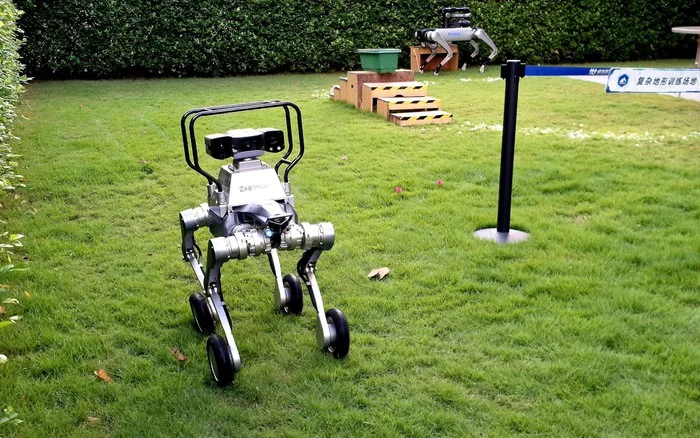
On a small lawn between office buildings in Sanya city, a four-legged robot on wheels ran back and forth along the fence.
A few meters away, a silver robot dog stood next to the wooden steps. On its back is a mechanical arm carrying a tree branch.
The Chinese voiceover introduced to the reporter that the running robot was a 'foot-wheel' security patrol robot. While the other robot is learning how to plant trees.
After explaining, this person stopped to let the interpreter translate, followed by a sharing that easily surprised many listeners: "We ourselves do not make robot bodies. We train companies to make robot bodies, to improve the efficiency of their products in specific application contexts."
The practice lawn above belongs to Zhuoshi Company's 'common brain' practice training base for embodied intelligence in Sanya City, Hainan, China. The company logo is clearly printed on the robot dog's body, but that robot is not what Zhuoshi wants to sell. What they sell is the software inside.
A 'hot' market
Zhuoshi's choice makes sense when looking at the scale of China's robotics industry. The number of robots operating in Chinese factories reached 2.027 million, a world record.
From 2024, for the first time, Chinese robot companies will sell more industrial robots than foreign companies domestically, increasing their market share from 47% to 57%.
In the first nine months of 2025, China produced 595,000 industrial robots and 13.5 million service robot sets, both exceeding the previous year's output, according to the China Federation of Mechanical Industry.
The 2025 revenue of large-scale robot enterprises in China exceeds 300 billion yuan, equivalent to about 42 billion USD.
The upward momentum is still maintained when in the first half of 2026 alone, industry revenue reached 165.5 billion yuan, an increase of 24.5% over the same period.
As hardware becomes increasingly crowded, hundreds of robot models will need the same thing: software to help them see, understand and work in real life. That's the gap Zhuoshi wants to fill.
According to business data platform Tianyancha (Tianyancha), China currently has about 1.165 million robot-related businesses. In the first 8 months of 2026, there were about 144,000 new businesses added in the field and the majority of these operate in research and development, software and system integration, not machine manufacturing.
How to sell your ‘brain’, not your ‘body’
Is a national-level "Little Giant" Specialized - Excellent - Unique - New enterprise (
Chinese title for small and medium enterprises leading a technology niche
), Zhuoshi is considered a high-tech company and has presided over the issuance of many standards for large specialized models.
Zhuoshi positions his practice as: “the neutral embodied intellectual brain.” In particular, "neutral" means that the company is not tied to any particular brand's hardware. They want their software to run on all types of robot bodies, in all contexts.
The Chinese company frankly said its ambition is to become "the Android operating system of the robotics industry". This comparison is easy to understand as Android does not produce phones, but runs on phones from many brands. Zhuoshi wants to play similar roles for humanoid robots, robot dogs, patrol cars or mechanical arms.
Currently, the core product of this business is called ZoeInside TriCore - a 'three-core brain' based on a large model developed by the unit itself. This brain unifies perception, perception, decision making and coordination, so that many different types of robots can work together and complement each other's capabilities.
"Our customers are robot body manufacturers," said a business representative.
Explaining why the robot must be trained outdoors, the company said that the laboratory is not like real life for three reasons.
First, the outdoor ground is rough and not flat like the floor.
Second, under natural light, the robot's image recognition ability is completely different than when indoors.
Third, whether the robot does well or not well, data is collected in real time to the system to continue training the model. This is the most important factor.
In other words, every time the robot stumbles is also a piece of data that Zhuoshi takes advantage of. The company calls this a closed loop "data collection - data management - model improvement - value creation". Indicators of model training and algorithm improvement are also continuously updated by the business on a large electronic board in the product introduction room.
Furthermore, the most interesting problem probably lies in the agricultural sector. Zhuoshi uses a four-legged robot dog as a transport vehicle, attaching a mechanical arm to his back to plant rice. In addition, the equipment mounted on the robot is also used to collect data on crop images and visible characteristics of plants to serve breeding selection work.
According to the explanation, traditional agricultural machinery and fixed gantry collection systems have been very popular, but are only suitable for large fields in Northeast and Northwest China.
On Hainan Island, the fields are small and scattered, and they are breeding fields. Therefore, a robot with legs that can walk on its own has an advantage. The company's goal is that machines will expertly replace people in rice planting.
Besides the agricultural terrain factor, it is no coincidence that Zhuoshi is based in Sanya. They want to take advantage of the policy, industry and location of the free trade port in Hainan.
Committed to continuing to increase local investment, the company targets Hainan's strong industries of tourism, health, deep sea, aerospace and plant varieties. The further ambition of this robotics software company is to turn Hainan into a place to bring Chinese AI abroad.
Because, if robot hardware becomes cheaper and more similar, value will shift to software and data, just like what happens with smartphones.

