Box taps Nvidia’s AI models to build a rich context layer for autonomous enterprise agents
Tóm lược nhanh
“Few technology firms have embraced the arrival of artificial intelligence agents quite like Box Inc., and today it went even further down the road to automation with an expanded partnership with Nvidia Corp. At its annual customer conference BoxWorks 2026, Box debuted a new retrieval engine that’s powered by Nvidia’s AI models and designed to […] The post Box taps Nvidia’s AI models to build a rich context layer for autonomous enterprise agents appeared first on SiliconANGLE.”
Box taps Nvidia’s AI models to build a rich context layer for autonomous enterprise agents
Few technology firms have embraced the arrival of artificial intelligence agents quite like Box Inc., and today it went even further down the road to automation with an expanded partnership with Nvidia Corp.
At its annual customer conference BoxWorks 2026, Box debuted a new retrieval engine that’s powered by Nvidia’s AI models and designed to give AI agents the much-needed context they require to get more work done. It was announced alongside a new orchestration tool for multistep agentic workflows and new threat detection tools designed to safeguard organizations from rogue agents.
Box’s flurry of announcements are designed to fix a growing bottleneck in enterprise AI workflows. As Box Chief Executive Aaron Levie explained, autonomous agents are only as useful as the context they’re fed allows them to be. If AI agents lack context, they’re going to make mistakes, and that means enterprises simply won’t trust them to do any work, stalling adoption.
Levie said that much of the context that AI agents need does not reside in clean, structured databases, but rather deep inside organizations’ messy troves of unstructured data – things such as contracts, software documentation, policy manuals, internal emails, customer communications records and research archives. Companies know that’s the case, but they’re wary about letting autonomous agents jump right into their data. What’s needed is a way to give those agents secure, permission-aware access to this data, so they’re not looking at things they’re not authorized to see or accidentally leaking secrets all over the internet.
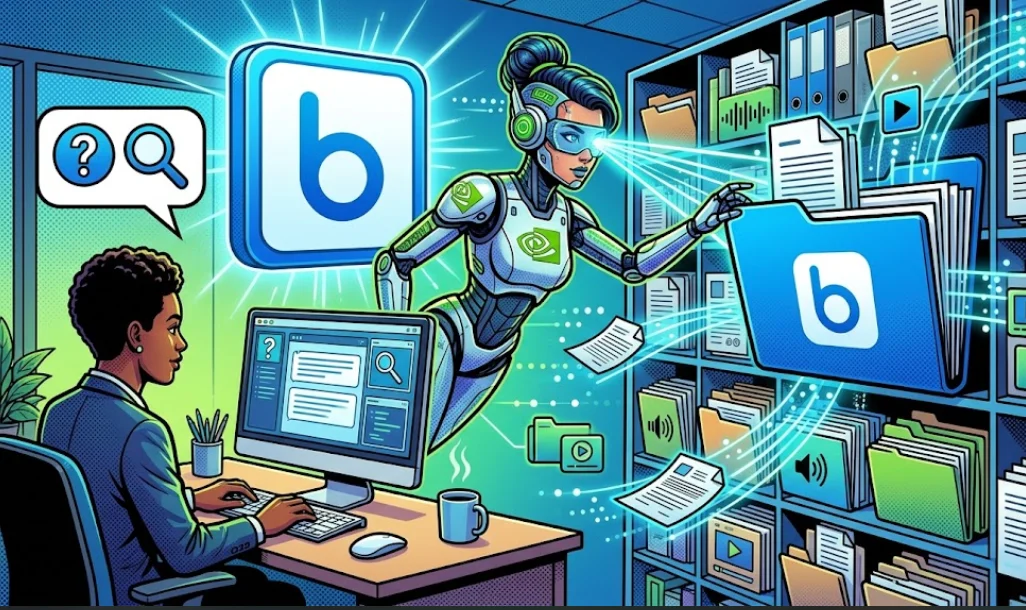
This is where Box’s new partnership with Nvidia intends to make a difference. The company today introduced a new tool called Box Content Retrieval, which is a data retrieval engine that transforms messy enterprise content into a structured knowledge base that agents can access more easily and reason over. It was built using Nvidia’s specialized Nemotron Retriever embedding models, which help to create a neat index of unstructured content like scanned documents, images, audio and video files using multimodal and hybrid search techniques.
Box said Box Content Retrieval is able to improve search accuracy by 20% while reducing token consumption by up to 90%, enabling AI agents to find the context they need to improve their response times to worker’s questions by around four-times. It also makes sure that each AI agent adheres to the native file permissions for each piece of content, so they’re never able to access files their users don’t have permission to see.
“By partnering with Nvidia we are creating a new intelligence layer for enterprise content that gives customers faster, more precise ways to ground AI in the content that powers their business,” Levie said.
The new partnership also sees Box bringing Nvidia’s frontier open-weight models to the table, including the new Nemotron 3 Ultra large language model. These models are directly available within Box AI, and because they’re open-weight, they can be accessed at much more affordable prices than proprietary models from companies like Anthropic PBC and OpenAI Group PBC.
Nvidia’s open-weight models have been trained on the domain-specific knowledge for highly specialized workflows, Levie said. For instance, financial analysts can use Nemotron Ultra 3 to query loan applications with strict data-access boundaries, while legal teams can use it to identify contract precedents within corporate agreements by understanding their conceptual meaning rather than searching for keyword matches.
“Open weight is an important part of our vision, complementing closed models while driving innovation and broader adoption across the industry,” Levie added.
Holger Mueller of Constellation Research told SiliconANGLE that Box’s partnership with Nvidia bodes well for the company because the chipmaker is by far and away still the world’s leader in AI platforms, and it will allow it to integrate more closely with the leading public cloud providers too. “Documents are a treasure trove for AI in general and context specifically, and enterprises are very keen to tap into them so they can develop better AI applications,” the analyst said. “This confirms the theory that data has to move to the compute in the AI era.”
Building agent workflows with Box Architect
Box’s AI push isn’t totally reliant on Nvidia. Indeed, it has its own thing going on with Box Architect, a new tool that will launch in beta later this year, allowing business workers to build, test and deploy new agentic processes using their natural language. According to Box, it can connect to native Box tools such as Extract, Automate, Apps and Forms to create complex workflows, with a selection of open and closed models.
Using Box Architect, law firms will be able to build contract review workflows that are informed by their previously-approved playbooks for past agreements, so that they can compare incoming contracts against it. Should it flag any high-risk clauses, these can immediately be sent to an attorney for review. Alternatively, a bank might use Box Architect to build a streamlined client onboarding workflow that collects applications through Forms, verifies identity documents with Extract and then generates and signs an agreement with Doc Gen and Sign.
Deep Analysis analyst Alan Pelz-Sharpe said these are the kinds of coordinated, autonomous workflows that can make a real difference in terms of the value enterprise AI provides. “While legacy approaches require brittle point-to-point configurations for extraction and execution, an integrated agentic design layer dynamically orchestrates content understanding, process steps and analytical visualization within a single governed ecosystem,” he said.
Box also understands that organizations are going to need more security to protect these more advanced and capable AI agents, which is why it’s simultaneously introducing new threat detection capabilities across its platform. The company said the new security tools make it possible to identify the actions of rogue AI agents in real-time, so that if any of them start exfiltrating data in bulk, deleting massive numbers of files, or taking over user accounts, they’ll immediately be flagged for review.
For instance, administrators will be able to control what files each agent can access through classification-based policies, constrain agent’s actions with MCP guardrails that dictate which third-party tools each one can use, and then detect harmful activities that exceed predefined limits.
In terms of availability, the Nvidia Nemotron models in Box AI and the agent security controls are available immediately for Enterprise Advanced and Shield customers. Box Context Retrieval and the advanced threat detection capabilities are scheduled for general availability early next year for Enterprise Advanced and Shield subscribers.
Image: SiliconANGLE/Meta AI
A message from John Furrier, co-founder of SiliconANGLE:
Support our mission to keep content open and free by engaging with theCUBE community. Join theCUBE’s Alumni Trust Network, where technology leaders connect, share intelligence and create opportunities.
- 15M+ viewers of theCUBE videos, powering conversations across AI, cloud, cybersecurity and more
- 11.4k+ theCUBE alumni — Connect with more than 11,400 tech and business leaders shaping the future through a unique trusted-based network
Are you an AWS customer? Support SiliconANGLE financially by buying your AWS services from our Marketplace portal page and links: https://siliconangle.com/aws-marketplace/
About SiliconANGLE Media
Founded by tech visionaries John Furrier and Dave Vellante, SiliconANGLE Media has built a dynamic ecosystem of industry-leading digital media brands that reach 15+ million elite tech professionals. Our new proprietary theCUBE AI Video Cloud is breaking ground in audience interaction, leveraging theCUBEai.com neural network to help technology companies make data-driven decisions and stay at the forefront of industry conversations.