AI Assigned to Control Telescopes to Find Extraterrestrial Signals
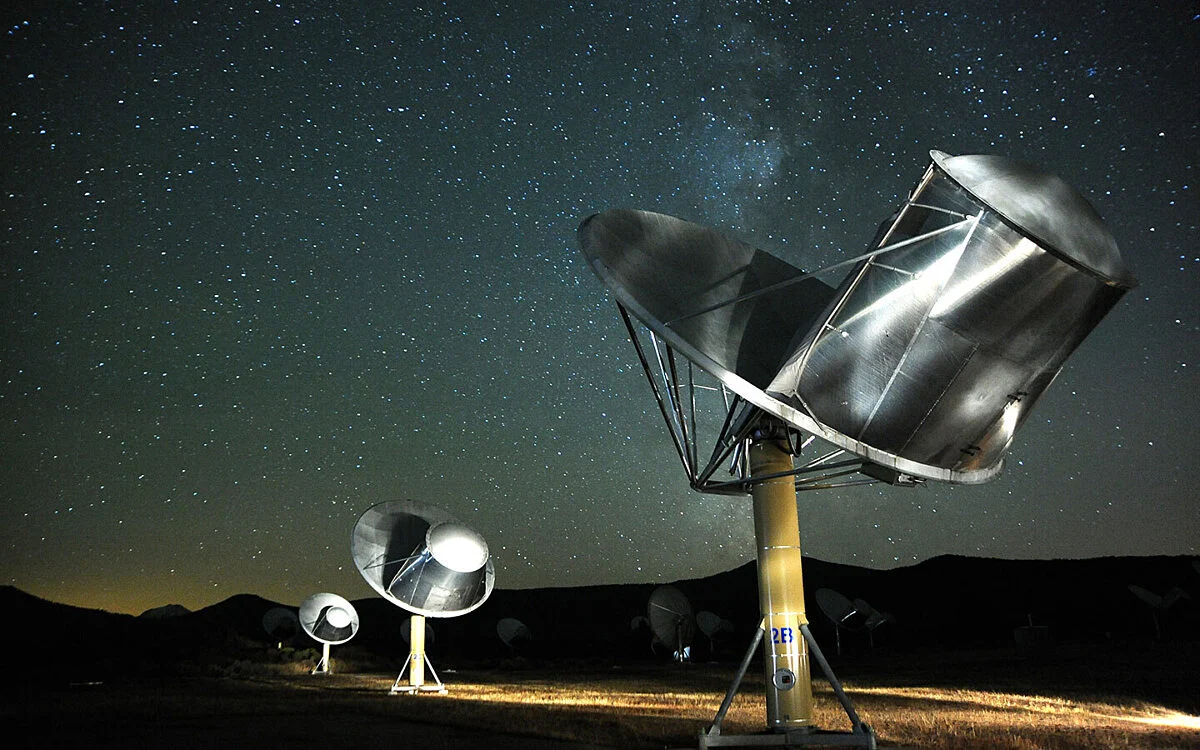
The Allen Telescope Array in California.
AI is being used to operate radio telescopes and process cosmic signals as data arrives. At the Allen Telescope Array in California, it helps researchers monitor observations and identify signals worth further investigation.
When AI Participates in Operating Telescopes
At the Allen Telescope Array in California, NVIDIA and the SETI Institute are bringing AI into both operations and data analysis. Researchers can use natural language to ask the system to coordinate observation steps. Data is processed while the telescope is still collecting signals, helping the research team monitor what is happening without having to manually operate separate software.
According to SETI's introduction, the Allen Array located at Hat Creek consists of 42 antennas with a diameter of about 6 meters. This is a facility serving both radio astronomy and the search for extraterrestrial technological signatures. The radio telescope dishes in the image do not take a picture of the sky like optical cameras; they are part of a radio observation system.
Data Goes Straight to the GPU to Be Processed Upon Arrival
In an October 30 announcement, NVIDIA described three tasks. DAQIRI feeds sensor data into GPU memory; CyberEther performs signal computations; Nexus coordinates equipment, resources, and processing steps. The AI agent can assist with redirection, equipment calibration, and detecting data errors.
NVIDIA stated that the system using RTX PRO 6000 Blackwell can process 2.4 terabits per second, with inference running right at the observatory. This is a specification announced by the company, not an independent measurement by AIINEWS. It refers to the amount of data processed, not directly indicating the correct detection rate for a rare signal.
Finding a Pulsar Does Not Mean Finding Aliens
According to NVIDIA's announcement, the system has identified a signal from a pulsar in the Crab Nebula. A pulsar is the remnant of a star, spinning rapidly and emitting regular pulses of radiation. This is the result of identifying a natural source in the universe, not yet a sign of extraterrestrial technology.
The possibility of AI on Earth encountering the AI technology of an extraterrestrial civilization remains a hypothesis. An attractive search target and confirmed evidence are two very different levels. One cannot use the successful identification of a pulsar to jump to the conclusion that an extraterrestrial message exists.
What Scientists Are Actually Looking For
NASA uses the concept of technosignatures to refer to observable manifestations that could originate from extraterrestrial technology. Research directions include not only radio waves but also laser signals and other traces. This is a search for testable evidence, without defaulting to the existence of a civilization to contact.
AI can assist in finding patterns in large amounts of data. However, detecting something unusual only yields something worth further study. Attributing it to an artificial source requires additional reasoning and evidence.
Strange Signals Must Pass Independent Verification Steps
The SETI principles updated in June 2026 emphasize the verification of signal candidates, ideally through independent observations by multiple facilities, organizations, and instruments. Initial results may be ambiguous or unconfirmed upon follow-up. Speculation needs to be clearly stated; confirmation reports must present data and analysis methods, accompanied by scientific peer review.
From an operational perspective, the question worth following is not just how fast the machine processes. Can another device record the signal? Are the decisions made by AI saved for inspection? These questions are how AIINEWS reads the technological progress in the article, not new test results. Automation can help find candidates faster; scientific conclusions still require a verification process.
Further reading
This article was researched from the cited public sources and edited with AI assistance.
An AIINEWS Editorial Publication