How NVIDIA Is Helping Researchers Build 6G Networks
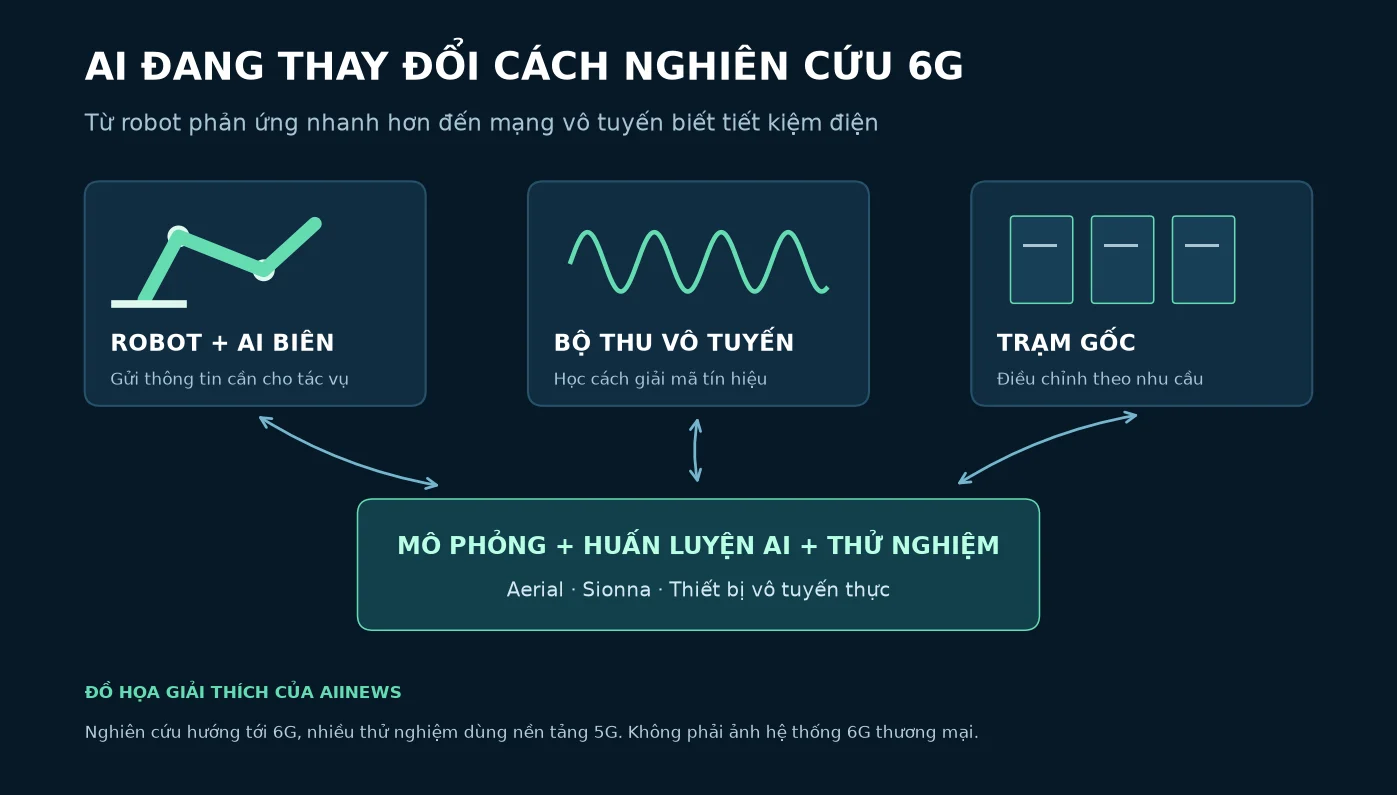
Original AIINEWS explanatory diagram of AI and wireless research towards 6G. Many experiments use 5G testbeds; this is not a photograph of a commercial 6G network.
NVIDIA is providing tools for researchers to test ideas for 6G networks. Projects focus on helping robots react faster, improving signal reception capabilities, and reducing base station power consumption.
The Evolution of the 6G Open-Source Ecosystem
NVIDIA's tools help researchers simulate networks, train AI, and test ideas on real wireless equipment. The Aerial software suite was open-sourced a year ago, complementing Sionna and the company's existing research tools.
In a November 6, 2026 announcement, NVIDIA stated that adoption levels of Aerial AI and Sionna increased tenfold over the past year, with open-source 5G/6G tools surpassing one million downloads. The company also noted that more than 8,000 research and academic organizations are using these platforms.
These are figures published by the vendor. The examples below primarily use 5G systems, simulations, and testbeds to research directions toward 6G; they do not prove that a commercial 6G network has achieved similar improvements.
Sending Task-Essential Information for Faster Robot Reactions
When robots perform object manipulation tasks, response speed depends partly on the wireless connection to the server processing artificial intelligence tasks.
Instead of continuously sending entire images, the robot only sends information needed for the task, such as where the object is located and what it is next to. This exchange method helps reduce the amount of data that must be transmitted and processed.
At King's College London, a system connected a camera-equipped robotic arm to a Jetson AGX Orin edge server via an OpenAirInterface 5G testbed. NVIDIA describes this research as part of the Sionna tool ecosystem. In fruit-packing and block-stacking trials intentionally induced with errors, the team recorded a task completion time reduction of up to 52.6% compared to periodically sending raw images. Configurations with digital twins also checked projected movements to limit collisions; the system additionally handled dropped items or unsuccessful operations.
Note that this is the robot's end-to-end task completion time rather than a claim that pure network latency has decreased by 52.6%, and this result does not represent all commercial robots.
SoftBank Tests Using AI to Improve Data Transmission Speeds
SoftBank integrated a Transformer-based neural receiver into NVIDIA Aerial CUDA-Accelerated RAN (ACAR), then tested it with commercial 5G phones in a shielded room with controlled interference and a single uplink layer.
The average uplink L1 throughput was higher than conventional receivers across all 15 setups. NVIDIA summarized the maximum increase at around 60%; SoftBank's published source stated precisely 60.5% at a test point near −0.6 dB SINR. The graphic below uses two rounded average values of 47.9 and 29.9 Mbit/s.
Data throughput is not spectrum bandwidth. Results in a shielded room also do not mean every subscriber on a commercial network will be 60% faster.
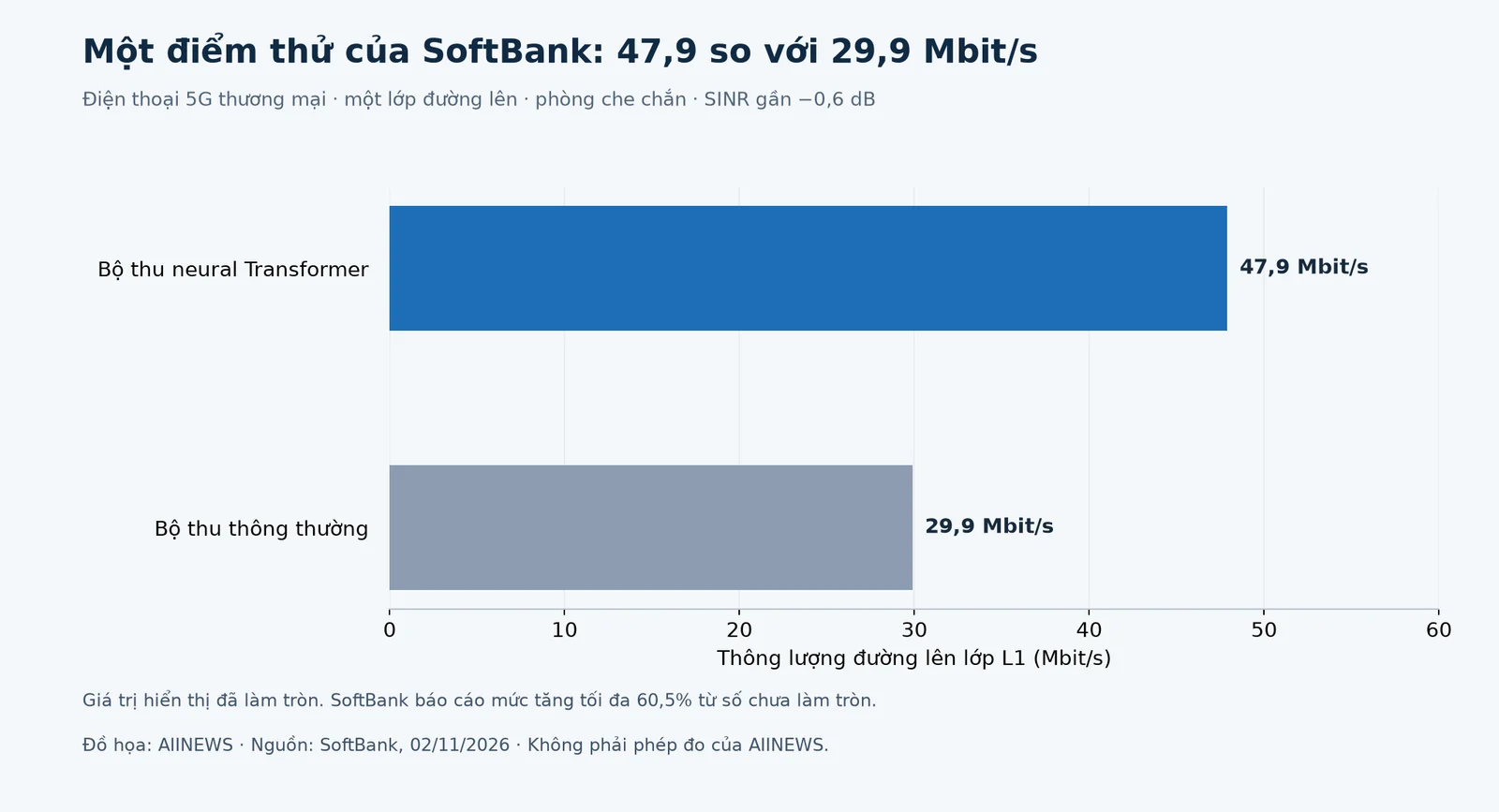
Original AIINEWS graphic using SoftBank-reported data for one controlled test point, not independent AIINEWS measurements. — AIINEWS · OWNED
ETH Zurich Reduces Signal Reception Errors Using Testsite Data
With measurements at a test site, the ETH Zurich team fine-tuned a neural receiver on the NVIDIA Aerial Testbed. NVIDIA cited results of a block error rate reduced by more than a third compared to certain pre-trained versions chosen as benchmarks.
The important distinction is the comparison baseline. The research paper also noted that the MMSE reference receiver had a lower block error rate than the fine-tuned model-driven (MDX) receiver in the two single-layer propagation environments examined. Therefore, the fine-tuning results cannot be turned into a conclusion that every AI receiver outperforms every classical receiver; lower block error rates also do not mean download speeds increase at the same rate.
Putting Base Stations into Sleep Mode Based on Demand Forecasts
As connected device density increases in the 6G era, managing network infrastructure power consumption has become an urgent problem for operators.
At the University of Leeds, researchers developed a system that forecasts network demand 10 minutes in advance to make decisions on switching base stations to sleep mode. Before cutting power, the system checks neighboring stations to ensure user equipment does not lose connection. The system continues monitoring to restore capacity when needed.
Testing using a small-scale network system running on a DGX Spark platform combined with a digital twin showed that RAN power consumption decreased by 45.6% compared to the baseline operating at full capacity.
It is necessary to clearly distinguish that this is the energy consumption of the radio access network segment alone in a four-base-station urban test scenario, rather than the overall electricity bill of a telecommunications provider or phone battery life.
Accelerating Network Simulation with GPU Radio Channel Models
Simulating network scenarios before actual deployment typically consumes significant computational time, limiting the number of design options engineers can explore.
The Centre Tecnològic de Telecomunicacions de Catalunya (CTTC) collaborated to integrate GPU-accelerated radio channel models running on ACAR into the open-source 5G-LENA network simulator.
According to documentation from NVIDIA, this combination helps shorten simulation time from about three hours down to 10-20 minutes depending on the integration configuration. Meanwhile, CTTC's separate report on a scenario with 21 macro cells and 210 users recorded a time reduction from about three hours to three minutes.
The reports have not provided comparisons showing that the two timeframes belong to the same test configuration. Therefore, each result must be read within the context of its publishing source. Faster simulations give the research team the opportunity to explore multiple options, but are not sufficient to prove a real network will perform better.
Questions Posed for Operators and Researchers
Although initial test results provide positive signals, network operators and the research community need to ask specific questions before considering practical applications.
First, how do these AI solutions and optimization models incur additional computational costs and hardware complexity when operating at scale across comprehensive network systems?
Second, how do neural receivers and adaptive energy-saving systems adapt to sudden fluctuations in real-world user traffic rather than controlled laboratory scenarios?
Open-source tools
NVIDIA Aerial ACAR · NVIDIA Sionna
Further reading
- How NVIDIA Open Source Tools Are Helping Researchers Build Next-Generation 6G Networks
- Goal-Oriented Communications for Physical AI: Design and Testbed
- SoftBank Demonstrates Higher 5G Uplink Throughput with a Transformer Neural Receiver
- On the Impact of Site-Specific Training for a Real-World 5G NR System
- Intent-Driven Agentic AI for Safe Energy-Efficient Open RAN Optimization via a 5G Network-in-a-Box Digital Twin
- CTTC Accelerates 5G Network Simulation from Hours to Minutes with NVIDIA
This article was researched from the cited public sources and edited with AI assistance.
An AIINEWS Editorial Publication