AMD boss: No one knows what AI will look like in 5 years, so the infrastructure must be flexible enough to adapt
Executive Briefing
Synthesized and verified with gemini-2.0-flash-thinking-exp
“**At the recent AI Infra Summit, AMD's leader in the Asia-Pacific region said that the biggest risk”
Key Takeaways
- 1.**At the recent AI Infra Summit, AMD's leader in the Asia-Pacific region said that the biggest risk for businesses does not lie in choosing the wrong technology today, but in building an infrastructure that cannot be changed when the rules of the game change.** No one in the industry can say for sure which model architecture will dominate next, where the balance between training and inference will end, or how much AI will run in an enterprise's own data center, in a partner's data center, on a laptop or even a smaller device.
- 2.Yet those in charge of infrastructure still have to spend money now for an IT platform that will carry the burden of the business for the next 5 to 7 years.
- 3.Speaking at AI Infra Summit, Mr.
At the recent AI Infra Summit, AMD's leader in the Asia-Pacific region said that the biggest risk for businesses does not lie in choosing the wrong technology today, but in building an infrastructure that cannot be changed when the rules of the game change.
No one in the industry can say for sure which model architecture will dominate next, where the balance between training and inference will end, or how much AI will run in an enterprise's own data center, in a partner's data center, on a laptop or even a smaller device. Yet those in charge of infrastructure still have to spend money now for an IT platform that will carry the burden of the business for the next 5 to 7 years.
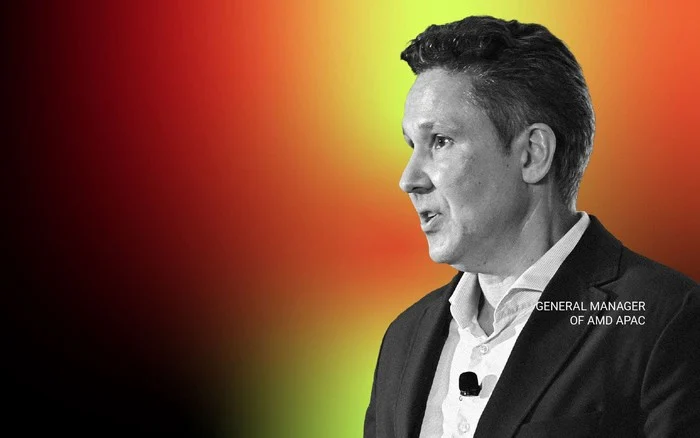
Speaking at AI Infra Summit, Mr. Alexey Navolokin, General Director of AMD APAC region, called this the most difficult problem for infrastructure workers today. According to him, the most expensive mistake is not choosing the wrong chip, but building a system so rigid that when changes are required, the only way is to do it over and over again.
From giant training clusters to a world of AI running everywhere
A few years ago, mentioning AI infrastructure was referring to large-scale training sessions, relatively predictable needs, running in batches on a giant cluster of machines. That workload has not disappeared, but now has to live with inference, Agentic AI and a series of distributed tasks with very different requirements.
Inference runs non-stop and is sensitive to both latency and cost for each request. Agentic AI pushes this pressure even higher, as a single user request can turn into a whole series of steps such as retrieving and preparing input data, calling tools, running code, coordinating sub-agents, and staying in work state longer than any single request.
As a result, the problem is no longer just how much computing power is needed, but what shape the system must have. An optimal training cluster infrastructure of yesterday is not only underpowered but also structurally wrong, because the balance between compute, memory, and network no longer matches where the work actually happens. Mr. Navolokin emphasized that a structural problem cannot be solved by buying more of what is already there. Expanding the familiar is mainly a matter of budget, while absorbing the new is a matter of architecture and operations.
Therefore, optimization must follow the entire system, not each individual component. Compute, memory, networking, storage, software, power and reliability must be designed to work together.
Don't guess who wins, keep the right to change direction
If things are in flux, the reasonable design goal is not to bet on a winner but to retain the freedom to move on to the next thing. According to Mr. Navolokin, that freedom can be verified through three characteristics.
The first is adaptability. The solution portfolio needs to be deep enough that when workloads change, the answer is just a different configuration, not a different vendor, with the right type of compute power for the right job, running on a common software platform.
The second is economic efficiency, and according to him, don't understand it as being the cheapest but paying for the right tool. Training is a capital investment decision, made moment by moment, while reasoning is an operational decision repeated billions of times every day. With Agentic AI, a request is no longer a single inference but a whole chain of inferences, so the metric worth tracking is not the cost per token but the cost per completed task.
Third is openness. An ecosystem based on widely accepted standards prevents customers from being tied to a single vendor's product roadmap, which is why open connections and open networks are increasingly important.
AMD's Width Problem
From that logic, AMD chose to invest across the entire stack instead of focusing on one flagship product. At the lightest end, AMD EPYC server CPUs handle inference, tokenization, orchestration, and general-purpose compute tasks, while AMD Radeon and AMD Ryzen AI bring small models and local AI down to the personal machine. Moving up a notch, AMD Instinct PCIe cards handle large language model inference and fine-tuning. At the heaviest end, AMD Instinct eight-GPU systems serve distributed inference and training, then scale up to AMD Helios rack-scale solutions for mega-scale deployments.
However, Mr. Navolokin believes that the important thing does not lie in each product. A broad catalog without a common software story is just a catalog, but the breadth that comes with the software creates flexibility. That cohesive role belongs to AMD ROCm, the platform that helps hardware run a variable workload without having to start from scratch.
He also affirmed that AMD does not build the entire stack with the expectation that customers have to buy the entire package. Each component must prove its worth, and thanks to open standards, businesses can choose the AMD pieces that best fit their workloads while remaining free to choose other vendors elsewhere.
Win not because you guess correctly, but because you are flexible enough
For Mr. Navolokin, the organizations that do well in the next five years will not be those that predict every turn, but those that are free and flexible enough to steer when the turns appear. That leads to three pieces of advice for infrastructure workers. Build to accommodate whatever shape the future takes, build to be economical and only pay for the right tools, not the biggest tools, and build on an open platform to preserve choice, because when there is no choice, the price to pay will be very high.
The only thing that is certain is that AI will continue to change, and according to him, the infrastructure should be built from the beginning with that assumption in mind.