I may not use the touch screen on the MacBook Pro, but I understand why some people would find it useful
Executive Briefing
Synthesized and verified with gemini-2.0-flash-thinking-exp
“**There are times when making music, 3D design, or editing photos when it's more convenient to inter”
Key Takeaways
- 1.**There are times when making music, 3D design, or editing photos when it's more convenient to interact on a screen.
- 2.The touch screen on the MacBook Pro can come in handy in moments like these, although it's not a feature everyone needs every day.** At the launch event of the new MacBook Pro, Apple for the first time brought a touch screen to a laptop line that is already familiar with using the keyboard and trackpad.
- 3.I had the opportunity to attend the event and see many demos firsthand, from music making, fashion design, manipulating 3D models to creating virtual film studios.
There are times when making music, 3D design, or editing photos when it's more convenient to interact on a screen. The touch screen on the MacBook Pro can come in handy in moments like these, although it's not a feature everyone needs every day.
At the launch event of the new MacBook Pro, Apple for the first time brought a touch screen to a laptop line that is already familiar with using the keyboard and trackpad. I had the opportunity to attend the event and see many demos firsthand, from music making, fashion design, manipulating 3D models to creating virtual film studios. What's interesting is whether touch actually helps in those tasks or just makes the performance look more interesting.
Before watching the demos, I was quite skeptical as I had used laptops with touch screens, but the frequency of raising my hand to touch the screen was very low. Writing articles or handling office work is all convenient with the keyboard and trackpad. When writing by hand or drawing, placing the iPad on the table is still more comfortable.
After the experience, my initial impression did not change much: for most users, the touch screen on the MacBook Pro is probably only used occasionally. However, when viewing the applications with your own eyes, you will see that there are times when direct touch is very convenient, especially when you need to adjust many parameters at the same time or rotate or zoom a 3D model.
Making music: when a mouse pointer is not enough
In the music making demo, producer Fab Dupont works with Logic Pro, from recording to editing and playing virtual instruments on the screen. It is worth noting the times when many parameters need to be changed while the sound is still playing.
Another example is envelope lines - lines that represent volume or effects that change over time. The music maker places points and then drags them to create the desired increase or decrease. Using a mouse or trackpad is still possible, but direct touch may be more convenient when you want to quickly try a change.
I also asked Vietnamese music producer Kriss Ngo how touch can help in this work. Kriss showed me how he controls the volume with a lever: push it up to increase the volume, pull it down to decrease it. If operating on the touch screen, you can touch the corresponding control and drag it directly.
A more obvious difference appears when needing to control multiple effect knobs at the same time. Kriss explains that with mice, he usually can only turn one knob at a time. If the application supports multi-touch, multiple fingers can adjust two parameters at the same time, helping you immediately hear how they combine together instead of adjusting them one at a time and then listening again.
Kriss Ngo talks about how touchscreens can help with work.
Kriss also uses an external controller for these operations. The device has physical buttons for control, but users need to assign each button with a function in the software. Dedicated controllers still have the advantage of feeling of use; When working on a laptop or wanting to quickly try out an idea, immediately tapping on the open interface is a more convenient option. This is a need I rarely encounter in my daily work, but through the way Kriss explains it, it's quite easy to understand why musicians would be interested.
3D design: tap to view, then return to familiar tools
When designing in 3D, the mouse and keyboard are still necessary for accurate rendering steps. But there are many times when people just want to rotate the object to see the back, zoom in on a detail or step back to see the whole.
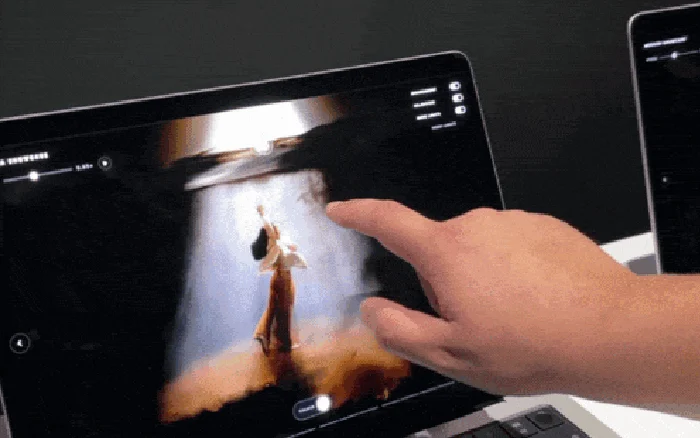
In the demonstration by Susan Fang and Orelio de Jonghe, fashion design is combined with rendering and separate tool development. The ability to interact directly with the model is especially intuitive when you need to examine the structure of an item from multiple sides, or show the design to others.
Even if you've mastered 3D software, tapping to rotate or zoom the model can still help you check perspectives more quickly. When it is necessary to enter dimensions or adjust small details, the designer returns to the mouse and keyboard.
Botanical artist Azuma Makoto's Workflow has a similar need for observation. When constructing a flower composition in digital space, the composition needs to be viewed from many sides to check the proportions and space between components.
Azuma Makoto said the touch screen makes working more convenient when space on the desk is tight. With flower works built in digital space, users can touch to rotate, zoom in on the model and check the proportions and spaces between components without needing additional room to operate the mouse.
Touch here can make viewing and exchanging ideas more direct, if the application supports it well. It does not by itself replace the tools used to build models.
Filmmaking and photo editing: convenient when you need to try quickly
In the studio test, ILM demonstrated how to build a digital environment, while Foundry demonstrated putting that image on an LED screen as a background for the scene. The background doesn't just need to look good on its own: its brightness and color must also match the character, the actual lighting, and the image captured by the camera.
When the crew sees that the background is a bit bright or the color doesn't match, the operator can try making adjustments and then see the results right on the big screen and the image from the camera. In such applications, touching the controls directly on the laptop can be more convenient than pointing the cursor to each button with a trackpad. Changes are also easy to track when many people are viewing and discussing the same frame.
In another demo, I saw color correction using the color wheel on Final Cut Pro. This is the type of tool where it's pretty easy to visualize the benefits of touch: touch the color wheel, drag to test a hue, look at the results, then adjust further. With sliders or other color areas, direct manipulation can also be useful when you need to quickly try out a few options.
In photographer Jeremy Cowart's demo, the camera is connected to a Mac so that photos just taken appear right on the screen. Jeremy used Capture One in this workflow, combining portrait photography with constantly changing lighting and backgrounds.
When there are many photos taken in a row, the touch screen can be convenient in the viewing and selection step: open one photo, zoom in to check the sharpness in the eye area, then quickly move to the next photo. When discussing with the crew, touching directly on the details being discussed is also easier to follow.
When it comes to careful editing, the mouse and keyboard still have their own roles. But right in the studio, short and repetitive image viewing operations are a situation where the touch screen can be effective.
A notable option for professional work
The touch screen doesn't need to be the primary use of the MacBook Pro. The keyboard and trackpad are still adequate for most work; Touch adds a way to operate when you need to directly touch the thing you are viewing or adjust multiple parameters at the same time.
At the Back to the Mac event in 2010, Steve Jobs once said that the touch screen on the vertical screen looks good when performing, but using it for a while will make your hands tired. After watching the demos this time, I think that comment still makes sense if I have to keep my hand on the screen constantly. However, music, 3D design, and filmmaking workflows demonstrate the need to tap for brief moments, to complete a specific action and then return to the keyboard or trackpad.
Who knows, maybe that's how Apple envisions the touch screen on the MacBook Pro: an option for when it's really handy. With daily work, I probably won't use it much. But for some professionals, a few well-timed touches can be a "nice to have" on the device they use every day.