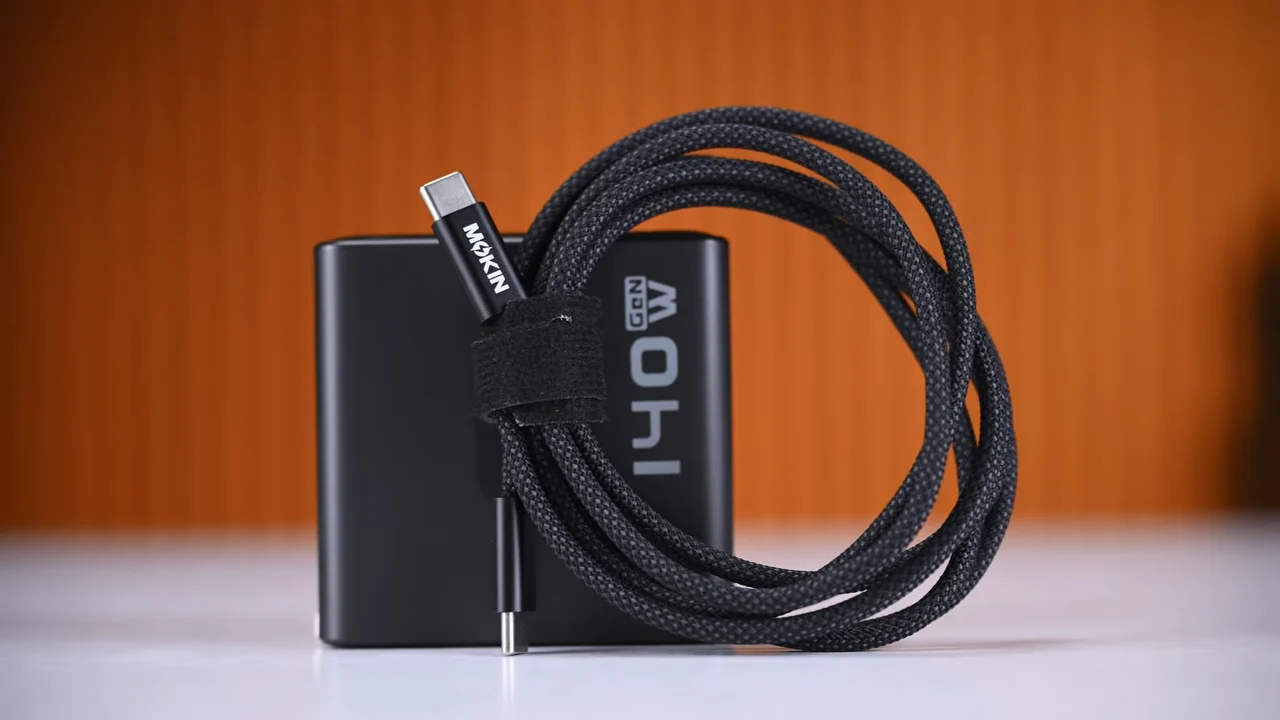
Mokin GAN 140W on hand: 2 140W C output ports, versatile for daily use
Executive Briefing
Synthesized and verified with gemini-2.0-flash-thinking-exp
“If you are a multi-device user like me, you will definitely need a multi-purpose, high-capacity char”
Key Takeaways
- 1.If you are a multi-device user like me, you will definitely need a multi-purpose, high-capacity charger to handle all your daily usage needs.
- 2.I need a multi-purpose, high-capacity charger to handle the full 140W for my ASUS ProArt P16 laptop and charge many other devices at the same time.
- 3.Mokin GAN 140W is the solution I am holding in my hand at this time.
If you are a multi-device user like me, you will definitely need a multi-purpose, high-capacity charger to handle all your daily usage needs. I need a multi-purpose, high-capacity charger to handle the full 140W for my ASUS ProArt P16 laptop and charge many other devices at the same time.
Mokin GAN 140W is the solution I am holding in my hand at this time. This is a new brand officially imported into Vietnam through Viettel Distribution and is expected to be available at dealers soon.
I am using the version with 3 USB-C ports and 1 USB-A port, with a display screen and a 140W cable (28V 5A) in the box. Its current selling price is about 1 million VND, while the original price is nearly 2 million VND, I consider this a worthy investment for a charger for nearly every device I carry every day.
This is not a detailed review of the performance or durability of the Mokin GAN 140W. I have only tried it for nearly a week and will test the specific parameters more carefully to report to you later.
This charger is currently carrying 140W for the ASUS ProArt P16 laptop running the N1X chip, while also charging many other devices at the same time. Compared to the other 140W charger I am using with similar size, the Mokin GAN 140W has superior features.
Both C ports both output 140W
The biggest difference of Mokin GAN 140W compared to the other 140W charger I am using lies in the ability to allocate power to two USB-C ports. On the old charger, only the PC1 port can output a maximum of 140W, while the second port is limited to 65W. But with the Mokin GAN 140W, both of the first two USB-C ports can output a maximum capacity of 140W, which gives me a lot more flexibility when choosing the port without worrying about power limitations.
When all four ports are plugged in at the same time, PC1 port will output 60W, PC2 port will output 30W and the remaining two ports including PC3 and USB-A will each output 20W. I simulated a real-life charging situation by plugging in PC1 for the 15-inch MacBook Air, PC2 for the 13-inch MacBook Air, PC3 for the iPhone, and a USB-A port for a smartwatch or headset.
This configuration is completely sufficient for daily work needs with a phone, watch, headset and computer, and it can even meet more specialized tasks such as charging cameras, drones or camcorders.
Be neat when traveling on business
For me, this charger is indispensable when going on a business trip, just bringing this one charger along with the cables is enough, no need to worry about other chargers. The backpack is thus more neat, has fewer accessories and is less cluttered.
Advertisement
Charging standards and smart features
This charger fully supports today's popular charging standards such as USB 3.1, Power Delivery (PD) and Quick Charge (QC) 3.0. Mokin's website lists compatible devices stopping at Samsung Galaxy S25, iPhone 16/17, Google Pixel 9/10 and some laptops launched in the last 1-2 years. However, with newer devices, unless you use a very special charging standard, this charger will still support common standards such as PD or QC.
In terms of safety, Mokin is equipped with a series of protection technologies including over-voltage, over-current, short circuit and overload protection. GaN technology helps the charger achieve large capacity in a compact body. In particular, the Smart Thermal Protection sensor will monitor the temperature in real time and automatically turn off the power when it reaches the safety limit. In addition, active current distribution technology will identify the device and load the correct charging technology to optimize current.
One point that I find better than my old charger is that when the cord is plugged into the port but not yet plugged into the device, the Mokin will not automatically divide the power. Meanwhile, normal chargers, including my old one, just need to plug in the cord to start dividing power.
High temperature but stable capacity
When I charged a single USB-C port with near maximum capacity, about 136-137W for the ASUS ProArt B16, the temperature measured on the charger fell to about 69 degrees Celsius in a cold room environment of 26-27 degrees Celsius at the Delicate coffee campus.
Advertisement
I assess this number to be quite high and have talked to Mokin representatives in Vietnam, they said they will investigate further. However, practical experience shows that even at such high temperatures, the capacity is still stable. When the device needs nearly 140W, the charger still pumps enough, the display remains at 136-137W and never drops below 100W.
I ran AI Agent on the P16 for nearly a week, the device operated at 100% capacity continuously and the charger responded well. I will test this temperature more thoroughly and share details in the next article or video.
Conclusion
After nearly a week of use, I found that Mokin GAN 140W almost meets all the basic charging needs of current normal users. With a price of about 1 million VND compared to the original price of nearly 2 million VND, what do you think about the price and appeal of Mokin GAN 140W?
Do you find this price and performance of Mokin GAN 140W attractive? I really want to hear your opinion about the "deliciousness" of this deal.