Refrigerators do not produce cold air: the compression and expansion cycle of the medium carries heat out of the refrigerator
Executive Briefing
Synthesized and verified with gemini-2.0-flash-thinking-exp
“Opening the refrigerator door, cold air blows out, making many people think there is something insid”
Key Takeaways
- 1.Opening the refrigerator door, cold air blows out, making many people think there is something inside that creates the cold.
- 2.Actually, in physical terms, cold is just less heat.
- 3.The refrigerator does not pump cold air in, but continuously absorbs heat from the food and air inside and releases it into the kitchen.
Opening the refrigerator door, cold air blows out, making many people think there is something inside that creates the cold. Actually, in physical terms, cold is just less heat. The refrigerator does not pump cold air in, but continuously absorbs heat from the food and air inside and releases it into the kitchen.
HowStuffWorks summarizes the principle in one sentence: when liquid evaporates, it absorbs heat. Applying a little alcohol to the skin will feel cool because the alcohol evaporates, taking heat from the skin. Most home refrigerators do the same thing using a vapor compression cycle, the same principle as air conditioners, the only difference is that the liquid is trapped in a sealed tube and used again and again.
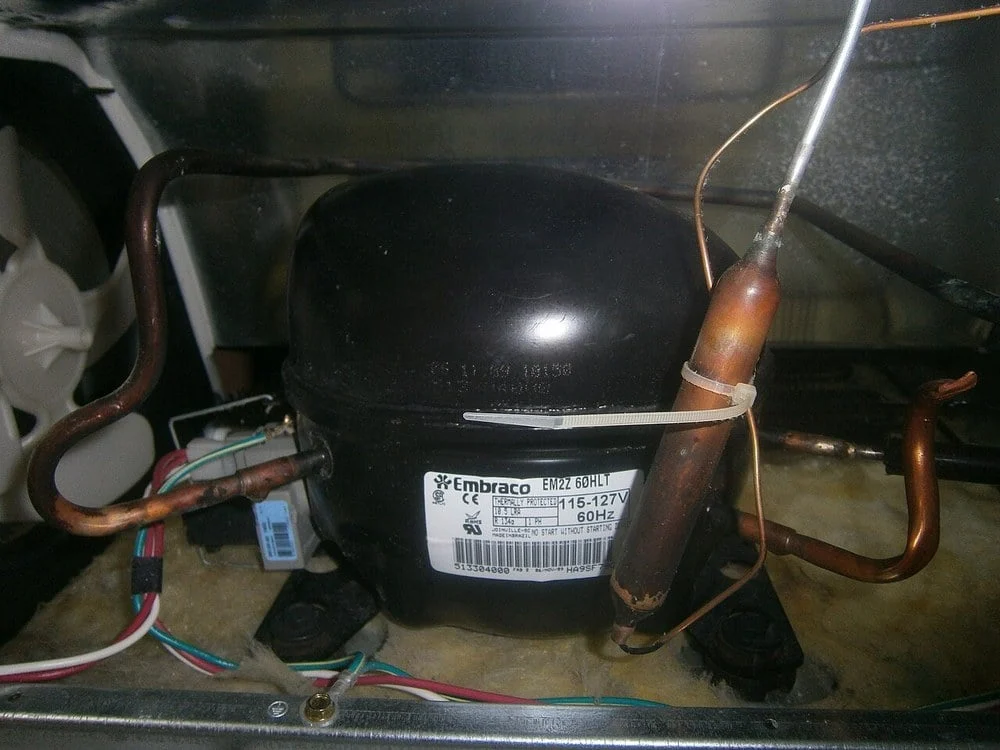
Embraco compressor in a 2010 Maytag refrigerator, the part pushes the refrigerant around and creates a pressure difference for the entire cycle
Five components of the cold circuit
According to HowStuffWorks, refrigerators have five main components:
- Compressor: sucks in refrigerant vapor and compresses it to high pressure.
- Outdoor unit (condenser): tube bent outside the cold compartment, according to Britannica usually on the back or bottom of the cabinet.
- Acceleration device: expansion valve or capillary tube, essentially a pinhole-sized constriction in the pipe.
- Indoor unit (evaporator): bending tube inside the refrigeration compartment.
- Refrigerant: liquid that evaporates inside the refrigerator to create low temperatures.
The secret lies in the pressure
The boiling point of a liquid depends on pressure. Water boils at 100 °C at sea level, but high in the mountains, where the pressure is lower, it boils at about 87 to 93 °C, according to HowStuffWorks. The refrigerant was chosen to boil at very low temperatures: isobutane (R-600a), which is widely used in new refrigerators in Europe, boils at about -11.8 °C under atmospheric pressure.
When the pressure is reduced, the medium boils at a lower temperature than the food in the refrigerator, so it absorbs heat. When compressed to high pressure, it is hotter than the air in the room, so it releases its heat. The compressor and the throttle are those two pressure "switches".
A four-step cycle
Illustrative diagram: the refrigerant runs in a closed pipe, absorbing heat from the indoor unit inside the cabinet and releasing heat from the outdoor unit
- Compression: the medium enters the compressor in the form of low pressure steam, at approximately the same temperature as in the cabinet, then exits as high pressure hot steam.
- Condensation: hot air flows through the condenser, is cooled and liquefied by the air in the room, remains at high pressure and is only slightly warmer than the room.
- Expansion: fluid is forced through the constriction into a much lower pressure area. A sudden drop in pressure causes part of the liquid to evaporate immediately, taking heat from the remaining liquid, causing the entire stream to cool. Regarding the ratio, the two Wikipedia articles write differently: about half, or less than half.
- Evaporation: the cold mixture flows through the condenser, the fan blows the air in the refrigerator through the tubes. The refrigerant evaporates, absorbs more heat from the air, then returns to the compressor for a new cycle.
The cold air in the refrigerator is still warmer than the refrigerant in the condenser, and that difference causes heat to flow from the air to the refrigerant.
Illustrative diagram: four steps of the vapor compression cycle and energy balance in the outdoor unit
Advertisement
According to Encyclopedia.com, the outdoor unit must release both the heat absorbed from the cabinet and the energy input from the compressor. Therefore, opening the refrigerator door does not cool the room: the heat absorbed is released right into the room, plus heat from the compressor.
Britannica says most refrigerators do not run continuously. When the compartment is warmer than the set point, the thermostat turns on the compressor, cools it slightly below that level, and then turns it off. Inverter cabinets change the compressor speed instead of turning it on and off.
From ether to isobutane
- 1755: William Cullen in Scotland vacuumed an ether flask, causing the ether to boil, absorb heat and create a little ice.
- 1834: Jacob Perkins built the first working, closed-loop, continuously operating vapor compression refrigeration system.
- 1854: James Harrison's first commercial ice machine was born in Australia.
- 1913: The first household electric refrigerator appeared. In 1927, the GE Monitor-Top became the first widely popular refrigerator model, with more than a million units produced.
- 1920s and 1930s: Freon replaced toxic sulfur dioxide or methyl formate.
- 1990s: R-12 banned in new cabinets because it destroys the ozone layer, replaced by R-134a; Since 1993, isobutane has been introduced into refrigerators through the Greenfreeze project.
1929 General Electric Monitor-Top refrigerator at the Tallahassee Automobile Museum (USA), the compressor cluster is located on the top of the refrigerator
Isobutane has almost no effect on the ozone layer, low global warming coefficient, but is flammable; Wikipedia notes that there was an explosion when leaking gas accumulated in the cabinet and then encountered a spark.
Advertisement
Understanding this cycle also explains some familiar advice. Clean the dust on the condenser and leave space around it to help the refrigerator dissipate heat better. The US FDA recommends keeping the refrigerator at 4 °C or below and the freezer at -18 °C; Wikipedia notes that coolers usually do not need to be colder than 4 °C.
Source:
Wikipedia (Refrigerator)
,
Wikipedia (Vapor-compression refrigeration)
,
HowStuffWorks
,
Britannica Kids
,
Encyclopedia.com