Sony releases a 3D screen without glasses that costs several hundred dollars: why 3D without glasses has failed
Executive Briefing
Synthesized and verified with gemini-2.0-flash-thinking-exp
“## **A 3D photo frame placed on the table** The ELF-MN1 is not a screen for working or watching mov”
Key Takeaways
- 1.## **A 3D photo frame placed on the table** The ELF-MN1 is not a screen for working or watching movies.
- 2.Sony makes it to place on a table, displaying cartoon characters, avatars or 3D objects as a display item.
- 3.The device plugs into a phone or computer via a USB-C cable with video output, supporting Windows computers and some new iPhone, Galaxy, Pixel, and Xperia phones.
A 3D photo frame placed on the table
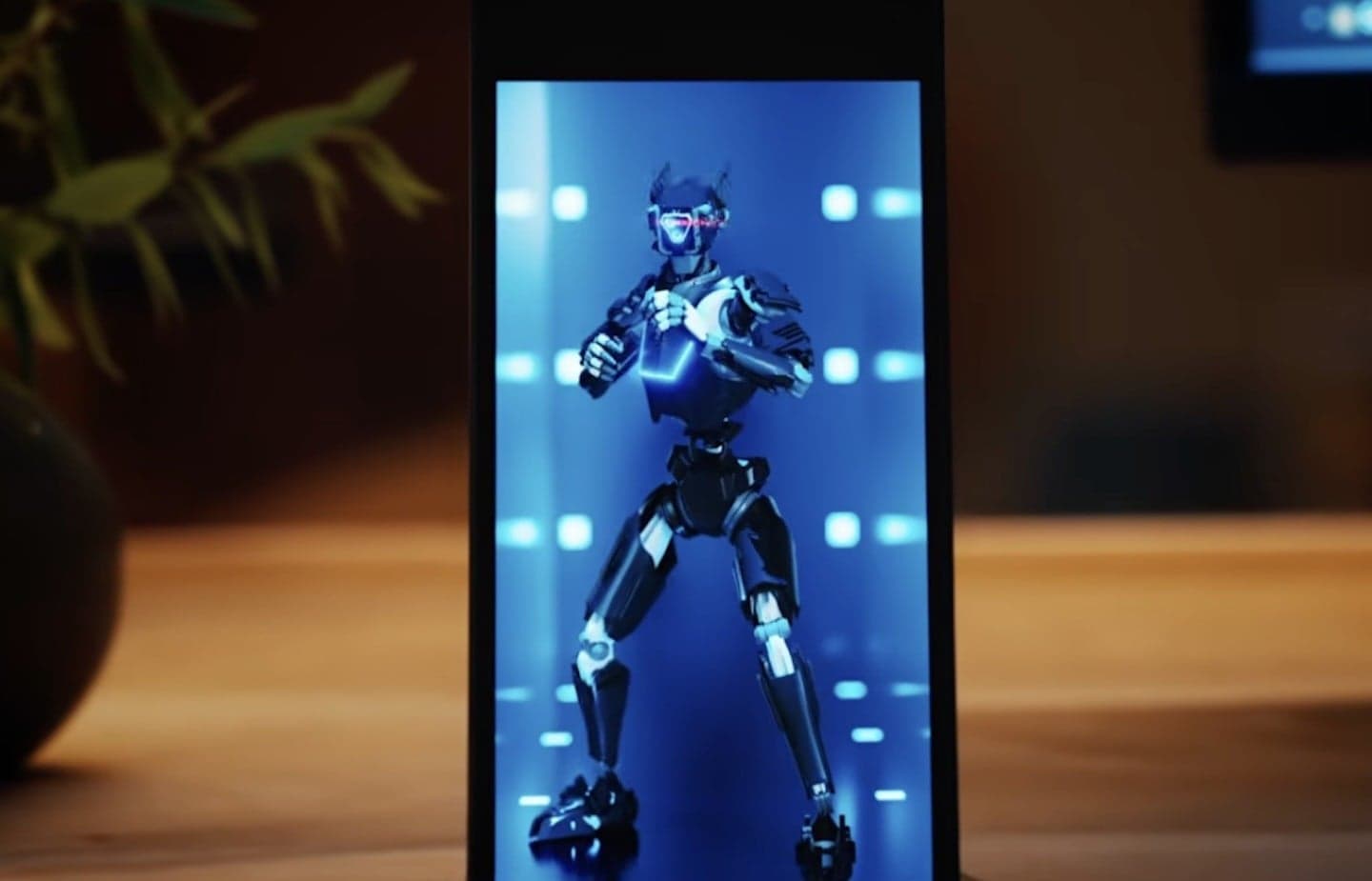
The ELF-MN1 is not a screen for working or watching movies. Sony makes it to place on a table, displaying cartoon characters, avatars or 3D objects as a display item. The device plugs into a phone or computer via a USB-C cable with video output, supporting Windows computers and some new iPhone, Galaxy, Pixel, and Xperia phones.
Sony also joined hands with Gugenka to bring copyrighted anime character models from the HoloModel service to the screen. Instead of buying each plastic model and leaving space on the shelf, users switch characters on the same screen. There is also a developer kit, which runs with Unity and OpenXR.
The screen follows the viewer's eyes
Sony's approach is to use sensors to track the position of the viewer's eyes, then reconstruct a 3D image according to that perspective in real time, each eye receiving a separate image through the microscopic lens layer on the LCD panel. This time, Sony added an infrared sensor to still catch the eye when the room is dark, and the screen has the highest pixel density of any 3D screen Sony has ever made.
In return, only one person can watch at a time, sitting about 30 to 80 cm away from the screen and no more than 25 degrees away. The person standing next to it will see that the image is not correct. So this is a personal item, not for the whole family to see.
Previously, 3D without glasses has failed many times
The 2011 Nintendo 3DS is the most popular glasses-free 3D console. But just two years later, Nintendo released the 2DS and completely abandoned the 3D feature, and according to Wikipedia, CNET at that time called this Nintendo admitting 3D was an unnecessary feature. The 3DS screen only floats when the eye is located in a small area in front of the device. If the head is slightly tilted, the image will be blurred or split into two images.
Advertisement
The phone has also been tried. HTC Evo 3D and LG Optimus 3D were released in 2011, with two rear cameras for taking 3D photos and a glasses-free 3D viewing screen. A few years later, 3D screen phones almost disappeared from the market. As for 3D TVs, both with glasses and without glasses, by around 2017, almost all companies had stopped making them.
Why did previous attempts fail
Taken together, there are several reasons for repetition. Firstly, the viewing angle is narrow, the viewer has to sit in the right place, but the screen does not know where the person is. Second, the resolution is divided in half between the two eyes, so the 3D image is less sharp than the normal image. Third is eye strain, many people complain of headaches when watching for a long time. And most importantly, there is a lack of content. If there is nothing worth watching in 3D, people will turn it off.
Sony solves the first two reasons by tracking eyes and serving only one person, accepting the loss of general viewing ability. As for content, Sony does not target movies or games but targets characters and 3D models, which are already widely available thanks to the avatar making community and VTubers.
From 5,000 USD to several hundred USD
Advertisement
Sony's first glass-free 3D screen is the ELF-SR1, released in 2020 for $4,999.99 in the US, with a large 15.6-inch screen and aimed at designers and engineers. The ELF-MN1 is much smaller, so a direct price comparison isn't entirely fair, but it shows that Sony is confident enough to bring this technology out to regular users.
I think the ELF-MN1 will hardly become a mass product, because it is still a single-viewer device and depends on the supported application. But for anime model collectors in Japan, a display frame that can change characters seems to be a much more reasonable direction than trying to fit 3D into a phone or TV like before. Would you like one like that to put on the table?
Attribution & Original Source
Synthesized and verified from Tinhte.vn. All copyrights and intellectual property belong to the original publication.