Turning AI Phone into an "iPhone killer": the ambition of an American startup founded by former Google and Oracle employees
Executive Briefing
Synthesized and verified with gemini-2.0-flash-thinking-exp
“**The American startup founded by former Google and Oracle employees is developing "AI Phone" with t”
Key Takeaways
- 1.**The American startup founded by former Google and Oracle employees is developing "AI Phone" with the ambition to replace the iPhone in users' pockets.** Cyclon, an American startup backed by Y Combinator, is developing a phone that can use apps and do work for the user.
- 2.Behind the project are two founders who worked at Oracle and Google, with the ambition to create an "AI Phone" that can replace the iPhone.
- 3.*“An AI phone to replace your iPhone”* -an AI phone to replace your iPhone.
The American startup founded by former Google and Oracle employees is developing "AI Phone" with the ambition to replace the iPhone in users' pockets.
Cyclon, an American startup backed by Y Combinator, is developing a phone that can use apps and do work for the user. Behind the project are two founders who worked at Oracle and Google, with the ambition to create an "AI Phone" that can replace the iPhone.
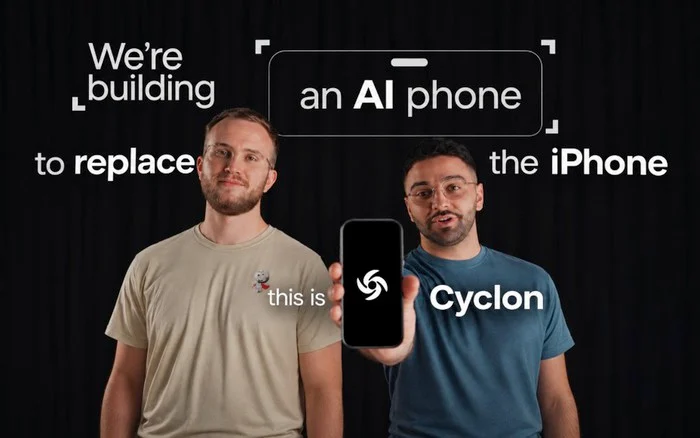
“An AI phone to replace your iPhone” -an AI phone to replace your iPhone. That's how Adam Zinebi, co-founder and CEO of Cyclon, introduced the product in a post on X. According to him, if users can do something on their phone, they should also be able to ask their phone to do it for them.
From iPhone to “AI Phone”, the play on words also reflects the direction that Cyclon is pursuing: making AI the main interface for using the phone. Users say what they want to accomplish, and the system operates within applications, handling work in the background and creating additional tools when needed.
AI Phone introduction video.
Cyclon was founded by Adam Zinebi and Thomas Kiefer. According to information announced by the founders, Zinebi used to work at Oracle and studied electronics and miniature hardware at EPFL; and Kiefer used to work on Android at Google.
The team is developing both the operating system and the hardware, aiming for an experience where assigning tasks to AI becomes a familiar way of interacting with smartphones.
One example introduced by Zinebi is asking the phone to find a contract in Google Drive, send the link to a contact via WhatsApp and then call that person. Cyclon uses applications and accounts logged in on the device to perform this series of operations. When information is missing, the assistant can ask again, then continue working.
In a separate demo video posted on X, Zinebi describes asking Cyclon to find documents in Google Drive.
Users can still open the application and operate it manually. What's new is the ability to assign a multi-step task to the phone, instead of having to manually switch to each service. Tasks like organizing notifications and sending messages are also within the scope of what the team wants AI to take care of.
The ability to create your own apps is the next notable part. Zinebi introduces a document scanning tool similar to CamScanner but without ads, along with an example of a Spanish learning app. According to the founder's description, Cyclon writes code, tests, fixes errors and then installs the results into an application on the phone.
This build takes place in a separate cloud environment. Created applications can also connect to external services, but the user must provide the necessary account or API key. That opens up the possibility of creating tools to serve individual needs, although quality and stability still need to be verified in actual use.
Users can now pre-order the Cyclon phone with a $199 refundable deposit, which is deducted from the final purchase price. Eligible customers in the first round in the US will receive an additional Pixel 8a pre-installed with Cyclon OS within 30 days to participate in the closed testing program. This is an early experience device, but the product they ordered is still the Cyclon phone. The use of AI is included and does not require a subscription during the beta period.
Redner Cyclon photo, may not be the final image of the product.
Cyclon phones are expected to be delivered in the second quarter of 2027, depending on the FCC licensing process in the US. Hardware images on the website are still conceptual designs.
Regarding software, Cyclon said the operating system can run most Android applications. However, some banking, payment, or work apps that require a Google-certified device may encounter problems. Operations such as identity verification may still need to be performed directly by the user.
Access rights and data processing are also points that need attention. Within the scope of assigned tasks and permissions, AI can send messages or change content in the application without asking again at each step. Users can turn off access rights for each app. Data related to the request, such as screen content, messages or location, can be sent to AI providers for processing.
However, the Cyclon phone is still in development, and the pilot program on Pixel 8a will help verify the software experience before its own hardware appears. From an attractive demo to an "AI Phone" stable enough to replace the iPhone in daily use is still a gap that this startup must overcome.