What did Apple personnel say about laptops with touch screens?
Executive Briefing
Synthesized and verified with gemini-2.0-flash-thinking-exp
“The touch panel is integrated right into the panel, not an additional layer glued on top.”
Key Takeaways
- 1.The touch panel is integrated right into the panel, not an additional layer glued on top.
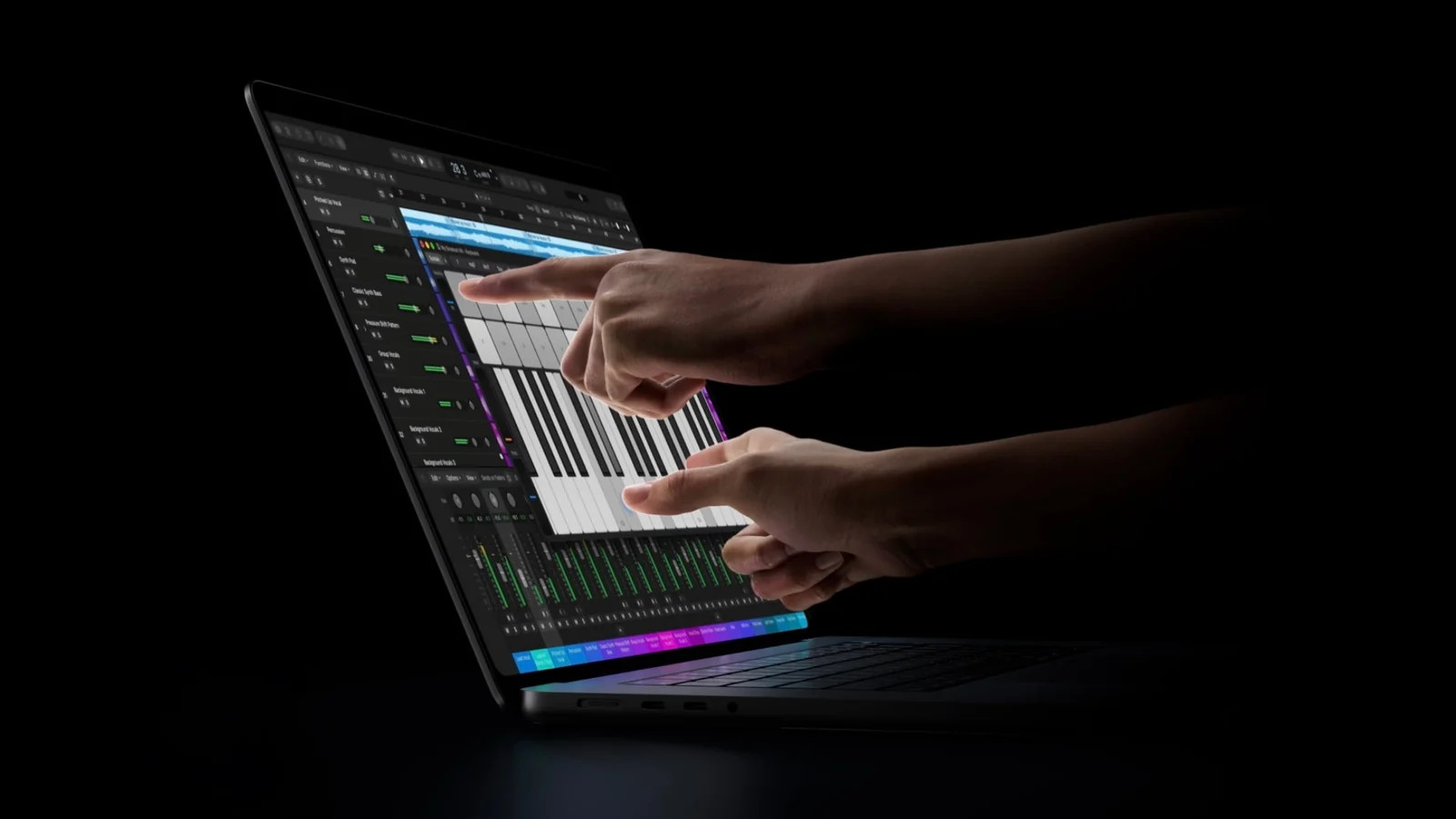
- 2.The hinge has been reworked so that the screen does not vibrate when touched, and macOS 27 automatically converts touch operations into clicks, supporting swipe to scroll, pinch to zoom, drag and drop and double tap to enlarge the window.
- 3.Starting price is $2,899 for the 14-inch version and $3,399 for the 16-inch version.
The touch panel is integrated right into the panel, not an additional layer glued on top. The hinge has been reworked so that the screen does not vibrate when touched, and macOS 27 automatically converts touch operations into clicks, supporting swipe to scroll, pinch to zoom, drag and drop and double tap to enlarge the window. Starting price is $2,899 for the 14-inch version and $3,399 for the 16-inch version. The device will accept pre-orders from October 28 and will start selling from November 6.
Apple launches MacBook Pro with PROLED XDR touch screen, equipped with M5 Pro and M5 Max chips
Speaking to WIRED's Steven Levy, John Ternus, who has been CEO for about two months, just laughed: "Who knew?" (Who would have thought?). This question has its reason. As early as February, when the device was just a rumor, M.G. Siegler had an article on Spyglass recalling Tim Cook's famous "toaster and refrigerator" line and asked whether old statements would come back to "bite" Apple. For nearly 16 years, almost everyone at Apple's leadership level has spoken out against touch laptops. Below are those statements, in chronological order.
Steve Jobs, Back to the Mac event (October 2010)
On October 20, 2010, at the Back to the Mac event in Cupertino, where Apple introduced the new MacBook Air and previewed OS X Lion, Steve Jobs, then CEO, explained why the Mac would not have a touch screen:
"We've done tons of user testing on this, and it turns out it doesn't work. Touch surfaces don't want to be vertical. It gives great demo, but after a short period of time you start to fatigue, and after an extended period of time, your arm wants to fall off. It doesn't work. It's ergonomically terrible. Touch surfaces want to be horizontal. Hence, pads."
"We tested it with users many times, and it turned out it didn't work. The touch surface shouldn't be vertical. During the demo it was very impressive, but after a while your hand starts to get tired, and if you use it for a long time, your arm feels like it's going to fall off. It's not good, the ergonomics are terrible. The touch surface has to be horizontal, that's why there's a trackpad."
According to him, on laptops, the multitouch trackpad is the best way to put multitouch into use. This is the original statement that both Apple and commentators later repeated.
Tim Cook, Q2 FY 2012 earnings call (April 2012)
On April 24, 2012, during a call to report business results for the second quarter of fiscal year 2012, analyst Toni Sacconaghi (Sanford Bernstein) asked Tim Cook, then CEO, whether MacBook Air and iPad would converge or not, in the context of Windows 8 betting on touch. Cook replied:
"Anything can be forced to converge. The problem is that products are about trade-offs, and you begin to make trade-offs to the point where what you have left at the end of the day doesn't please anyone. You can converge a toaster and a refrigerator, but those things are probably not going to be pleasing to the user."
"Anything can be forced to merge. The problem is that products are always a trade-off, and at some point you trade off so much that what's left makes no one happy. You can combine a toaster with a refrigerator, but that certainly won't make the user happy."
He added that combining the two devices is both a compromise and does not satisfy any user group, then concluded: "We're not going to that party". He believes that opponents can do so "from a defensive point of view" (to defend), and Apple will play in both areas with two separate products.
Advertisement
Phil Schiller, interview with Backchannel on iMac launch (October 2015)
In October 2015, when Apple refreshed the iMac line, Phil Schiller, Senior Vice President of Global Marketing, told Steven Levy (Backchannel) that Apple had carefully researched ergonomics:
"From the ergonomic standpoint, we have studied this quite extensively, and we believe that on a desktop scenario, where you have a fixed keyboard, having to reach up to do touch interfaces is uncomfortable."
"In terms of ergonomics, we've studied this quite a bit, and we believe that with a desktop with a fixed keyboard, having to reach up for touch operations is uncomfortable."
He also said the two worlds of Mac and iOS are "intentionally different", so that Apple optimizes each side instead of mixing it into a "lowest common denominator" experience.
Jony Ive, interview with CNET on the launch of MacBook Pro Touch Bar (October 2016)
Advertisement
At the end of October 2016, Apple launched the MacBook Pro with Touch Bar, a small touch strip instead of a row of function keys. In an interview with CNET editor-in-chief Connie Guglielmo, Jony Ive, Apple's Chief Design Officer, said that Apple had considered a touch screen for the Mac "many, many years ago" but found the Mac was not the right place. Asked why, he dodged:
"For a bunch of practical. It's difficult to talk without going into a lot of details that puts me starting to talk about things that we are working on."
"For a bunch of practical reasons. It's hard to talk about without going into a lot of detail, which then leads me to start talking about what we're doing."
He called the Touch Bar "the beginning of a very interesting direction".
Phil Schiller, Backchannel interview about MacBook Pro Touch Bar (November 2016)
A few weeks later, in the article "Apple Goes Part Time on Touch" by Steven Levy on Backchannel (mid-November 2016), Schiller explained in more detail. According to him, we have to think about the whole platform: if a laptop has a touch, then a desktop must also have it, and that's absurd:
“Can you imagine a 27-inch iMac where you have to reach over the air to try to touch and do things? That becomes absurd.”
"Can you imagine a 27-inch iMac where you have to reach across space to touch it? That would be absurd."
He also admitted that Apple actually tried:
"Our instincts were that it didn't, but, what the heck, we could be wrong — so our teams worked on that for a number of times over the years. We've absolutely come away with the belief that it isn't the right thing to do. Our instincts were correct."
"Our intuition was that it wasn't right, but heck, maybe we were wrong, so teams tried it many times over the years. And we were absolutely convinced that it wasn't the right thing to do. Our intuition was right."
He concluded: "You can't optimize for both… It's the lowest common denominator thinking." (It's impossible to optimize for both. That's lowest common denominator thinking.)
Craig Federighi, interview with WIRED at WWDC (June 2018)
At WWDC 2018, when Apple revealed plans to bring iOS applications to Mac (later Catalyst), many people predicted a touch Mac was about to appear. Craig Federighi, Senior Vice President of Software Engineering, brushed it off when speaking with WIRED's Lauren Goode:
"We really feel that the ergonomics of using a Mac are that your hands are rested on a surface, and that lifting your arm up to poke a screen is a pretty fatiguing thing to do."
"We actually found that ergonomically, when using a Mac, your hand rests on a surface, and lifting your hand to poke at the screen is quite tiring."
WIRED wrote that he is "not into touchscreens" on computers. Regarding his competitors' touch laptops, he considered them "experiments" and said Apple has never looked at them and thought "how fast can we get there?" (how to quickly catch up?).
Phil Schiller, CNET interview about 16-inch MacBook Pro (November 2019)
On November 13, 2019, when the 16-inch MacBook Pro launched with a new scissor keyboard, CNET's Roger Cheng asked Schiller if adding a touch screen to the Mac was a compromise. He replied:
"That engineering effort is better spent on making the Mac be the best keyboard-trackpad experience possible. That's what our customers want us to spend our time on."
"That engineering effort should go into making the Mac the best keyboard and trackpad experience possible. That's what customers want us to focus on."
He also rejected the idea of Mac and iPad merging, because that would become "this in-between thing, and in-between things are never as good as the individual things themselves".
Craig Federighi, interviewed by The Independent about Mac M1 and macOS Big Sur (November 2020)
In November 2020, when the first M1-powered Macs launched, Federighi told The Independent's Andrew Griffin:
"I gotta tell you when we released Big Sur, and these articles started coming out saying, 'Oh my God, look, Apple is preparing for touch'. I was thinking like, 'Whoa, why?' We had designed and evolved the look for macOS in a way that feels most comfortable and natural to us, not remotely considering something about touch."
"I have to say, when we released Big Sur and all those articles like 'Oh my god, look, Apple is preparing for touch' appeared, I thought: 'Eh, why is that?' We design and develop the macOS interface in the most comfortable and natural way, completely without taking into account touch."
Note: this time he did not declare "never make a touch Mac", but only denied that the Big Sur interface was made to prepare for touch.
John Ternus, WSJ interview about MacBook Pro M1 Pro/M1 Max (October 2021)
At the end of October 2021, when the 14- and 16-inch MacBook Pros with rabbit ears were released, The Wall Street Journal's Joanna Stern asked why the Mac didn't have Face ID or a touch screen. John Ternus, then Senior Vice President of Hardware Engineering, responded:
"We make the world's best touch computer on an iPad. It's totally optimized for that. And the Mac is totally optimized for indirect input. We haven't really felt a reason to change that."
"We make the best touch computer in the world, which is the iPad. It's completely optimized for touch. The Mac is completely optimized for indirect gestures. We don't see any reason to change that."
Five years later, he was the CEO who introduced the first touch-sensitive Mac.
Entry signals (2022–2024)
Craig Federighi at Web Summit in November 2021, latest photo from the WSJ Tech Live event in October 2022. Photo: Harry Murphy/Web Summit via Sportsfile, CC BY 2.0.
From 2022, Apple's tone began to soften. On October 25, 2022, at the WSJ Tech Live conference, Joanna Stern asked Craig Federighi and Greg Joswiak if Apple would make a touch Mac. Federighi simply replied: "Who's to say?" (Who knows?). This answer is different from the previous emphatic rejections.
In May 2024, in Joanna Stern's iPad Pro M4 review on WSJ, Tom Boger, Vice President of Mac and iPad product marketing, still maintained the old view: "We don't see them as competing devices. We see them as complementary devices." (We do not see them as competing devices, but as complementary).
According to him, the iPad "has always been a touch-first device", while the Mac is for indirect manipulation, and "MacOS is for a very different paradigm of computing". But when asked if Apple ever changed its mind, he left it open: "Oh, I can't say we never change our mind." (I can't say we never changed our minds.)
From Steve Jobs's "arm that feels like it wants to fall off" to Tim Cook's "toaster and refrigerator", it took Apple nearly 16 years to change its mind. Now John Ternus tells WIRED that the Mac is "first and foremost" still an indirect input device with a keyboard and trackpad, but "there are times when it's comfortable and convenient to have touch." Johny Srouji, Hardware Director, put it more succinctly: "Ten years is a very, very long time." Whether the new MacBook Pro can avoid the "oven-cum-refrigerator" trap as Tim Cook once warned or not, must wait for users to answer.