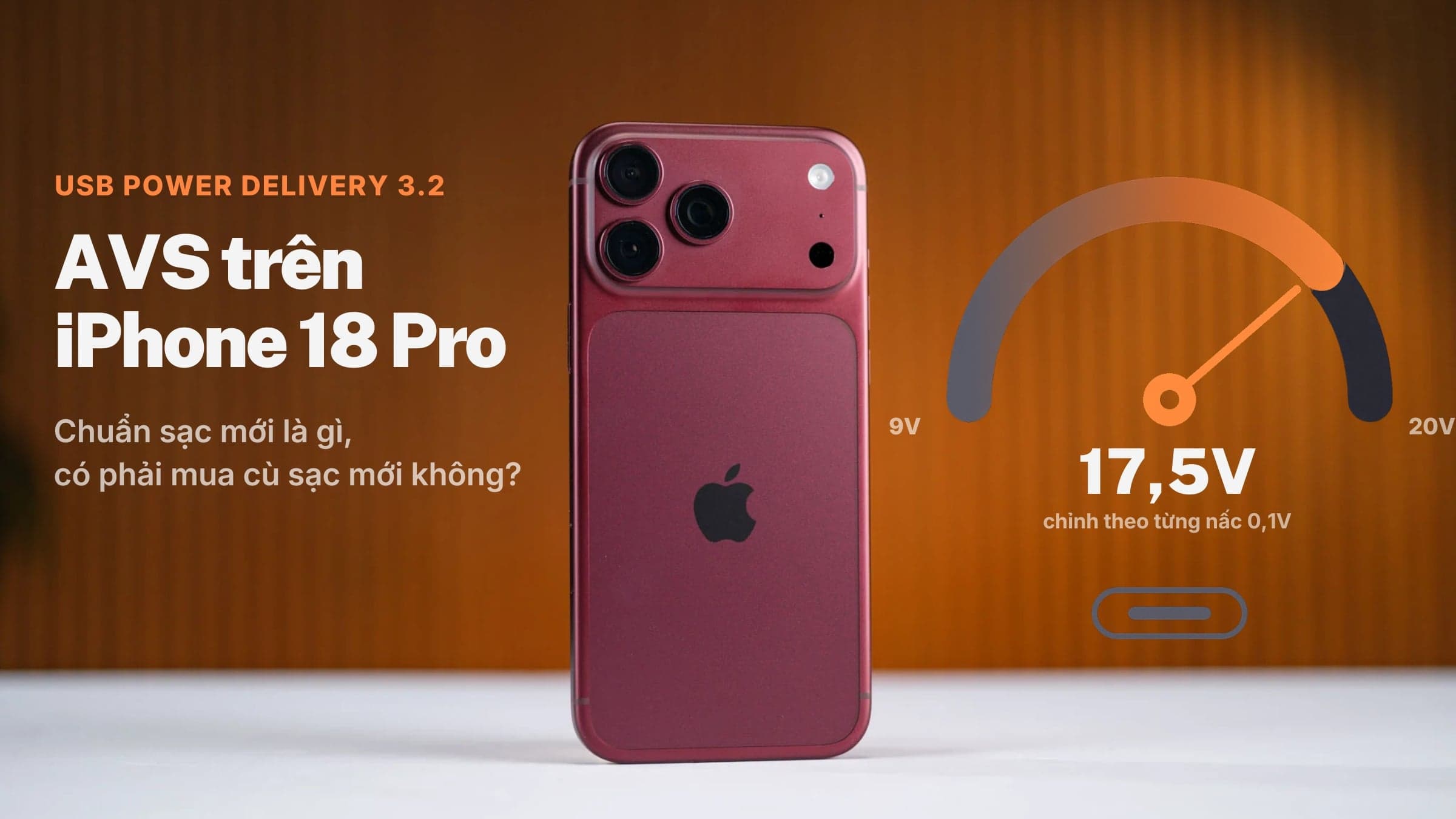
What is AVS on iPhone 18 Pro, do I need to buy a new charger?
Executive Briefing
Synthesized and verified with gemini-2.0-flash-thinking-exp
“Many users have become curious about this technology, so what exactly is AVS and how does it change”
Key Takeaways
- 1.Many users have become curious about this technology, so what exactly is AVS and how does it change your charging experience?
- 2.Fast charging on phones is nothing new.
- 3.Samsung or Google have used PPS (Programmable Power Supply) in the USB Power Delivery standard for many years, Chinese companies have gone further with their own charging protocol of more than 100W.
Many users have become curious about this technology, so what exactly is AVS and how does it change your charging experience?
Fast charging on phones is nothing new. Samsung or Google have used PPS (Programmable Power Supply) in the USB Power Delivery standard for many years, Chinese companies have gone further with their own charging protocol of more than 100W. Apple is always slower and more cautious. Last year's iPhone 17 Pro needed about 20 minutes to reach 50%, this year is about 5 minutes faster but brings with it a new name that users must pay attention to when buying a charger, why?
What is AVS?
AVS (Adjustable Voltage Supply) is a dynamic voltage regulation mechanism introduced by USB-IF into the USB PD 3.1 (EPR range) and USB PD 3.2 (SPR range) standards. Unlike familiar fixed voltage levels such as 5V, 9V, 15V or 20V, AVS allows the voltage to change continuously with steps of only 0.1V (100mV). You can imagine this, instead of forcing the battery to "drink" exactly one glass of available water, be it 5V or 9V, now you can pour water at the exact level to the milliliter that the battery needs at that time.
This mechanism works based on the charger and the phone constantly negotiating with each other to adjust the voltage to match the battery's needs. According to nuvoltatech.com, the main purpose of this is to reduce energy loss due to the voltage conversion process inside the device, thereby helping the device stay cooler when charging. This is a marked difference from PPS (Programmatic Power Supply), which is also a pressurization mechanism but usually targets lower power levels. According to usb-guide.com, PPS and AVS are two completely different mechanisms, PPS cannot replace AVS, while grlps.com says USB PD 3.2 requires all chargers with a capacity over 27W to support AVS.
How does AVS run on iPhone 18 Pro/Pro Max?
iPhone 18 Pro and Pro Max are the first iPhone generation to require AVS for maximum charging speed. According to chongdiantou.com, this is the first time Apple has issued this technical requirement for its high-end device. Without this dynamic pressurization mechanism, the phone would be limited to a lower power level than with AVS.
Technically, iPhone 18 Pro/Pro Max uses the USB PD 3.2 SPR (Standard Power Range) standard combined with AVS, operating in the voltage range from 9V to 20V. One point worth noting is that this device only accepts SPR AVS, completely incompatible with EPR AVS (Extended Power Range) with voltage range from 15V to 28V. This means that even if you own extremely high-capacity chargers that support EPR, iPhone 18 Pro/Pro Max will still only negotiate and receive current within the SPR range.
The effectiveness from applying AVS is clearly shown through measurement data. According to charge-test.com, when using a charger that supports AVS, the peak capacity that the iPhone 18 Pro Max reaches is 52W, while if using a charger that does not support AVS, this number only stops at 43W. This difference is clearly shown in the user's waiting time. According to cultofmac.com, to charge from 0 to 50%, the device with AVS only takes about 15 minutes, 5 minutes faster than the 20 minutes without AVS. When fully charged to 100%, the time is shortened from more than 80 minutes to about 70 minutes.
The specific charging process is also recorded in detail by Chongdiantou, showing how the voltage changes dynamically with the battery level. During the first 9 minutes, the device maintains a peak power level of 52.9W, then gradually decreases to about 41W at the 15th minute and stabilizes at 40W until the 22nd minute. When the battery reaches 80%, the capacity drops to 25.6W at the 29th minute, then continues to drop to about 9W at the 46th minute when switching to 5V mode. Total time to fully charge the battery is 1 hour 12 minutes.
Maximum fast charging conditions
For iPhone 18 Pro or Pro Max to achieve maximum charging speed according to AVS standards, you need to make sure both ends of the connection wire meet certain requirements. According to support.apple.com, the mandatory condition is to use a USB-C cable capable of transmitting 60W or more combined with a USB-C charger that is also 60W or more and supports SPR AVS (comes with USB PD 3.1 or 3.2 standard). If either of these two elements is missing, the device will not be able to activate optimal fast charging mode.
The good news for those who just bought the device is that the USB-C cable included in the iPhone 18 Pro box is qualified to transmit 60W, so you don't need to bother looking for a new cable right away. However, most iPhone boxes often do not come with a charger and if you want to take full advantage of AVS, choosing the right charger is very important. Apple currently sells the 40W Dynamic charger separately for $39. This charger is capable of providing a maximum capacity of 60W and supports SPR AVS. This is the simplest genuine option for you to fully experience this feature.
Advertisement
The interesting thing is that high capacity does not necessarily mean faster charging speed without the AVS standard. According to measurements by zeerawireless.com, when using a 140W charger that does not support AVS, the time to charge from 0 to 50% battery is 17 minutes and to 80% is 32 minutes. Meanwhile, the 60W charger that supports AVS is faster, taking only 15 minutes to reach 50% and 29 minutes to reach 80%. This difference shows that optimizing the voltage and current across the AVS protocol is more important than simply increasing the input power.
LTT Labs also verified this when testing with a UGREEN Nexode 140W charger using PD 3.1 EPR standard but without SPR AVS. The results show that the iPhone 18 Pro is "caught" down to 15V/2.5A, the total capacity is only about 40W and the charging time is about 1 to 2 minutes slower than Apple devices with AVS.
Similarly, some measurements published on forums.macrumors.com show that when using an Anker 65W Nano II that supports PD 3.0 and PPS but does not have AVS, the device cannot activate this mode and the peak power only reaches about 43W. These cases remind you that when investing in charging accessories for iPhone 18 Pro, prioritize devices with SPR AVS support certification instead of just looking at the wattage number on the packaging.
Compatible with third-party chargers and devices
Support for the AVS standard is not limited to genuine accessories from Apple but has spread to many third-party accessory brands on the market. According to data from chongdiantou.com, there are currently more than 25 charger models tested and confirmed to be able to activate AVS mode on iPhone 18 Pro Max, with power ranges ranging from 45W to 160W. Familiar names such as UGREEN (with some specific models), Innergie, Nuvolta and Apple all have products integrating this technology, showing that the standardization trend is happening quite quickly in the accessories industry.
However, you need to be very careful when reading the specifications printed on the packaging or charger body, because not all bulbs marked "AVS" are compatible with iPhone 18 Pro. According to charge-test.com, there is quite a common confusion between two different AVS standards: one is SPR AVS (for phones, low voltage) and the other is EPR AVS (for high-power laptops, voltage 15-28V). Many chargers simply labeled "AVS" are actually using the PD 3.1 EPR standard, which is completely incompatible with the iPhone. To be sure, look for the words "SPR AVS" or "USB PD 3.2 AVS" on the product, this is a mandatory condition for the device to recognize and activate maximum fast charging.
Advertisement
Another practical problem is that the majority of 65W USB-C chargers widely sold on the market currently do not support AVS, according to reviews from cultofmac.com. This means that if you own a 65W charger purchased 1-2 years ago, there is a high possibility that it will not be able to achieve the maximum charging speed on the iPhone 18 Pro/Pro Max, even though the nominal capacity is large enough. This requires users to check their existing accessories before deciding to buy more, avoiding the case of buying an expensive new charger but not taking advantage of the full potential of the new charging standard on the device.
For other mobile devices such as power banks, the current situation is still in the early stages. According to charge-test.com, only a few high-end backup battery models have begun to support AVS, while the vast majority of popular products are still using old charging standards such as PD 3.0 or PPS. If you have the habit of charging externally with a backup battery, finding a battery that supports SPR AVS may be more difficult and more expensive than buying a wall charger, because the market for mobile accessories is often a step slower than fixed accessories.
Do users need to buy a new charger?
The short answer is not required, but depends on what type of charger you are using and what charging speed you want. If you are using low-power chargers like 20W or 30W, the iPhone 18 Pro can still charge normally, just the speed will be slower.
In case you own a charger of 40W or more but does not support AVS, the situation is not too bad. According to cultofmac.com, these chargers still help the iPhone 18 Pro reach a charging level of about 43W, enough to fully charge 50% of the battery in 20 minutes. Compared to the speed when using AVS, it only takes about 5 minutes more to reach the same capacity.
However, if your goal is to achieve 50% battery in 15 minutes, you must use a charger of 60W or higher that supports SPR AVS with the corresponding charging cable, according to instructions from support.apple.com.
One point to note is that you do not need to buy too high capacity chargers like 100W or 140W, because according to zeerawireless.com, a 60W charger with AVS will be faster than a 140W charger without AVS.
Attribution & Original Source
Synthesized and verified from Tinhte.vn. All copyrights and intellectual property belong to the original publication.