Windows 11 turns out to run with just 128MB of RAM, 32 times less than Microsoft's minimum requirement
Executive Briefing
Synthesized and verified with gemini-2.0-flash-thinking-exp
“**A programmer has just pushed Windows 11 26H2 to an unbelievable limit, making the operating system”
Key Takeaways
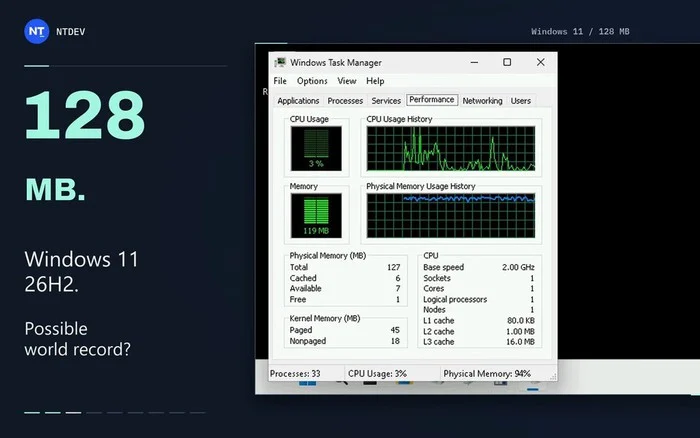
- 1.**A programmer has just pushed Windows 11 26H2 to an unbelievable limit, making the operating system that requires a minimum of 4GB of RAM operate with a memory capacity even lower than many early smartphones.** NTDEV, the programmer behind the Tiny11 project, claims to have successfully booted Windows 11 26H2 on a system with only 128MB of RAM.
- 2.This is equivalent to 3.125% of the minimum 4GB RAM that Microsoft offers, or exactly 32 times lower.
- 3.Notably, the reduced version of Windows can still load the Desktop interface, open File Explorer, access the Start menu and run the classic Notepad application.
A programmer has just pushed Windows 11 26H2 to an unbelievable limit, making the operating system that requires a minimum of 4GB of RAM operate with a memory capacity even lower than many early smartphones.
NTDEV, the programmer behind the Tiny11 project, claims to have successfully booted Windows 11 26H2 on a system with only 128MB of RAM. This is equivalent to 3.125% of the minimum 4GB RAM that Microsoft offers, or exactly 32 times lower.
Notably, the reduced version of Windows can still load the Desktop interface, open File Explorer, access the Start menu and run the classic Notepad application. NTDEV posted a video recording the testing process, showing the operating system actually working instead of just stopping at the boot screen.
Can run but "painfully slow"
The Windows 11 version in testing has had a series of components, drivers, and background services removed to reduce memory usage as low as possible. NTDEV has not published a complete list of the components that have been disabled, but this method is built on years of testing with streamlined versions of Windows.
Although it is possible to access the Desktop and open some basic applications, NTDEV itself admits that the system operates "painfully slow". So this is mainly a technical demonstration to explore the limits of Windows 11, not a practical solution for reviving computers with only a few hundred megabytes of RAM.
The results also do not mean that a regular machine can install Windows 11 with 128MB of RAM. When fully restoring drivers, security features, background services, and software compatibility, the amount of memory required increases significantly.
Continuously pushing Windows 11 to unbelievable limits
This is not the first time NTDEV has tested Windows 11 on extremely low configurations. In 2023, this programmer started the operating system with 176MB of RAM by drastically cutting down on system components, using the IDE storage interface to limit the number of drivers and eliminating the standard Desktop environment.
In another project, NTDEV also shrunk the entire Windows 11 installer to 699,811,840 bytes, just enough to fit on a CD-ROM. The test build created with the Pico11 tool still has a Desktop interface and can run applications such as Calculator, Settings, Notepad and Paint.
Pico11 testing was conducted on a virtual machine with 4GB of RAM, of which the operating system used about 883MB after booting. This number is more realistic than 128MB, but the Windows version still has to trade off many components compared to a standard installation.
Projects like Tiny11 and Pico11 show that Windows can be cut very deeply while still retaining some core functionality. However, removing drivers, services, and system components entails poor performance, limited compatibility, and many security risks, making them more suitable for testing purposes than for everyday use.