ChatGPT knows how to make GIFs: from Muybridge's galloping horse in 1878 to CompuServe's 39-year-old format
Executive Briefing
Synthesized and verified with gemini-2.0-flash-thinking-exp
“On November 4, 2026 (US time), this morning November 5 Vietnam time, OpenAI introduced Images 2.6, a”
Key Takeaways
- 1.On November 4, 2026 (US time), this morning November 5 Vietnam time, OpenAI introduced Images 2.6, a new version of the image creation model in ChatGPT, Codex and API.
- 2.The most notable feature is not speed, but something very "nostalgic": ChatGPT can now create animated GIFs.
- 3.You just need to type a command or upload a photo, then adjust the running speed, view and edit each frame, and share with others.
On November 4, 2026 (US time), this morning November 5 Vietnam time, OpenAI introduced Images 2.6, a new version of the image creation model in ChatGPT, Codex and API. The most notable feature is not speed, but something very "nostalgic": ChatGPT can now create animated GIFs. You just need to type a command or upload a photo, then adjust the running speed, view and edit each frame, and share with others.
According to The Verge, before this update ChatGPT could not automatically create GIFs in one step. The example OpenAI gives is the command "can you make a gif of a cat dancing?" (make me a GIF of a dancing cat), with a speed button and frame-by-frame viewing mode. OpenAI suggests uses such as making moving brand mascots, reaction photos and memes for social networks, or animated storyboards to test character movements before recording a video. Images 2.6 is being rolled out to all subscriptions on web, desktop and mobile, although Decrypt said it was rolling out gradually so when they tried it, accounts did not have this feature yet.
In addition to GIFs, OpenAI says Images 2.6 creates images 50% faster than before. There are two models in the API: GPT-Image-2.6 Flare, which is more about speed, can produce images in just about 6 seconds at low quality, and GPT-Image-2.6 Sunburst gives more detailed images, keeping characters and products more consistent across multiple edits. The API also has the ability to mark areas that need to be corrected on images, export SVG files, and a "complexity" parameter to determine how carefully the model will "plan" a request. ChatGPT users can also save reference photos of themselves, pets or characters to reuse without having to upload them again. The most notable number: according to OpenAI, users create 4 billion images per week across ChatGPT, Codex, and API, an average of more than half a billion images per day, up from the 3 billion images per week the company reported in September.
There is a small but interesting technical detail in OpenAI's introduction page itself. A sample command tells the model to draw "a single sprite sheet for a seamlessly looping GIF": exactly 6 consecutive frames, arranged in a 3-column, 2-row grid, read from left to right then top to bottom, all cells the same size, fixed camera angle, and the sixth frame must transition smoothly to the first frame. The Decoder site explains that ChatGPT creates many slightly different variations of the same character, then reassembles them in flipbook style. The difficulty lies in consistency: previous models would have had the character change too much between frames, causing this game to fail.
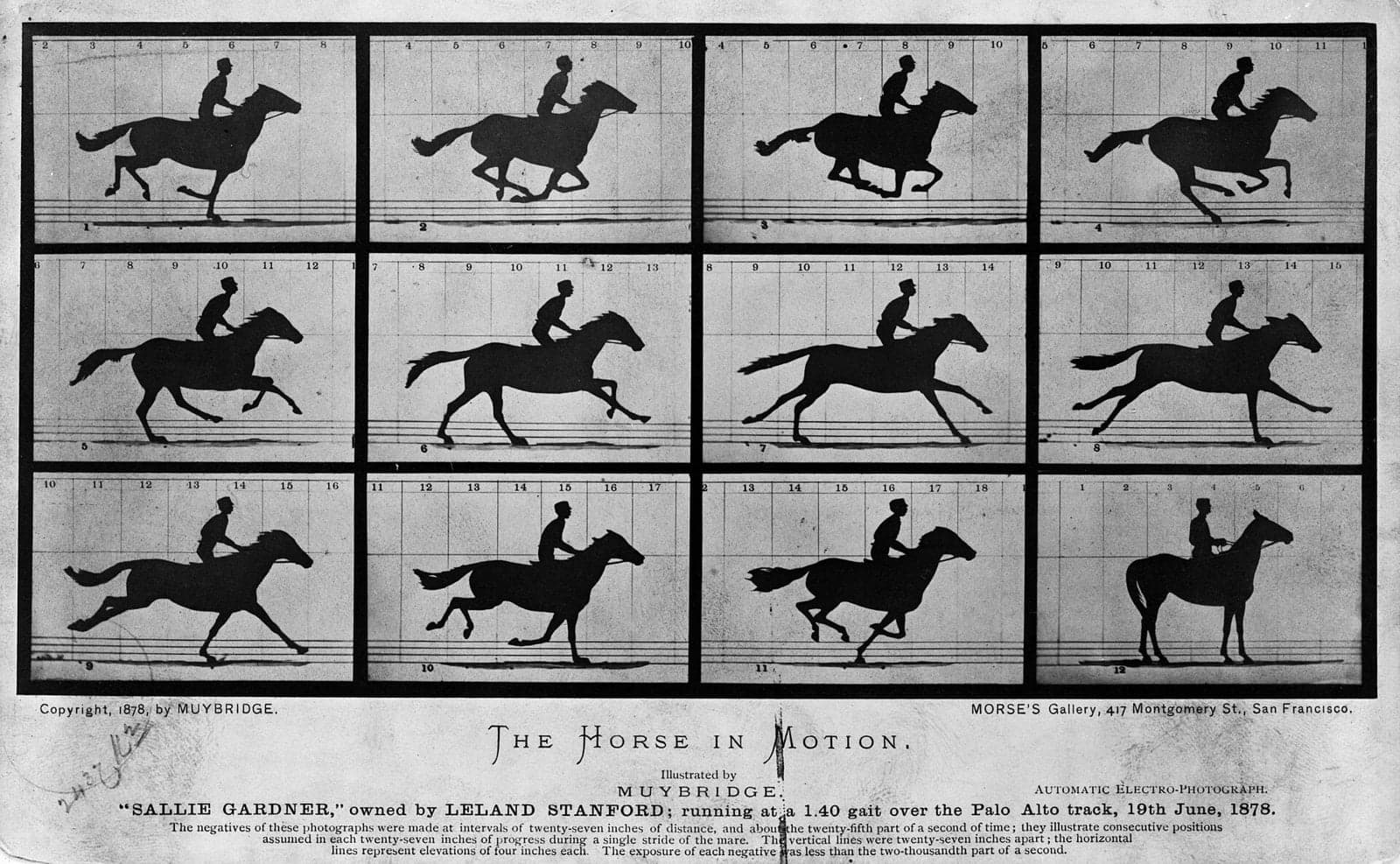
An evenly spaced grid, each cell representing a moment of movement, read from left to right. If that image looks familiar to you, then yes: it is identical to a card printed in San Francisco nearly 150 years ago.
Eadweard Muybridge's "The Horse in Motion" card (1878): 12 frames of galloping Sallie Gardner horse, arranged in a grid exactly like a "sprite sheet" for today's GIF images
The story begins with an argument about horses. Leland Stanford, a railroad tycoon, former governor of California, and racehorse breeder, believed that the artists of the time all painted horses galloping incorrectly. According to Wikipedia, most oil paintings at that time depicted horses floating in the air, their front legs stretched forward, their hind legs stretched straight back, looking like a flying squirrel. Stanford wanted to use a camera to prove what he thought, and he hired photographer Eadweard Muybridge.
The first attempt in 1873 only produced a blurry photo. It wasn't until 1878, at Stanford's Palo Alto farm, that Muybridge built a proper system: 12 cameras lined up along the racetrack, behind a white background with lines and electric wires running across the road. As the wheel of the horse-drawn carriage rolled by, each wire was touched in turn, the circuit was interrupted and the shutter of each machine opened in turn, each time said to be only about 1/1000 of a second. On June 15, 1878, in front of the press, the horse Abe Edgington ran past; On June 19, it was the turn of the mare Sallie Gardner. The photos show that there were times when all four of the horse's legs actually left the ground, but when the legs were bunched together under the belly, not when they were straightened out like in the picture. A Sacramento newspaper at the time wrote that the "grace" of the galloping horse was actually an illusion, as the horse's legs were in all kinds of odd positions.
"The Horse in Motion" cards sold for $1.50 each, and the series became the first example of chronophotography. Some people even called the Sallie Gardner card "the world's first piece of cinema". But what's more remarkable is the way people prove those "weird" photos are real: they make them move.
The zoopraxiscope disc "A dancing couple" by Muybridge (1893), made in the style of a phenakistiscope disc: frames arranged around a circle, when rotated quickly, it will become a repetitive motion without stopping
Since 1880, Muybridge lectured with a "zoopraxiscope", a glass disc projector he made himself, on which photographs were drawn into shape. He was not the one who came up with this idea. According to Wikipedia, around December 1832, Belgian physicist Joseph Plateau and Austrian professor Simon Stampfer almost simultaneously invented the phenakistiscope, a cardboard disc with drawings arranged around the center and slits along the edge. The viewer turns the disc in front of the mirror and looks through the slit: the eyes combine the discrete images into one smooth movement. The name is a combination of Greek words, roughly understood as "to deceive the eye". The toy sold out immediately: Stampfer's first batch of plates sold out in four weeks. By 1867, the zoetrope, a rotating drum with a viewing slit, was patented and gradually replaced the phenakistiscope.
Wikipedia has a very good description of phenakistiscope: "like an animated GIF, it displays a short continuous loop". A short movement, no sound, no beginning or end, just repeating forever. That is the "grammar" of GIF images, which predates the GIF format by more than 150 years.
Advertisement
CompuServe's former headquarters building in Upper Arlington, Ohio, USA. The GIF format was born from CompuServe's engineering team in 1987
Now jump to 1987. CompuServe was then one of the major online services in the US, where users dialed in with a modem to read news, chat and download files. They needed a color image format for the file download area, instead of the old format of only black and white. On June 15, 1987, a team of engineers led by Steve Wilhite announced the Graphics Interchange Format, abbreviated as GIF. According to Wikipedia, each GIF image has a maximum of 256 colors, chosen from a palette of more than 16 million colors, a reasonable limit in a time when hardware that could display more than 256 colors at the same time was rare. To promote, CompuServe distributed free conversion tools for many different types of computers. By December 1987, Apple IIGS users were able to view images drawn on Atari ST or Commodore 64 machines.
What's interesting is that right from the first version, called 87a, GIF allowed multiple images to be contained in one file. Version 89a released in 1989 added the ability to set a timeout between images and a transparent background color. In other words, the GIF wasn't designed to be animated, but it just happened to have all the "ingredients": a stack of frames, plus a number saying how many hundredths of a second to wait before showing the next frame. The final piece of the puzzle comes from the browser. In September 1995, Netscape Navigator 2.0 added a separate data block, properly named "NETSCAPE2.0", to tell the browser how many times to repeat a sequence of frames, or forever. To date, nearly every browser understands this block even though it was never part of the official GIF specification. The phenakistiscope disc has a digital version.
Those of you who worked on the web in the late 90s probably still remember that golden age: moving "Under construction" icons and all kinds of decorative animations on personal websites. In 2016, Internet Archive also opened a search library of GIF images rescued from the GeoCities archive.
The 300 baud version of the Hayes Smartmodem was born in 1982. During those slow transmission times, GIF emerged thanks to the LZW compression algorithm that helped download color images faster
Advertisement
GIF popularized quickly for a very practical reason: it used the LZW compression algorithm, which was more efficient than other compression methods of the time, so sizable images could still load relatively quickly over slow modems. GIF also has an interlace mode: the image appears blurry first and then gradually sharpens, so that users see that the image is not exactly what they need, so they can immediately cancel the download to save time.
But it was LZW that almost killed GIF. This algorithm was developed by Terry Welch in 1983, based on the work of Abraham Lempel and Jacob Ziv, and was granted a US patent in December 1985, then belonged to the Unisys company. CompuServe chose LZW without knowledge of this patent. In January 1993, Unisys began licensing negotiations with CompuServe, and the agreement was announced on December 24, 1994. Programmers protested fiercely; A new format, PNG, was born in 1995 with the goal of replacing GIF. In 1999, when Unisys announced a one-time licensing fee of $5,000 or $7,500 for some websites, the League for Programming Freedom group launched the "Burn All GIFs" campaign. Yet GIF still survives, partly because PNG cannot make animated images. The LZW patent in the US expired on June 20, 2003, and in July 2004 it expired in all remaining countries.
There is another battle that has never been settled: is reading a GIF "gip" or "jip"? It was Steve Wilhite and his team that pronounced "jif", deliberately similar to the name of an American peanut butter company, and CompuServe employees often jokingly parodied the butter company's advertising line: "choosy programmers choose GIF". When accepting Webby's Lifetime Achievement Award in 2013, Wilhite publicly rejected the hard G, and that speech prompted more than 17,000 Twitter posts and dozens of articles. According to Wikipedia, he once said that the Oxford dictionary accepts both readings, but "they are wrong. It's a soft G, pronounced 'jif'. End of story." However, surveys show that the "gip" reading with a hard G is still more popular. Steve Wilhite passed away on March 14, 2022, at the age of 74.
By the 2010s, GIFs entered a second life, no longer a web decoration but a form of language. In 2012, the American version of the Oxford Dictionary chose "GIF" (used as a verb) as its word of the year, noting that GIFs have become a tool with both serious applications in research and journalism. In February 2013, Giphy was born as a GIF search engine; By October 2016, they said they were serving more than 1 billion GIFs per day. Facebook officially supported GIFs in May 2015. In 2020, Facebook agreed to buy Giphy for a reported price of $400 million, but the British competition authority forced Meta to sell it, and Shutterstock bought Giphy in 2023 for $53 million.
The irony is that most of the "GIFs" you see every day are no longer GIFs. Imgur since 2014 has converted uploaded GIFs to H.264 videos with the extension ".gifv", Telegram since 2016 converted GIFs to MPEG-4 videos which they say takes up to 95% less space for the same quality. In 2022, The Atlantic magazine also wrote an article titled "GIF is on a hospital bed". The 256-color format created for dial-up modems was clearly unsuitable for a million-color display, but the name "GIF" escaped the file format to become the generic name for any short, repetitive, soundless piece of motion.
That's probably why OpenAI chose the word "GIF" and not "short video". According to The Next Web, this feature comes a few months after OpenAI shut down its Sora video app in March. GIFs are a much smaller problem than videos: a few frames, no sound, no story, just the character keeping the same look from frame to frame. But that very requirement of "keeping the same appearance" is what image generation models used to do very poorly, and is also the point that OpenAI emphasizes the most in Images 2.6.
You should also note a few things. The numbers of 4 billion images per week or 50% faster are all self-published by OpenAI, and The Next Web notes that the 4 billion figure applies to all types of images, not just GIFs. The feature is gradually opening up so not everyone can use it right away. And when creating an animation only takes one command, the familiar arguments about character copyright or animation impersonating real people will certainly return.
In 1878, Muybridge needed 12 cameras, a whitewashed racetrack, electrical wiring and a tycoon to pay to record 12 moments of a horse. In 1987, a group of engineers in Ohio needed to compress images so small they could be downloaded over phone lines. In 2026, the command "make me a jumping cat" will be enough. The tools change imperceptibly, but what people want to see is almost the same: a short moment, moving, and repeating over and over again.
Do you read it as "gip" or "jip"? And are you planning to ask ChatGPT to make a GIF to drop in the comments?
Source:
OpenAI
,
OpenAI Developer Community
,
The Verge
,
The Decoder
,
The Next Web
,
Decrypt
,
TestingCatalog
,
Wikipedia (GIF)
,
Wikipedia (Steve Wilhite)
,
Wikipedia (The Horse in Motion)
,
Wikipedia (Phenakistiscope)
,
Wikipedia (Giphy)
Attribution & Original Source
Synthesized and verified from Tinhte.vn. All copyrights and intellectual property belong to the original publication.