The author of 'online temple' stirs up the internet with 30 minutes of AI programming
Executive Briefing
Synthesized and verified with gemini-2.0-flash-thinking-exp
“# The author of 'online temple' stirs up the internet with 30 minutes of AI programming Although no”
Key Takeaways
- 1.# The author of 'online temple' stirs up the internet with 30 minutes of AI programming Although not a technical expert, Park Jin-won, 26 years old in Korea, only took 30 minutes to create Sansa, a virtual temple that caused a fever with more than a million participants, thanks to vibe coding using AI.
- 2.At Sansa Temple, visitors can perform 108 prostrations, pray rosaries and pray without getting out of bed.
- 3.This is a virtual temple, operating online so users can participate from anywhere, at home, company or coffee shop.
Although not a technical expert, Park Jin-won, 26 years old in Korea, only took 30 minutes to create Sansa, a virtual temple that caused a fever with more than a million participants, thanks to vibe coding using AI.
At Sansa Temple, visitors can perform 108 prostrations, pray rosaries and pray without getting out of bed. This is a virtual temple, operating online so users can participate from anywhere, at home, company or coffee shop.
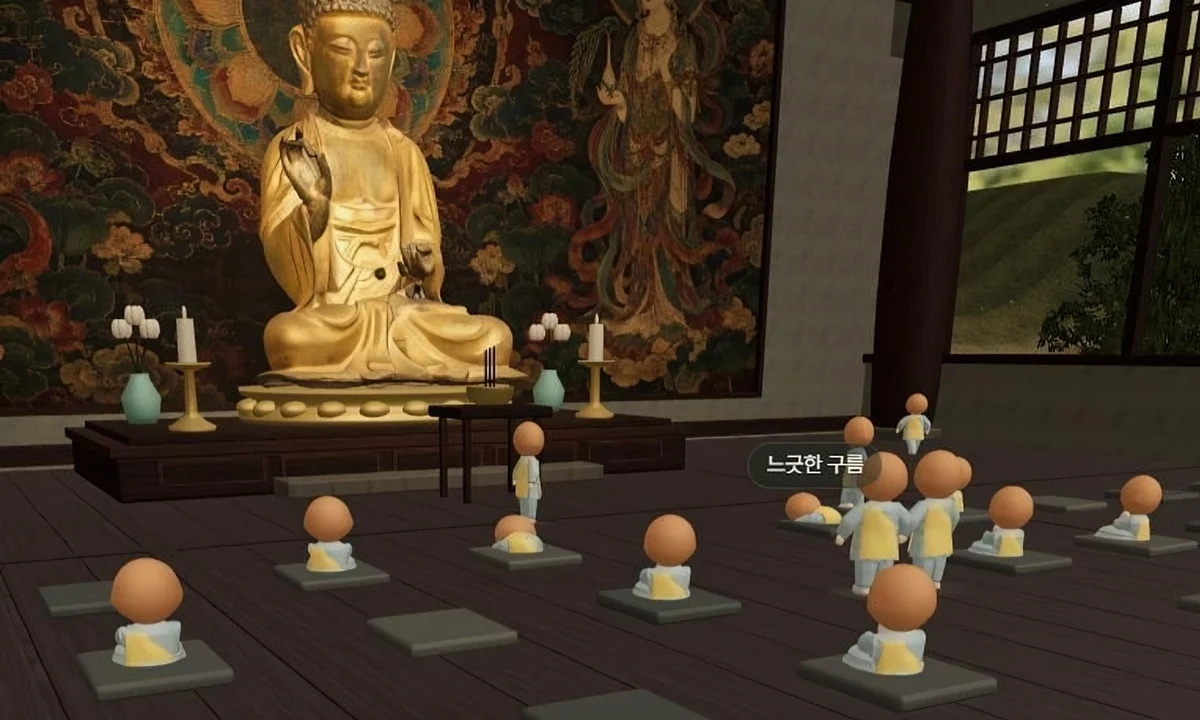
When accessing the website, they will walk straight to the Buddhist temple hidden in the dense forest, with a large Buddha statue placed in the main hall. Each person is given an avatar that looks like a monk, with a randomly assigned name like Lady Cloud or Soft Moonlight. Through avatars, users can walk around the temple, clasp hands to greet each other, kneel on cushions to bow, listen to chanting, creating a similar experience when going to the temple in real life.
According to Herald Business, Sansa launched on October 29, attracting 600,000 visitors in three days and surpassed one million visitors on November 1. Due to the large number of visitors, the number of virtual cushions increased from the initial 20 to 10,000, and the server even crashed due to overload.
Originally a Korean platform, after being shared on social networks, Sansa continued to attract participants from all over the world. The island of Taiwan, which is predominantly Buddhist, records 50,000 visits a day. Many Southeast Asian users such as Vietnam and Thailand also flocked.
The explosion was completely beyond the expectations of author Park Jin-won, a 26-year-old man who graduated in English Literature. Without studying information technology, Park was still able to quickly build an online temple thanks to vibe coding.
Vibe coding is the term for "writing code based on feeling" with the help of AI, not focusing on structure or details, as long as the product works. In it, users give commands to the chatbot using natural language to describe the software's functions, instead of having to type each line of code. The AI will generate code based on the description and continue to edit as required until the expected result is achieved.
To create Sansa, Park said, he described what he wanted to OpenAI's Codex tool and had the first working version in about half an hour. OpenAI first introduced Codex in 2021, and in mid-2025, the company launched the Codex programming agent with the ability to handle multiple technical tasks at the same time. Earlier this year, the company continued to release the Codex application for computers.
In February, OpenAI said Codex attracted more than 5 million weekly active users. Although programmers are still the largest group, other knowledge workers also account for about 20% of total users and are growing three times faster. They primarily use Codex to create reports, spreadsheets, presentations, contracts, and other work products. They also use tools for research, analyze data, automate workflows, and build lightweight tools that previously required technical support.
Park said Codex makes it easy to create a relaxing space online while busy and tired of looking for work. Although he is not a Buddhist, he wanted to spend an afternoon at the temple to rest, but did not have the time or energy.
"The large number of people responding made me realize there are many people who are as tired as me. Maybe what they really need is a quiet place to rest without having to say anything," Park explained.
Unlike most online spaces, Sansa does not have chat or texting features, allowing people to join the same prayer location without interacting with each other.
Sansa's success inspired similar platforms to spring up, especially when building an online space became easy thanks to AI. For example, the Chanmi virtual Catholic church has pews, prayer candles, and rosaries. Visitors can listen to traditional hymns, while the Angelus bells ring three times a day at 6am, 12pm and 6pm. Another platform, Goyottul, recreates a Protestant church where visitors can share prayers and listen to sermons.
Despite its many benefits, emotional programming also raises concerns that it will turn the software engineering profession upside down. According to Julian Togelius, professor of computer science and engineering at New York University, the definition of "software developer" has changed when moving from programming and writing syntax to designing and managing. Meaning, they take on roles where judgment is more important than programming language.
Ryan J. Salva, senior product manager at Google, said that five years ago, the value of programmers lay in programming languages like Python or Java Script. "Today, that's no longer true," Salva told Business Insider. He believes the value of programmers now lies in deciding what products to develop, thinking about software at the architectural level, predicting problems as they arise.
Matt, a software engineer in the US, also had to change his skills when vibe coding appeared. He said that since the beginning of the year, his work has gradually shifted from writing code, solving problems and designing software architecture to testing and evaluating code created by AI. He shared with Guardian that before AI, he proactively deployed solutions, but now the line between his decisions and what AI provides "has become blurred".
Thu Thao summary