Meta FAIR Releases e-means Algorithm to Accelerate Data Clustering
Executive Briefing
“Researchers at Meta FAIR have released e-means, a new clustering algorithm that updates...”
Key Takeaways
- 1.Meta FAIR released e-means as a drop-in replacement for Lloyd’s k-means algorithm, shipped within FAISS version 1.16.0.
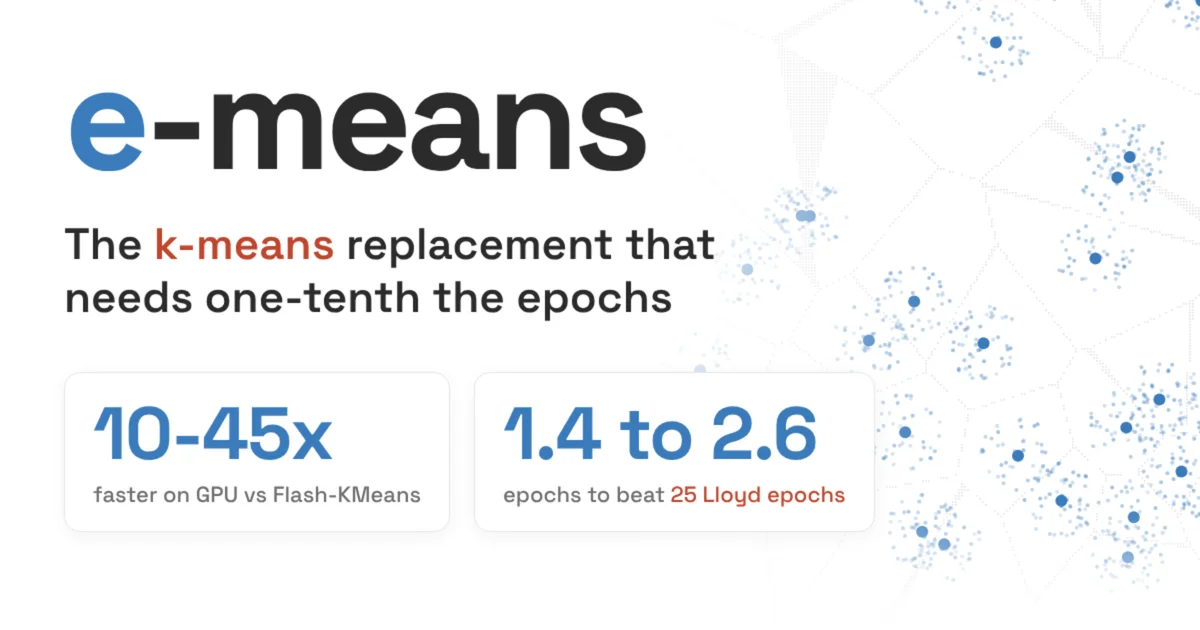
- 2.The clustering algorithm reaches the loss Lloyd’s k-means gets in 25 epochs in 1.4 to 2.6 epochs.
- 3.According to self-reported tests, e-means delivers a 10 to 45x GPU wall-clock speedup and an 8 to 15x CPU speedup over baseline implementations.
Researchers at Meta FAIR have released e-means, a new clustering algorithm that updates centroids using exponential moving averages to replace traditional Lloyd's k-means. The approach matches the loss of 25 traditional epochs in fewer than 3 epochs.
Key Developments and Technical Context
Meta FAIR released e-means as a drop-in replacement for Lloyd’s k-means algorithm, shipped within FAISS version 1.16.0.
The clustering algorithm reaches the loss Lloyd’s k-means gets in 25 epochs in 1.4 to 2.6 epochs.
According to self-reported tests, e-means delivers a 10 to 45x GPU wall-clock speedup and an 8 to 15x CPU speedup over baseline implementations.
Strategic Analysis and Industry Implications
Using exponential moving averages allows e-means to fade stale assignments and keep centroids tracking recent data without scanning the full dataset in every iteration.
Automated scaling laws eliminate manual hyperparameter tuning, streamlining the construction of large-scale vector indexes.
Outlook and Key Factors to Watch
The real-world performance of e-means across broader datasets outside the reported benchmarks remains to be independently validated.
Memory sharding requirements for extremely large datasets need further evaluation across diverse production environments.