Iron smelting: clay furnaces, charcoal and spongy iron blocks brought humanity into the Iron Age
Executive Briefing
Synthesized and verified with gemini-2.0-flash-thinking-exp
“According to Britannica, iron makes up about 5% of the mass of the Earth's crust, the fourth most af”
Key Takeaways
- 1.According to Britannica, iron makes up about 5% of the mass of the Earth's crust, the fourth most after oxygen, silicon and aluminum.
- 2.Yet humans used copper and brass for thousands of years before iron became a common metal.
- 3.The reason lies in the temperature: smelting iron from ore is much more difficult than copper, and it took a separate type of furnace for humanity to enter the Iron Age.
According to Britannica, iron makes up about 5% of the mass of the Earth's crust, the fourth most after oxygen, silicon and aluminum. Yet humans used copper and brass for thousands of years before iron became a common metal. The reason lies in the temperature: smelting iron from ore is much more difficult than copper, and it took a separate type of furnace for humanity to enter the Iron Age.
Metal falling from the sky
The oldest known iron objects are made from meteorite, a naturally occurring alloy of iron and nickel. According to Wikipedia, nine meteoritic iron beads found in tombs in Gerzeh, Egypt, dated around 3200 BC. Iron of this type is so rare that it is probably more expensive than gold. The Hittites in Anatolia, a region that is now part of Türkiye, used to exchange iron for silver with the Assyrians at the ratio of one part iron to 40 parts silver.
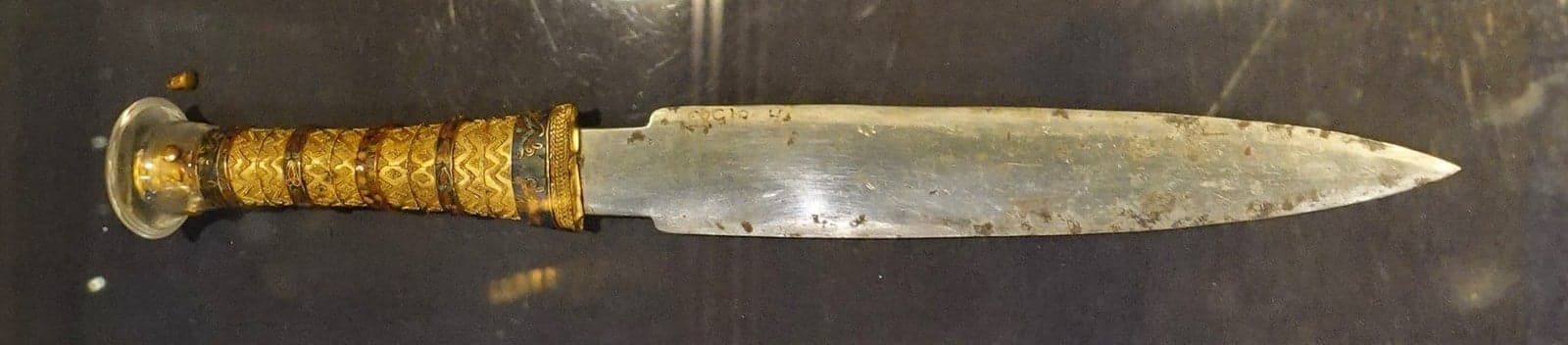
A golden-handled iron-bladed dagger found among the cloth wrapping the mummy of pharaoh Tutankhamun (died 1323 BC), displayed at the Egyptian Museum in Cairo. Iron at that time was rare and precious, mostly from meteorites
At the end of the Bronze Age, iron was still the preserve of kings. Pharaoh Tutankhamun's tomb had 19 meteorite iron items, including an iron-bladed dagger with a gold handle. To get iron cheap enough to make plowshares or sickles, people had to learn how to get it out of rocks.
The oven is not hot enough to melt iron
Copper melts at 1,085 °C, tin at only 232 °C, well within the capabilities of Neolithic furnaces. Pure iron flows at 1,538 °C. According to Britannica, ancient furnaces did not get hotter than about 1,150 °C, so smelters could not melt iron and then pour it into molds like casting brass. They had to find a way to separate the iron from the ore while it was still solid.
The solution is a bloomery type furnace. According to Wikipedia, this is a hole or chimney with walls made of clay or stone, near the bottom there is a wind pipe connected to the bellows. The smelter heats the furnace with wood and then converts it to charcoal, then pours crushed ore and additional coal from the mouth of the furnace, the total amount of coal and ore is usually approximately the same.
An ancient iron furnace reconstructed from clay, burning in a demonstration of ancient metallurgical techniques. Charcoal and ore are poured in from the mouth of the furnace
Coal burns without oxygen and produces CO gas. This gas removes oxygen from the iron oxide in the ore, leaving behind metallic iron even though the ore is not molten. Soil and rocks mixed in ore flow into liquid slag and settle to the bottom. Small iron particles fall and stick together to form a porous mass filled with slag, called bloom. According to Britannica, such a block can weigh up to about 5 kg.
Hammering and coal impregnation: from soft iron to steel
The sponge iron block cannot be used immediately. The blacksmith must heat and hammer many times to close the holes and push the slag out. The result is wrought iron, malleable but quite soft. The turning point is the charcoal infiltration technique. According to Wikipedia, blacksmiths in the Middle East discovered that heating a forged item in a layer of charcoal and then briefly dipping it in water or oil would turn the outer layer into hard steel, while the core remained ductile, less brittle iron. Wikipedia emphasizes that only when steel can be made, iron tools and weapons are stronger and lighter than brass.
The sponge iron block has just been taken out of the furnace, still bright red, about to be hammered to squeeze and push the slag out. Photo from an experimental archaeological project of Mary Washington University (USA) in 2006
Advertisement
The Legend of the Secret of the Hittites
It was once popularly assumed that the Hittites had a monopoly on the art of iron smelting, on which their imperial power rested, and when the empire collapsed at the end of the Bronze Age, the Sea Peoples carried the know-how across the region. According to Wikipedia, this idea is no longer accepted by researchers because there is no archaeological evidence. The number of Bronze Age iron objects in Anatolia is equivalent to that found in Egypt at the same time, and only a few of them are weapons. Early carbonaceous iron fragments were found in Kaman-Kalehöyük, Türkiye, in soil dating from about 2200 to 2000 BC, before the Hittite empire.
Why is iron cheaper than brass
Brass required copper and tin, while tin was scarce and had to be transported over great distances. Iron ore is available in many places. One theory is that upheavals at the end of the Bronze Age disrupted tin trade routes, forcing craftsmen to turn to iron, although Wikipedia notes there is no clear evidence of a tin shortage at that time. Whatever the cause, as technology spread and prices fell, wrought iron replaced cast brass.
According to Britannica, the Iron Age began in the Middle East and southeastern Europe around 1200 BC. Large-scale production of iron tools led to more permanent settlements, and iron weapons first came into the hands of the masses. Bloomery ovens were used for thousands of years. It wasn't until the 15th century that blast furnaces hot enough to melt iron appeared in Europe and gradually replaced it.
Source:
Britannica: Iron Age
,
Britannica: Iron processing, History
,
Wikipedia: Iron Age
,
Wikipedia: Ferrous metallurgy
,
Wikipedia: Bloomery
Attribution & Original Source
Synthesized and verified from Tinhte.vn. All copyrights and intellectual property belong to the original publication.