Note, MacBook users: macOS 28 will stop supporting a bunch of these apps
Executive Briefing
Synthesized and verified with gemini-2.0-flash-thinking-exp
“**The company still retains part of the translation tool for old games, but regular...”
Key Takeaways
- 1.**The company still retains part of the translation tool for old games, but regular...
- 2.**The company still retains part of the translation tool for old games, but regular...
- 3.**The company still retains part of the translation tool for old games, but regular...
The company still retains part of the translation tool for old games, but regular applications written specifically for Intel chips will no longer be opened.
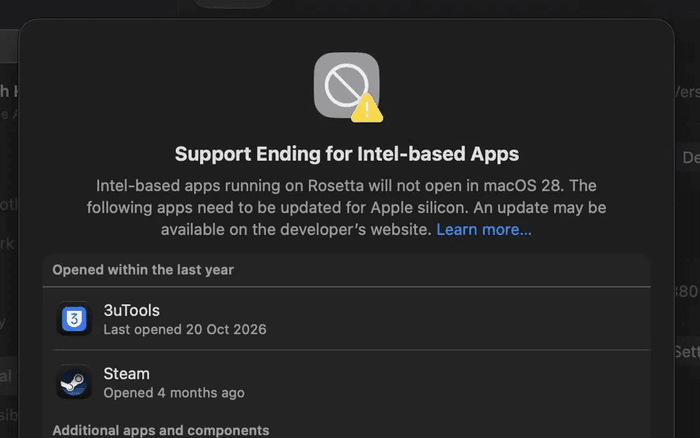
Apple confirms that from macOS 28, applications written specifically for Intel chips will no longer run on Macs using Apple silicon chips (M chip series) through Rosetta. Currently, macOS 27 still opens these applications normally, but comes with a warning that they will not be opened in the next version.
Rosetta is a tool Apple launched in 2020 to translate applications written for Intel chips into a form that can run on its own chips. According to Apple, Rosetta is designed to make the transition to Apple silicon easier. From macOS 28, this tool is only available for some older games that are not updated and rely on the system's Intel components.
This roadmap was announced in advance by Apple from June 2025. From macOS 26.4, users started seeing notifications when opening applications that still use Rosetta. On September 1, 2026, Apple sent a notice to developers, allowing Universal applications on the Mac App Store to drop Intel support. macOS 27 only runs on Macs with Apple silicon chips and does not have Rosetta pre-installed, the system will ask to install it when the user opens the Intel application for the first time. macOS 28 is expected to launch in the second half of 2027, Apple has not announced a specific date.
The point worth discussing is that this does not come from technical limitations. Apple itself said it would retain part of Rosetta for old games, meaning that M-chip Macs can still translate and run Intel code on macOS 28. Rosetta is not only a translator, but also relies on Intel version macOS system components to run applications. Keeping this part for the game shows that Apple chose to narrow the scope instead of completely abandoning the technology. Besides the end of the transition period, Apple has not stated any other specific reason.
This isn't the first time either. The original Rosetta, used to run PowerPC chip applications on Intel Macs, was removed from Mac OS
Apps marked "Universal" or "Apple silicon" are not affected. Users need to pay attention to applications that only have Intel versions, along with accompanying plug-ins, utilities or components that also use Rosetta: the main application may run native but a secondary component is still Intel. You can check in System Settings > General > About, click Details next to Intel-based Apps, or view the Kind column in the application information. Macs using Intel chips are not affected by this milestone, because macOS 26 is the last version that supports that model and Apple says these machines will still receive security updates for another 3 years.
Some developers have prepared early. Valve releases Steam running natively on Apple silicon from June 2025 through the test channel. macOS 27 is the last version that runs full regular Intel applications, and from macOS 28, applications that have not been updated by the developer will have to find a replacement.
Attribution & Original Source
Synthesized and verified from GenK. All copyrights and intellectual property belong to the original publication.