Mercedes-Benz reveals 3 new technologies: LED in the car window, hologram HUD and 800 V converter
Executive Briefing
Synthesized and verified with gemini-2.0-flash-thinking-exp
“Mercedes-Benz has just introduced three technologies in development, including an LED screen integra”
Key Takeaways
- 1.Mercedes-Benz has just introduced three technologies in development, including an LED screen integrated into the windshield to communicate with surrounding vehicles, a hologram HUD screen that turns the front windshield into a separate display surface for the driver and passengers, and a Power Converter that keeps the output voltage stable to 800 V regardless of whether the battery is full or empty.
- 2.The company emphasizes that these are research and development projects, not commercial features or plans to put them on mass-produced vehicles.
- 3.The first idea is to put LED display elements directly into the window, helping the car communicate with its surroundings.
Mercedes-Benz has just introduced three technologies in development, including an LED screen integrated into the windshield to communicate with surrounding vehicles, a hologram HUD screen that turns the front windshield into a separate display surface for the driver and passengers, and a Power Converter that keeps the output voltage stable to 800 V regardless of whether the battery is full or empty.
The company emphasizes that these are research and development projects, not commercial features or plans to put them on mass-produced vehicles.
The first idea is to put LED display elements directly into the window, helping the car communicate with its surroundings. They are pressed inside the laminated glass, so when not visible they are almost invisible and blend into the vehicle design.
Mercedes is testing two types of LED for two different purposes. Mini LED is suitable for large display areas such as the rear glass, can be a brake light, display warning symbols or traffic information for the vehicle behind. Micro LED provides high resolution, so it is suitable for small display areas that require sophisticated images, such as animation. Both only show content when needed, otherwise glass is still glass.
In the set of photos the company released, the rear window can warn when the car brakes suddenly, when there is an accident ahead or when the car is entering a parking space, in addition to having signs for pedestrians crossing the street or reminders to keep distance. In the side window, a small screen displays personalized information such as weather, charging status, messages or digital parking time cards. The biggest value here is that the car has an additional visual communication channel with people around, instead of just looking at the taillights.
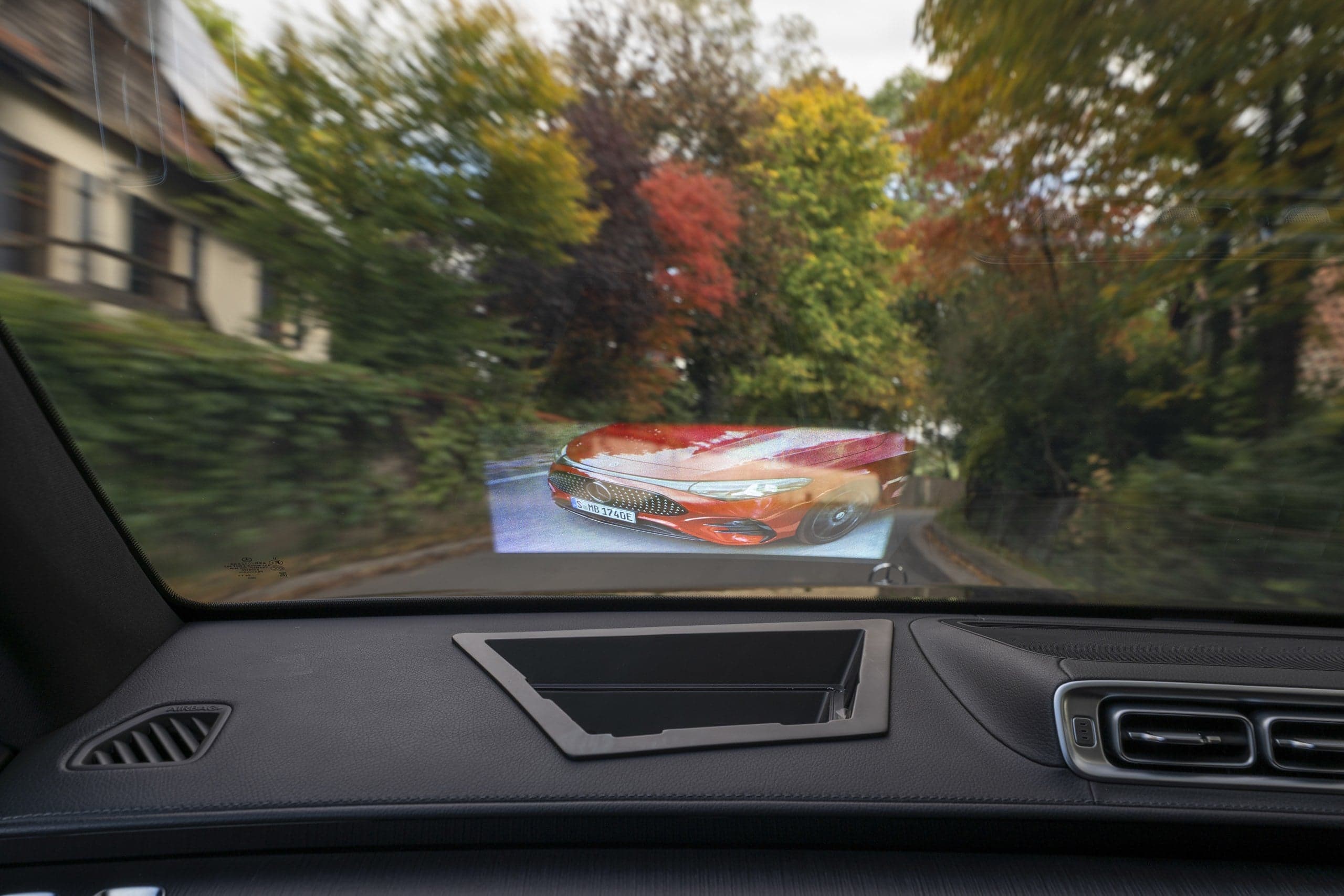
With the second technology, instead of the usual HUD, Mercedes uses completely new technology to provide visibility like an LED screen.
How it works: a projector placed in the dashboard projects content onto the windshield. Inside the glass is laminated with a special transparent film, using hologram optical elements (HOE, short for holographic optical elements). This layer of film only selectively reflects the wavelengths of light emitted by the projector, while gathering the light and directing it towards the viewer's eyes. Thanks to that, the image remains clear even in sunlight.
The special point is that the image can only be seen from certain angles. The driver does not see the content being displayed on the passenger side, and vice versa. Therefore, the same glass panel can display many types of content, from driving information, navigation, information about points of interest (POI) along the road to video calling or watching movies. The screen is also not permanently lit, but only appears when needed, so the windshield can be used depending on the situation without permanently changing the vehicle's appearance.
A third technology is less eye-catching but could have a profound influence on how electric vehicles are designed. Mercedes' Power Converter uses programmable micro-converters to control the energy flow of each battery cell, thereby providing a stable high-voltage output of up to 800 V, regardless of charge level or aging level of the cells.
In a conventional battery pack, the voltage of the entire block depends on the number of cells connected in series. With Power Converter, multiple converters are connected in parallel right at the cell or cell group level. Each unit self-regulates its own energy flow, then together create a stable high-voltage DC voltage. According to Mercedes, the output voltage is then no longer directly determined by the number of cells in series, but by the distributed converters and the software that controls them. Thanks to that, the high voltage voltage is almost separated from the battery architecture, while the total capacity can be adjusted according to the requirements of each vehicle.
The current generation reaches a maximum output of 3 kW and supports both AC and DC applications. This technology also aims for two-way charging, such as supplying power from the vehicle to the home (Vehicle-to-Home) or to the grid (Vehicle-to-Grid). According to the company's graphic materials, each group of cells can be controlled and charged independently, cell types with different chemical compositions can be combined, and depending on the configuration, the voltage can exceed 800 V.
Advertisement
In the long term, Mercedes believes that Power Converter can combine many functions currently performed by separate components into a single hardware block, helping batteries and power electronics to be designed more flexibly, efficiently and compactly. This can improve range and performance, and help modularize the powertrain for both pure electric and plug-in hybrid vehicles. The company revealed this research direction in November 2024, then stopped at the results showing that it can maintain a stable voltage of 800 V.
All three technologies are introduced as part of Mercedes-Benz's 140th anniversary year of innovation. The company clearly states that these are not features for customers or announcements about being put on mass-produced vehicles, so there is no specific timeline or model. However, I see the direction quite clearly: car glass is gradually becoming a display and communication surface, and high-voltage systems are increasingly software-defined.
Source: Mercedes-Benz
Attribution & Original Source
Synthesized and verified from Tinhte.vn. All copyrights and intellectual property belong to the original publication.


