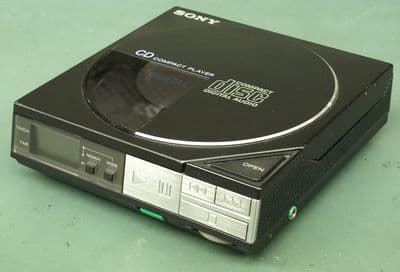
Sony D-50 (1984): the first portable CD player, as small as four disc boxes, priced less than 1/3 of the CDP-101
Executive Briefing
Synthesized and verified with gemini-2.0-flash-thinking-exp
“In 1984, CDs were only two years old and were still a luxury item.”
Key Takeaways
- 1.In 1984, CDs were only two years old and were still a luxury item.
- 2.Sony's first CD player cost 168,000 yen and was a desktop device, attached to a home stereo.
- 3.In November of that year, Sony launched a square machine only the size of four stacked disc boxes, priced at 49,800 yen.
In 1984, CDs were only two years old and were still a luxury item. Sony's first CD player cost 168,000 yen and was a desktop device, attached to a home stereo. In November of that year, Sony launched a square machine only the size of four stacked disc boxes, priced at 49,800 yen. It was the D-50, the world's first portable CD player, the machine that laid the foundation for the later Discman line.
Sony D-50 launched in November 1984, the world's first portable CD player. Square body, glossy black lid, silver metal front panel
Good CDs but expensive
The CD was jointly developed by Sony and Philips. On October 1, 1982, Sony sold the CDP-101 in Japan, the world's first commercial CD player, with a list price of 168,000 yen, about 730 USD at the exchange rate at that time. According to an article about the history of Japanese electronics on Icom's Beacon site, CDs at that time also cost 3,500 to 3,800 yen per disc, more expensive than vinyl records. Although companies tried to promote the quality of digital sound, high prices made CDs slow in popularity.
The CDP-101 (1982), Sony's first commercial CD player, is kept by the Leonardo da Vinci Museum of Science and Technology in Milan (Italy). Launch price in Japan is 168,000 yen
Wikipedia called Sony's price reduction effort at that time the CD CD project, short for Compact Disc Cost Down. Engineers improved the CDP-101 design, reducing components and reducing power consumption. The next goal is a smaller CD player so everyone can listen to digital music.
A block of wood to make a mold
Sony's product history page recounts that the general manager of the Universal Audio department at that time gave employees a 13.4 cm square block of wood, about 4 cm thick, the size of four CD cases, and asked them to make it make sound. To fit the disc reading mechanism into that size, engineers reduced the number of components and power, coordinated with other departments to develop a single LSI chip that takes on many functions, and at the same time made the optical reader cluster smaller and thinner.
Lid viewed from top: words CD Compact Player, Compact Disc Digital Audio logo and OPEN button in the corner. Early models were not named Discman
According to Wikipedia, the D-50 has all the functions of the CDP-101, only lacking the remote control and repeater function. The first units produced were called CD Compact Players, just like the words printed on the lid. The name Discman was used later because the device was portable and resembled a Walkman that played cassette tapes.
Details of 1984
- Launched: November 1984 in Japan, code D-50, and in some markets D-5.
- Price: 49,800 yen, about 350 USD in 1984, less than a third of the CDP-101 price.
- Size and weight: about the size of four CD cases, weighs 590 g according to Sony.
- Power source: the camera body has no battery, only the 9 V port on the back. Users purchase an additional AC-D50 power adapter attached to the back of the device, with two additional RCA audio output ports, or a removable battery pack.
- Controls: buttons are located on the front, next to the small LCD screen displaying song number and time.
Front of D-50: LCD screen indicating song number and time, two REMAIN and MODE buttons, large Play/Pause key, two song change keys, Stop key, blue power switch and volume wheel
Advertisement
The design of the D-50 is quite neat. The glossy black lid takes up almost the entire top, printed with a large circle the size of the disc inside. All buttons are concentrated on the silver metal front, lined up like a miniature tabletop disc player. Press the OPEN button in the corner, the cover pops up to replace the disc. In different power grid areas, the AC-D50 power adapter can be used with 110, 120, 220 or 240 V power.
The D-50 lid opens to reveal a CD placed on the spindle. According to Sony, the size of the device is only about four stacked CD cases
The machine that turns the tables
According to Sony, the D-50 became a huge seller, accelerating the popularity of CDs and leading to CDs surpassing vinyl records. Wikipedia notes that the device created an entire market for portable CD players, bringing down the prices of other brands' CD players and causing the number of CD players released to skyrocket. The article on Icom's Beacon page suggests that the price is only about a third of the first one, when mass production is not enough to lower the price, may be a strategic price to accept losses to sow the seeds for CDs.
Inside the D-50 when the circuit board is flipped up: the optical reader assembly is located on the slider, the part Sony made smaller and thinner to achieve the target size
Advertisement
After the D-50, Sony released the smaller D-50 Mark II and expanded the Discman line to many variants, from Video CD players to CD-ROM readers for computers. In 1999, the company made the D-E01 to celebrate the 15th anniversary of the portable CD player, equipped with G-Protection anti-shock technology. Since 2000, the name Discman was completely replaced by CD Walkman, and these machines stopped production in the early 2010s, when they were no longer popular. However, the D-50 is still listed by Sony as one of its product milestones, alongside the original Walkman TPS-L2.
Source:
Sony: Product & Technology Milestones, Personal Audio
,
Sony: Corporate History
,
Wikipedia: Discman
,
Wikipedia: Sony CDP-101
,
Icom Beacon: From gramophone to digital audio, episode 27
,
Studio RUM: Sony D-50 CD Compact Player
Attribution & Original Source
Synthesized and verified from Tinhte.vn. All copyrights and intellectual property belong to the original publication.