Sony Watchman FD-210 (1982): 33 mm thin pocket TV thanks to a picture tube with a tilted electron gun
Executive Briefing
Synthesized and verified with gemini-2.0-flash-thinking-exp
“In 1982, watching television was still a living room affair.”
Key Takeaways
- 1.In 1982, watching television was still a living room affair.
- 2.Three years after the Walkman brought music to the streets, Sony did the same thing with television: a black-and-white TV with a 2-inch screen, 33 mm thin, fits in one hand and runs on a small battery.
- 3.In Japan, it launched as the FD-200 and was called Flat TV.
In 1982, watching television was still a living room affair. Three years after the Walkman brought music to the streets, Sony did the same thing with television: a black-and-white TV with a 2-inch screen, 33 mm thin, fits in one hand and runs on a small battery. In Japan, it launched as the FD-200 and was called Flat TV. Overseas, it carried the code FD-210 and a more memorable name that Sony later used for the entire line: Watchman.
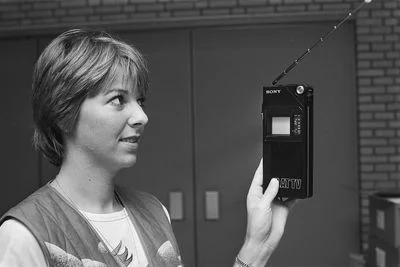
Sony's Flat TV pocket TV model was introduced at the Firato exhibition in Amsterdam on August 18, 1982. Photo: Hans van Dijk/Anefo, Nationaal Archief (Netherlands)
Start with a sketch
According to Sony's design history page, the device was made in a counter-intuitive way: designers drew the product's shape first, then engineers developed components to fit that sketch. A research document on Sony's design projects compiled by Morinaga Yasufumi said that the product was initially conceived as a tool for television program creators, but that market was small so the design team sought other needs. The proposal was opposed by the business department and was only commercialized thanks to the decision of senior leadership.
What makes the machine is a new style CRT picture tube. A conventional picture tube places the electron gun behind the screen, so every TV is thick. With Watchman, Sony placed an electron gun below the screen, shooting an electron beam at the glowing surface. Japan's Online Cultural Heritage Database records it as the world's first flat CRT, with the beam steered horizontally by a magnetic field and vertically by an electric field. Sony engineers published this design in an IEEE magazine in August 1982.
Close-up of the model at Firato 1982: 2-inch screen in the window frame, VHF/UHF channel tuning scale right next to it, adjustment knob in the upper corner and the words FLAT TV on the lower body
1982 numbers
According to Wikipedia and the Radiomuseum site, the device has the following main parameters:
- Dimensions 87 x 198 x 33 mm, weighs about 650 g. One actually measured in Japan weighs 675g with the battery installed.
- Monitor 2 inch (approximately 5 cm) flat black and white CRT.
- Receives waves VHF and UHF via retractable antenna, searches for channels using a knob with a digital scale printed next to the screen.
- Power 4 AA batteries or rechargeable batteries, with wall adapter included.
- Price 54,800 yen in Japan, 349.95 USD in the US.
In its list of first products, Sony called the FD-210 the smallest, lightest and thinnest TV in the world at that time. The body of the device is a vertical rectangular block, about the size of a walkie-talkie, with a small screen deep in the frame. The FD-210BE sold in Europe has a brushed aluminum front panel and a folding rear kickstand.
The Watchman FD-210 with metallic silver front, screen deep in the frame and retractable antenna in the upper corner
Sold out during Christmas season
Wikipedia records that the machine was widely introduced in Europe and North America around 1984, but American press reports showed that the first batches were on shelves at the end of 1982. In early December 1982, the Washington Post reported that buyers in New York were jostling to buy the first 1,000 units at Bloomingdale's store. TIME magazine in the early January 1983 issue wrote that Sony had sold out all 10,000 units imported to the US, distributors did not have enough to deliver, and the Japanese bought more than 5,000 units per month. Neiman Marcus chain said the machine was sold out in all 18 stores.
Advertisement
According to TIME, Sony expects users to take the device to the beach, to the stands to watch replays of situations, or watch TV series during breaks. In the same article, University of Miami psychology professor Jack Kapchan warned that the device would give people who depend on television more opportunities to distract and escape reality, a debate that still exists with phones.
Watchman's planar tube diagram: the electron gun (3) is on the bottom, firing beams (2) at an angle to the glowing surface (1) instead of from the back like a regular tube
More than 65 models then quietly disappeared
According to Sony, the first model alone sold 500,000 units. It is popular as a close-up TV for watching breaking news and sports matches, and in the US there is also a version with pictures of professional football teams. From then until 2000, Sony made more than 65 Watchman models. The 1984 FD-30 added a stereo AM/FM radio, the 1986 FD-45 had a 4-inch screen and was waterproof. In 1990, the FDL-310 switched to a color LCD display. The FD-280/285 produced until 1994 was the last generation to use a black and white CRT picture tube, while the 1998 FDL-22 had a wrist strap that also served as an antenna.
Watchman FD-20A manufactured in March 1984 with box, manual and carrying case, one of the early successor models
Watchman was discontinued in 2000. When countries switched to digital television broadcasting, most remaining Watchman could no longer receive any channels without an adapter. Today they have become collectibles and museum artifacts: an FD-210BE is in the collection of the Vienna Technical Museum (Austria), and many models are on display at Shizuoka University in Japan.
Advertisement
Many generations of Watchman on display at Takayanagi Memorial Hall, Shizuoka University (Japan), which honors Kenjiro Takayanagi, a pioneer of television
Watchman was not the first pocket TV, but it was the one that turned the idea of watching TV anytime, anywhere into a product people rushed to buy. The phone in today's pocket does exactly that, just with a bigger screen and color.
Source:
Sony Design: FD-200 (archive)
,
Sony Electronics: A Company of Firsts (archive)
,
Wikipedia: Sony Watchman
,
Bunka Online: ソニー FD-200
,
Radiomuseum: Sony Flat TV FD-200
,
TIME (1983): Video: Traveling Light in Lilliput
,
The Washington Post (1982): Watchman Cometh
,
IEEE: A Compact Flat Cathode Ray Tube
,
Morinaga Yasufumi: List of Sony design projects
,
Kulturpool: Sony Watchman FD-210BE (Technisches Museum Wien)

