Rivian spinoff Also wants to reinvent the wheel — but first, it has to ship
Tóm lược nhanh
“When Rivian quietly spun off its micromobility brand, Also, a lot of observers wondered if the luxury EV maker had bitten off more than it can chew. Chris Yu insists that's not the case. Yu, a Stanford aeronautics PhD and former CTO at Specialized, runs the startup as an independent business that counts Rivian as […]”
When Rivian quietly spun off its micromobility brand, Also, a lot of observers wondered if the luxury EV maker had bitten off more than it can chew. Chris Yu insists that’s not the case.
Rivian spinoff Also wants to reinvent the wheel — but first, it has to ship
Also President Chris Yu opens up about surviving the AI server component crunch, rewriting UL battery standards, and why the company’s modular e-bike is just the first step.
Rivian spinoff Also wants to reinvent the wheel — but first, it has to ship
Also President Chris Yu opens up about surviving the AI server component crunch, rewriting UL battery standards, and why the company’s modular e-bike is just the first step.
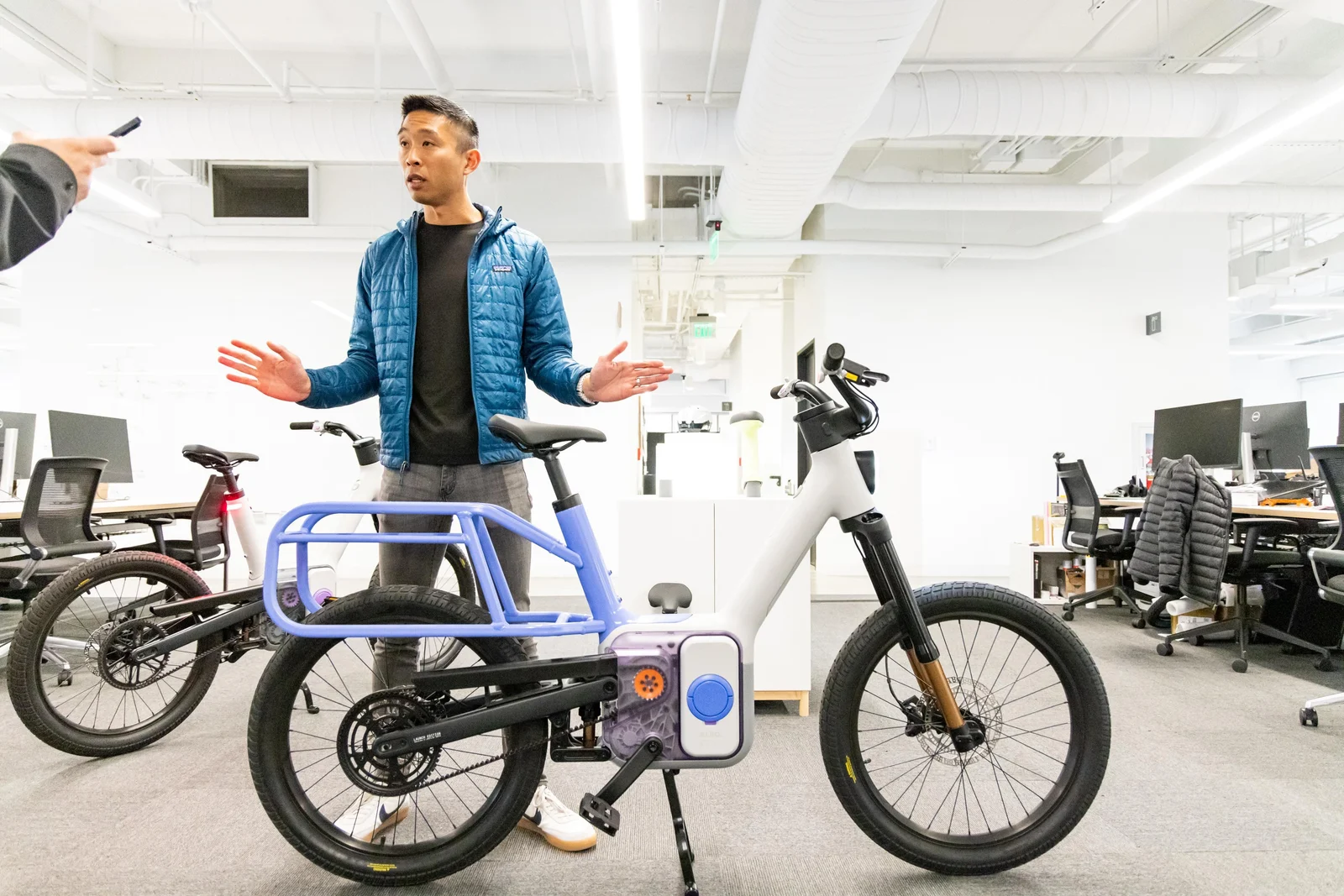
Yu, a Stanford aeronautics PhD and former CTO at Specialized, runs the startup as an independent business that counts Rivian as a minority shareholder. Under his lead, Also rolled out the TM-B — a quirky, modular e-bike with a raft of unique features, including a swappable top frame, USB-C chargeable battery, a built-in screen, a series hybrid pedal-by-wire system, and proprietary “Dream Ride” software. There’s also the TM-Q, an electric four-wheeler aimed at commercial deliveries.
But it hasn’t been completely smooth sailing. After dealing with supply chain headaches, confusing regulations, and some communication stumbles, Also is finally shipping its early Launch Edition bikes to customers while also getting ready to roll out the standard and performance versions. Meanwhile, customers have been letting the company have it on Reddit over the delayed deliveries, and the few people who have received their bikes have already experienced some minor software problems.
The Verge met up with Yu to chat about scaling production, surviving parts shortages, dealing with the mess of US e-bike laws, and why the company is betting big on autonomous delivery.
This interview has been lightly edited for length and clarity.
What is the current status of the bike and production ramp?
On the bike, the main thing is the production ramp. It’s one thing to create a product as a traditional OE where you work with several Tier 1 suppliers, get them to deliver on time, and assemble it. With us, we’ve built and designed everything down to individual components and ICs. Over the last year, every imaginable supply chain learning has come across.
We’ve been in the trenches competing with AI server demands for components like ICs, compute, memory, and raw PCBA [printed circuit board assembly] materials. Our inverter board is designed entirely in-house for high performance, and the thermals require a sophisticated board material. It turns out AI server farms have similar thermal requirements, triggering a global shortage, so we had to requalify and resource. But all that is behind us, and we are really starting to flow to customers and ramp up. A huge draw to come to Also was shipping a product that people will enjoy and use on the road every day, and reaching that milestone now has been huge for the team.
How many bikes have you delivered so far? Are you still in the Founder’s Edition phase?
That’s right. We’re quickly ramping up. We have a substantial number out there now, and you can see a lot of volume and traffic online of people taking their first rides. Deliveries are quickly increasing along the classic manufacturing ramp where you start steadily and then add volume.
In hindsight, was targeting a spring launch too optimistic?
At the time, based on everything we knew, spring was very much on plan. But as with Rivian on the automotive side or us earlier this year, a lot of unknown unknowns happened. Certainly I didn’t foresee the intense urgency around AI server hardware, nor the fact that those supply chains are so shared with light electric vehicles.
“Certainly I didn’t foresee the intense urgency around AI server hardware.”
— Chris Yu, president of Also Was there direct overlap between Also’s supply chain and Rivian’s?
I look at it as a three-way Venn diagram between us — vertically integrated small EVs — and Rivian — full-size automotive EVs — and broader AI hardware like robotics and servers. There is a healthy overlap right in the middle, alongside direct overlap between us and Rivian. Where we overlap with Rivian there is a clear benefit, but it wasn’t easy for Rivian either.
[Rivian CEO] RJ [Scaringe] and I talk all the time. Half the time we’re discussing how to handle a specific part or supply chain constraint. You either fight for the part and lean on suppliers, find an alternative supplier with the identical component, or — as both we and Rivian have had to do — completely redesign and requalify the system around a replacement part.
Can you get specific on what components had to be redesigned or requalified?
It sounds relatively boring on paper, but it’s critical. One example was IC components like high-performance capacitors. Swapping them requires the work of going through full validation testing to make sure the alternative hits our durability and lifespan standards, because those components dictate the reliability of PCBAs.
Another was raw PCBA board material. Only certain base materials meet our flammability, thermal cycle, and structural rigidity requirements. When supplies ran short, we had to qualify third and fourth alternatives. There is no parallelization of verification testing — components must spend weeks inside thermal chambers and on shock and vibration rigs to prove they can handle real-world conditions.
In a letter to customers, [head of product] Saul Leiken mentioned there were regulatory hurdles around power output as well. What happened with UL certification?
It wasn’t so much an impediment as proof of how nascent the regulatory space is relative to what we’re building. Our battery combines several uncommon attributes: exceptionally high power density, an automotive-style software-defined battery management system with two-way flow for regenerative braking, USB-C 3.1 charging at up to 240 watts, and a removable pack.
Those things combined don’t exist in standard e-bike battery guidelines. Certification bodies like UL write standards assuming a typical e-bike pack without USB data connections or such high bidirectional power throughput. When we presented our architecture, we identified undefined areas in the certification rules. Rather than treating it as a gray area and self-certifying, we partnered directly with UL to develop a clarification standard tailored to this type of battery architecture. We went back and forth, completed unit testing on both sides, agreed on the protocol, and we are now fully UL certified.
Do you anticipate any thermal runaway problems, given how battery fires have plagued the e-bike sector?
With any lithium-ion battery, you can never say never — whether you’re Tesla, Rivian, or an e-bike maker. Even from top-tier cell manufacturers like LG, Samsung, or Panasonic, there is an inherent cell fallout rate. Across thousands of vehicles and millions of cells, math dictates a non-zero number. That part is inescapable basic physics.
Where we are super confident is our pack architecture. We took an exceptionally robust and conservative approach from both a mechanical and software protection standpoint, incorporating passive and active propagation defenses learned from generations of automotive EV battery design. The cell architecture, array welding, and management systems all benefit directly from that engineering.
When do you anticipate starting deliveries of the Standard and Performance trims?
Super soon. We have started opening reservation conversions, and anticipation for the Performance trim has been huge. We are focused on fulfilling orders for the supporters who lined up first and waited the longest, and the Performance line will follow right around the corner.
Early reservation holders on Reddit voiced frustration about communication gaps during the delays. What did you learn from that?
I forget sometimes how much of a blessing it is for customers to care that much. It’s easy to make a product where nobody cares and there are zero Reddit comments. The responsibility is on us to be transparent. Our team’s default mentality was heads-down execution: chase suppliers, run engineering, and pass tests. We didn’t come up for air to keep everyone posted.
That was a mistake on our part — not providing regular, transparent updates for the cohort that backed us early. We’ve changed that over the last couple of months, establishing regular communication with our preorder holders about what’s happening in production and what’s coming next.
“That was a mistake on our part — not providing regular, transparent updates for the cohort that backed us early.”
Did the delays trigger many order cancellations?
Very few. Most people backed the project sight unseen, and since then almost everyone has attended a test event to try it out, which led them to double down. The overwhelming sentiment has just been: “I want it. When is it coming?”
Between pedal-by-wire, swappable frames, and custom software, did you overcomplicate the bike when an off-the-shelf design could have shipped much faster?
I don’t look at it that way at all. If we were to revisit the design, I would do the exact same thing. The largest untapped opportunity isn’t cyclists who already tolerate the current bike experience. It’s the massive demographic of people intrigued by leaving the car behind who haven’t opted in yet. Their hesitations are consistent: fear of theft, avoiding maintenance every two months, wanting seamless navigation and audio, and needing to carry a child without having to buy three different bikes.
Solving those pain points requires a baseline of technology. Just like in automotive EVs, once you use software to personalize the ride and eliminate friction, people opt in. The majority of people attending our test rides haven’t ridden a bicycle in 10 or 15 years. Our goal wasn’t to go overboard; it was determining the minimum amount of innovation needed to create an experience as frictionless as stepping into a Tesla Model Y or Rivian R2.
With cities and states cracking down on overpowered bikes and mopeds, how does Also fit into the shifting regulatory landscape?
We are well-positioned by design to navigate a patchwork regulatory system. Current backlash is driven by bad actors selling products labeled as e-bikes that are actually mini-motorcycles, or bikes where clipping a wire uncaps speeds to 45 mph without vehicle safety standards.
The primary issue is a lack of regulatory resolution between genuine Class 1, 2, and 3 e-bikes and unregulated vehicles, leading to blunt blanket bans like we’ve seen in New Jersey. Our philosophy is that the opportunity within legitimate Class 1, 2, and 3 categories is massive, and we remain definitively within that framework.
We engineered the bike with immediate low-end torque so accelerating to 20 or 28 mph is responsive and fun without needing dangerous motorcycle speeds. Furthermore, because the bike is software-defined, the identical hardware can be configured to local rules — whether that’s 20 mph, 28 mph, or European 25 km/h limits. We are also introducing over-the-air parental controls so families can set conservative speed limits for younger riders, which is the exact opposite of the cut-the-wire approach.
Were you concerned about delicate electronics or firmware falling out of calibration during shipping?
Physical package handling was an early challenge. FedEx did not handle the initial deliveries well, so we paused and switched carriers, which resolved the issue.
On firmware and calibration, it is a solved problem. Nobody picks up an electric car wondering if the drive-by-wire calibration got jostled in transit. Mechanically, the bike has very few moving parts. The drivetrain is fully sealed and pedal-by-wire, so traditional failure points like exposed derailleurs and shifters simply don’t exist. The down-tube computer, display unit, and hand controls are robust, solid-state systems rather than fragile instruments.
“FedEx did not handle the initial deliveries well, so we paused and switched carriers, which resolved the issue.”
What is the out-of-the-box assembly process like for non-cyclists?
Very minimal. I pushed the team to make it feel as turnkey as unboxing an Apple Watch. You release a few clips, slide off the outer carton, and find three core elements: the main frame, the top frame, and the cockpit. The cockpit handlebar contains all integrated controls and wiring with a blind internal connector.
Assembly entails mounting the front wheel, powering on the bike from shipping mode, connecting the mobile app, snapping on the modular top frame, and securing the stem base plate with two bolts. Threading the pedals is the final step, which is guided by short 20-second video walkthroughs in the app alongside a provided shock pump to set suspension pressure based on rider weight.
How will service and repairs work for riders who don’t live near an Also brand hub?
Many issues can be resolved over the air. When physical service is required, our onboard diagnostics pinpoint the exact issue immediately through data logs rather than requiring guesswork at a shop. If hardware replacement is necessary, we can dispatch parts proactively.
Our repair network combines our own facilities with authorized local bike shops. We currently have roughly 150 vetted partners, expanding beyond 200 soon. We provide these shops with complete technical documentation, dedicated software tools, and direct parts inventory. Because every component board is digitally serialized to the bike for anti-theft security, authorized partners use our proprietary software to link new parts directly to the frame.
Micromobility saw several high-profile company collapses after the pandemic boom. How does Also protect itself from those pitfalls?
We didn’t start Also solely to be an e-bike company. The bike is our flagship and our handshake with the world, but our broader mission is building purpose-built small vehicles. The vast majority of urban trips are short, low-payload journeys — moving a single passenger or delivering takeout. Designing an urban transportation network from scratch would never rely exclusively on multi-ton cars.
The bike serves as the architectural foundation for a broader vehicle roadmap that is software-defined, vertically integrated, and autonomy-first. Following the bike launch, we are heavily focused on autonomous delivery. Earlier this year, DoorDash joined as a strategic partner to develop and deploy autonomous delivery platforms. A light vehicle platform that carries payload across town at 28 mph offers significant cost-per-mile efficiencies, and our autonomous platform shares direct architectural commonality with that system.
Will that DoorDash collaboration result in a low-speed sidewalk robot?
Sidewalk robots represent a completely different product class — closer to an industrial automated robot than an L4 autonomous road vehicle. By nature, sidewalk robots travel at 1 to 2 mph. While that works within localized, high-density environments like university campuses, purpose-built light electric vehicles operate at vehicle speeds across entire metro areas.
I’m sure you’re aware there is some excitement going on around low-speed vehicles like golf carts.
One hundred percent. And it does feel like this kind of fits into that. There’s been a ton of interest there. And that’s one of the more common questions I get is like when can we get one of these. But I think what you just said is actually – that’s the point that I want to focus on, which is – It’s less about the specific form factor of like a TM-Q or otherwise. It’s more the notion that there’s this huge gap and a huge demand for people to say, hey, the average household has something like two point something vehicles. And nearly everyone agrees that you don’t need two Escalades. You need like one big capable vehicle. And we’ve seen that a lot of people have started picking up things like golf carts and LSVs. And I would argue that it’s in spite of the deficiencies in the category.
Because if you just think big picture, the problem that we’re trying to solve collectively is how do I have something that costs much, much less than an average-priced $50,000 car today? But at the same time, why does that have to be a crappy experience? I want that to be a premium experience and potentially be able to be L4 autonomous as well. And so for us, that’s a huge opportunity. So let’s take the notion of small purpose-built for getting around and doing the everyday trips that everyone does, but have it feel like a magical experience that potentially could be fully autonomous as well. That is a super interesting opportunity.
Follow topics and authorsfrom this story to see more like this in your personalized homepage feed and to receive email updates.