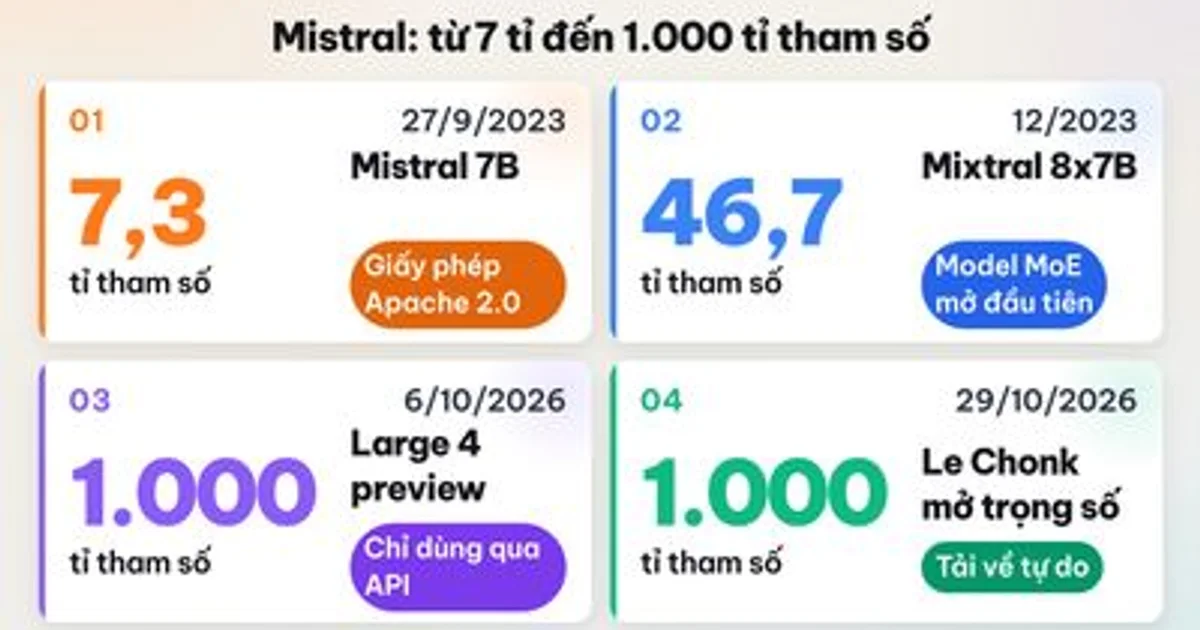
Mistral releases Le Chonk open weight model with one trillion parameters
Executive Briefing
“Mistral AI has released Le Chonk, a one-trillion-parameter open-weight artificial...”
Key Takeaways
- 1.Mistral AI released the open-weight version of its Large 4 model codenamed Le Chonk with approximately one trillion total parameters.
- 2.The mixture-of-experts architecture consists of 128 smaller experts, where a router selects 4 experts plus 1 shared expert to process each token.
- 3.The model supports text and images, over 160 languages, and a context window of one million tokens.
- 4.The associated license is the Mistral Ecosystem Open-Weight License, permitting usage and commercialization except for direct model-as-a-service rental businesses.
Mistral AI has released Le Chonk, a one-trillion-parameter open-weight artificial intelligence model built on a mixture-of-experts architecture. The system enables community deployment and customization while requiring enterprise-grade server infrastructure.
Key Developments and Technical Context
Mistral AI released the open-weight version of its Large 4 model codenamed Le Chonk with approximately one trillion total parameters.
The mixture-of-experts architecture consists of 128 smaller experts, where a router selects 4 experts plus 1 shared expert to process each token.
The model supports text and images, over 160 languages, and a context window of one million tokens.
The associated license is the Mistral Ecosystem Open-Weight License, permitting usage and commercialization except for direct model-as-a-service rental businesses.
Strategic Analysis and Industry Implications
The mixture-of-experts architecture significantly reduces computational costs by activating only a fraction of parameters per token despite reaching one trillion in total scale.
Releasing open weights enables organizations to maintain infrastructure sovereignty and data security, although the hardware demands a cluster of high-end GPUs.
Outlook and Key Factors to Watch
The actual performance of the model when deployed outside benchmarks published by the company remains to be independently validated at scale.