Pottery: humanity's first pot was born during the ice age, before agriculture
Executive Briefing
Synthesized and verified with gemini-2.0-flash-thinking-exp
“About 20,000 years ago, during the coldest period of the last ice age, a group of hunter-gatherers i”
Key Takeaways
- 1.About 20,000 years ago, during the coldest period of the last ice age, a group of hunter-gatherers in Xianrendong cave in Jiangxi province, China, shaped clay into pots and then fired them.
- 2.Their fragments are the oldest ceramic containers ever found.
- 3.This discovery shows that the pot was born more than 10,000 years before agriculture, contrary to the long-standing belief that people only made pots when they knew how to grow crops.
About 20,000 years ago, during the coldest period of the last ice age, a group of hunter-gatherers in Xianrendong cave in Jiangxi province, China, shaped clay into pots and then fired them. Their fragments are the oldest ceramic containers ever found. This discovery shows that the pot was born more than 10,000 years before agriculture, contrary to the long-standing belief that people only made pots when they knew how to grow crops.
Earthenware existed before the pot
People knew how to bake clay a long time ago. Statue of Venus Dolní Věstonice in the Czech Republic, made of ceramic, dated to about 29,000 to 25,000 BC. But it's a statue, not a container. For a long time, archaeologists believed that ceramic pots appeared about 10,000 years ago, at the same time as agriculture and settled villages, to cook grains and vegetables.
Statue of Venus Dolní Věstonice found in the Czech Republic, made of fired ceramic, dated about 29,000 - 25,000 BC
In 2012, the team of Ngo Tieu Hong (Peking University) and Ofer Bar-Yosef (Harvard University) published in the journal Science the results of radiocarbon dating for soil layers containing pottery shards in Xianren Cave: 20,000 to 19,000 years ago, 2,000 to 3,000 years earlier than other pottery in East Asia. Boston University analyzed microstratigraphy to ensure the sediment layer was not disturbed. According to New Scientist, Bar-Yosef said that these were rudimentary pots and bowls, about 20 cm in diameter, not baked properly, so they were fragile.
What is the first pot used for
The outside of many ceramic pieces in Tien Nhan cave has scorch marks and soot, signs that they were once placed on fire to cook. Bar-Yosef notes that that time coincided with the glacial maximum, when food was scarce, and cooked food gave more energy than raw food. According to the authors, other hunter-gatherer groups also used pots to store food or brew alcoholic drinks.
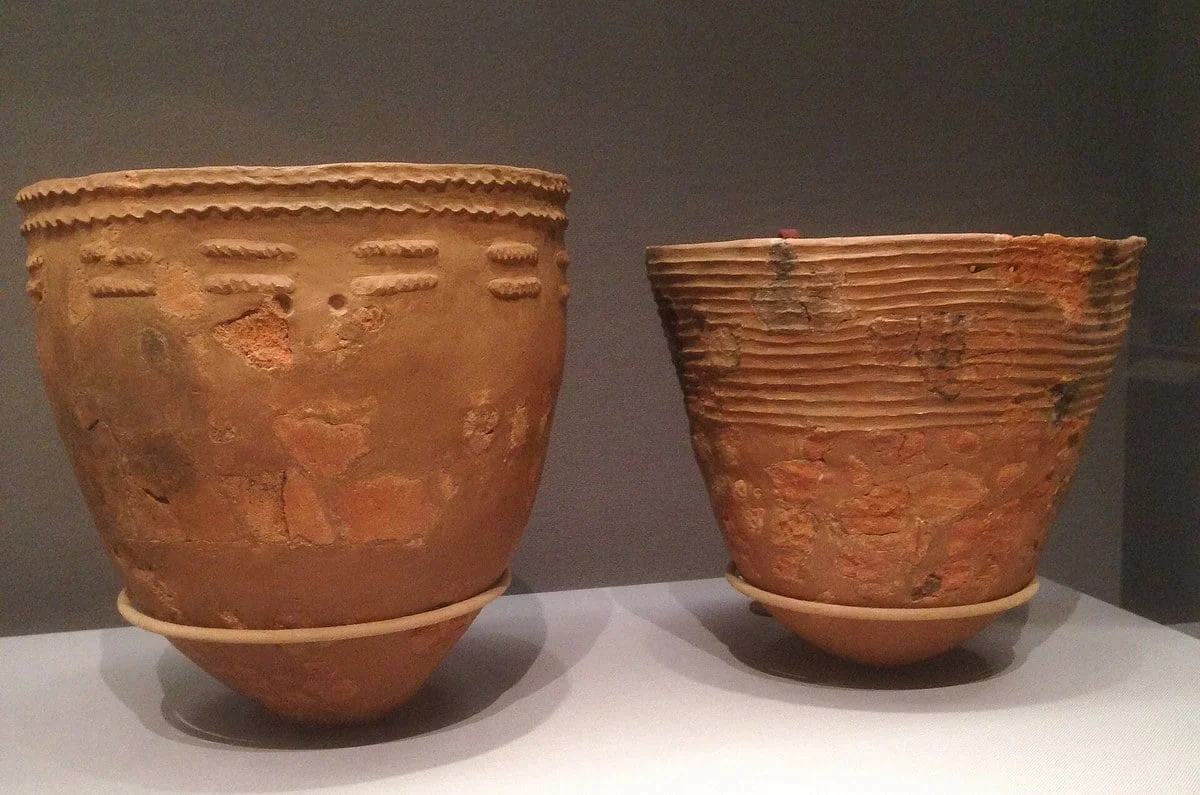
More direct evidence comes from Japan. In 2013, Oliver Craig's group (York University, UK) published in the journal
Natureanalysis results of 101 samples of burnt residue in early Jōmon pottery, dated about 15,000 to 11,800 years ago. Fat and isotope analysis showed that these pots were used to cook fish and other freshwater and saltwater aquatic species. This is the earliest direct evidence of ceramic use for cooking.
Early Jōmon deep bowl at Tokyo National Museum (Japan)
Later, when agriculture appeared, the pot took on a new role. Summary of
Science writes that ceramics help store food more safely than woven baskets or leather bags, and can also be used for cooking.
How clay turns into ceramic
Clay mixed with water becomes flexible and easy to mold. When dried, it hardens, but when exposed to water, it still softens. Only when fired at high temperatures do the minerals in clay change permanently, making the object much stronger and harder. According to Wikipedia, ceramics are fired at 600 to 1,400 °C in a fire, pit or furnace. The first pots were hand-shaped, fired at low temperatures outdoors or in pits, and were not decorated. Depending on the firing temperature and soil type, ceramics are divided into three main groups:
- ** Terracotta **: can be fired from about 600 °C, usually below 1,200 °C, porous so it is difficult to contain liquid if not glazed.
- Crockery: fired at about 1,100 - 1,200 °C, strong and waterproof. The Chinese were able to do this very early, but Europe did not do it until the late Middle Ages.
- Porcelain: usually contains kaolin, fired at 1,200 - 1,400 °C, hard, white and slightly transparent.
Advertisement
Artist Sara Fina Tafoya fired ceramics outdoors at Santa Clara Pueblo (New Mexico, USA) around 1900, using open-air firing without a kiln
Turntable and batch-made pots
Before there were turntables, people rolled the soil into long rolls, then stacked them on top of each other and rubbed them together. Slow turntables were used in the Near East around 3500 BC. A stone turntable found in the Sumerian city of Ur (present-day Iraq) is dated to around 3129 BC, and a turntable of the Cucuteni-Trypillia culture in western Ukraine has been dated to the middle of the 5th millennium BC, the oldest ever found. In the middle and end of the 3rd millennium BC, the fast turntable was born, using heavy stone wheels to store energy like a flywheel. Potters can stretch the walls of pots thinner and make more pots per hour.
Painted ceramic jars of the Yangshao culture, a Neolithic agricultural culture along the Yellow River (about 5000 - 3000 BC)
Because they are durable over time, pottery shards are one of the main sources of archaeological data, often remaining long after wooden, leather or fabric objects have decayed. From crude pots in Tien Nhan cave, ceramics today are present in dishes, tiles, sanitary equipment and even insulating porcelain.
Source:
Science (2012)
,
New Scientist
,
Boston University
,
Nature (2013)
,
Wikipedia: Pottery
,
Wikipedia: Potter's wheel