Open source UAEF framework brings unified closed loop evaluation to AI agents
Executive Briefing
“AWS introduced the Universal Agent Evaluation Framework, an open source system that...”
Key Takeaways
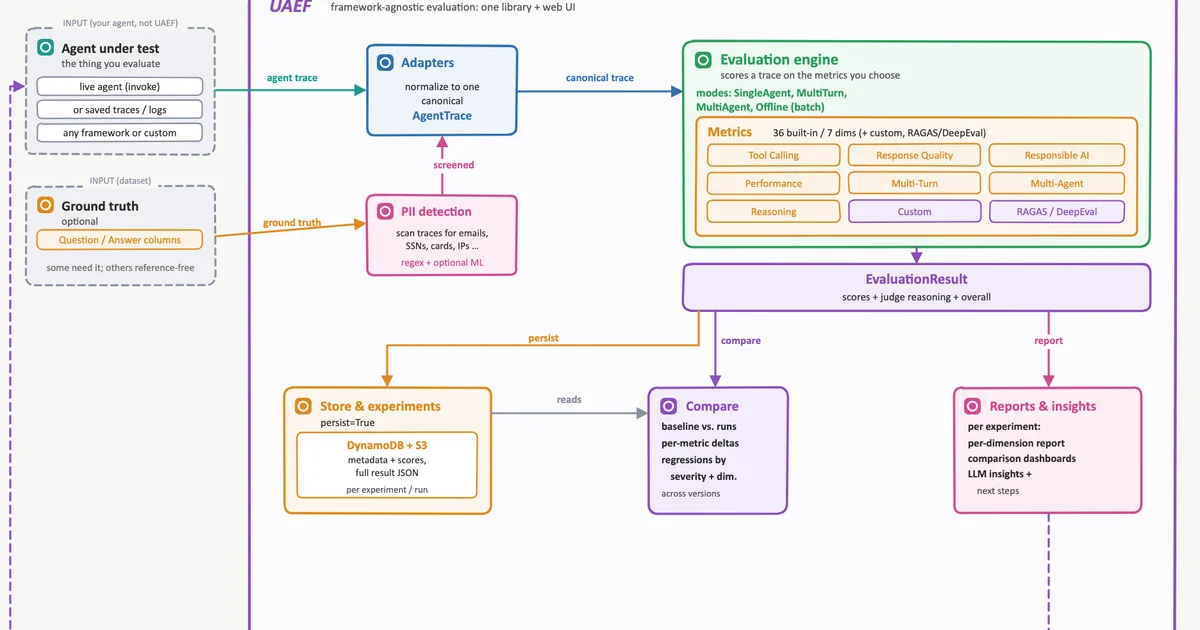
- 1.The UAEF system uses adapters to convert execution traces from frameworks such as LangGraph, LangChain, Strands Agents, and Amazon Bedrock AgentCore into a single common format.
- 2.The evaluation engine scores traces based on 36 built-in metrics across 7 quality dimensions, including tool calling, response quality, responsible AI, and performance.
- 3.Results are stored in Amazon DynamoDB and Amazon S3 so development teams can compare agent versions, detect regressions, and generate detailed reports.
AWS introduced the Universal Agent Evaluation Framework, an open source system that converts execution traces from various frameworks into a common format to evaluate AI agent quality consistently.
Key Developments and Technical Context
The UAEF system uses adapters to convert execution traces from frameworks such as LangGraph, LangChain, Strands Agents, and Amazon Bedrock AgentCore into a single common format.
The evaluation engine scores traces based on 36 built-in metrics across 7 quality dimensions, including tool calling, response quality, responsible AI, and performance.
Results are stored in Amazon DynamoDB and Amazon S3 so development teams can compare agent versions, detect regressions, and generate detailed reports.
Strategic Analysis and Industry Implications
Separating the normalization of execution traces from the scoring mechanism solves the challenge of performing fair comparisons across different agent development frameworks.
The ability to detect personally identifiable information before storing data helps organizations better adhere to security standards when processing real traffic.
Outlook and Key Factors to Watch
The actual performance and operating costs of running LLM judges for all 36 metrics at large enterprise scale remain unquantified in detail.