Trigram campaign impersonates about fifty AI and blockchain brands to target developers
Executive Briefing
“Security researchers uncovered a large-scale campaign dubbed Trigram that impersonates...”
Key Takeaways
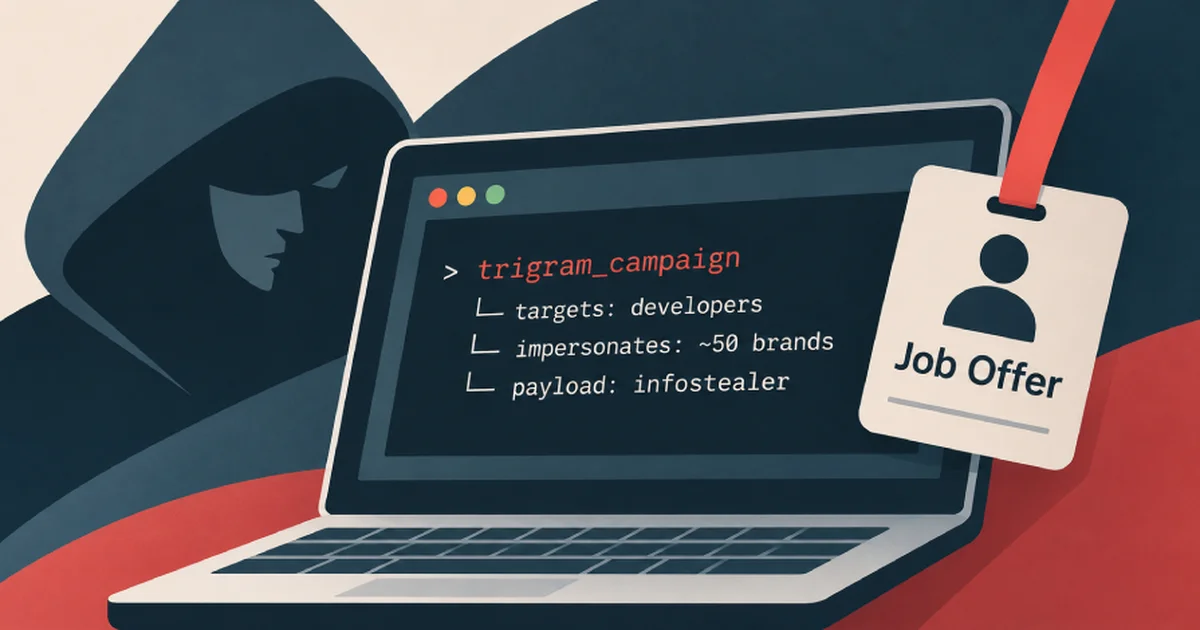
- 1.The Trigram campaign impersonates about 50 brands in the blockchain and AI sectors to trick developers into executing an infostealer themselves.
- 2.Three social engineering scenarios covering recruitment, conferences, and package tracking, alongside software supply-chain compromises and trojanized code repositories, converge on the same infrastructure.
- 3.The activity shares similarities with intrusion sets linked to North Korea, particularly Kimsuky and UNK_DeadDrop, notably through recruitment lures and attack techniques.
- 4.Stormshield published a deep-dive technical report detailing the campaign's management platform, victim-tracking consoles, and email-delivery infrastructure.
Security researchers uncovered a large-scale campaign dubbed Trigram that impersonates dozens of artificial intelligence and blockchain brands to target software developers with infostealers. The operation leverages social engineering scenarios and centralized management infrastructure to deploy malware and harvest sensitive data.
Incident Details & Technical Context
The Trigram campaign impersonates about 50 brands in the blockchain and AI sectors to trick developers into executing an infostealer themselves.
Three social engineering scenarios covering recruitment, conferences, and package tracking, alongside software supply-chain compromises and trojanized code repositories, converge on the same infrastructure.
The activity shares similarities with intrusion sets linked to North Korea, particularly Kimsuky and UNK_DeadDrop, notably through recruitment lures and attack techniques.
Stormshield published a deep-dive technical report detailing the campaign's management platform, victim-tracking consoles, and email-delivery infrastructure.
Risk Assessment & Security Implications
Combining multiple initial distribution vectors ranging from fake recruitment portals to compromised source code repositories demonstrates a high degree of automation and professionalization in developer-targeted attacks.
Abusing legitimate services such as GitHub, GitLab, and reputable email providers helps malware disguise its network traffic, thereby reducing the effectiveness of traditional defense measures.
Mitigation & Factors to Watch
The precise financial and operational scale of the damage inflicted on affected organizations and individuals globally has not been fully disclosed.
The exact identities of the individuals behind the campaign remain grounded in technical overlap assessments rather than direct legal evidence.