AWS advises factories to start with fixed AI workflows before autonomous multi-agent systems
Executive Briefing
“AWS recommends that factories start with predefined workflows before letting AI agents...”
Key Takeaways
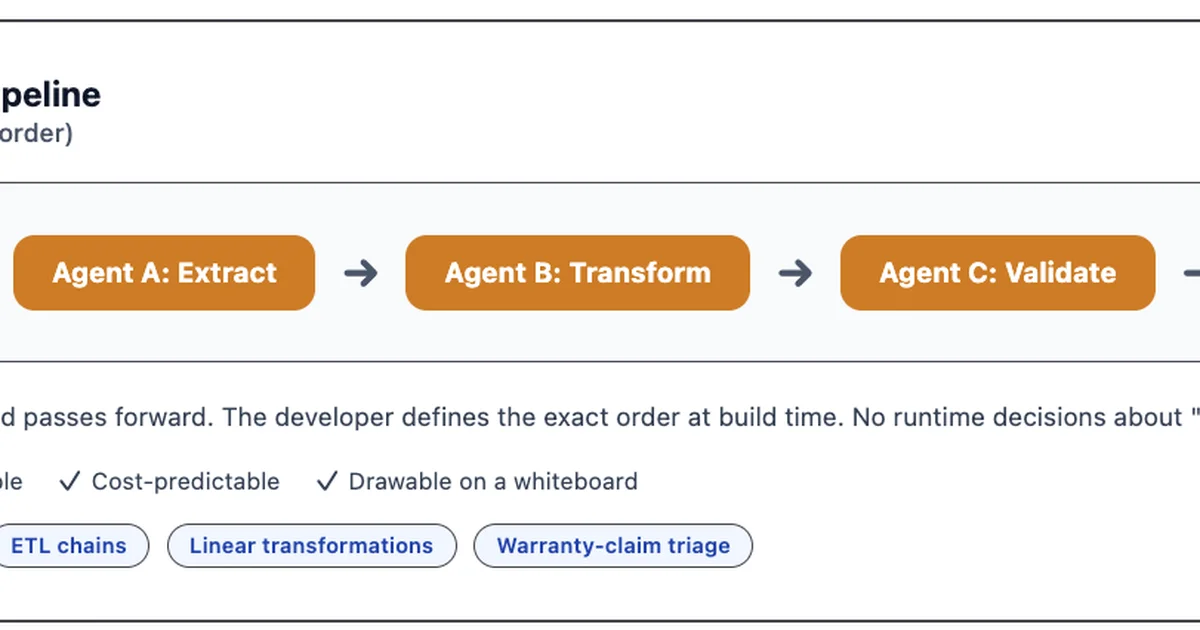
- 1.AWS divides multi-agent coordination into two groups. Developers set the workflow in the first; the model chooses its path at runtime in the second.
- 2.AWS recommends starting with a predefined workflow and moving to autonomous coordination only when subtasks emerge during the work. The latter adds token costs, latency and debugging difficulty.
- 3.To illustrate the risk of chaining steps, the article calculates that 10 steps, each 95% reliable, yield 59.9% end-to-end reliability. The example assumes a strictly sequential chain with no retries.
- 4.For factory equipment, AWS recommends keeping deterministic control systems at the core while AI agents observe, analyze and recommend. Before execution, a recommendation should be checked against current operational state and receive approval appropriate to its scope.
AWS recommends that factories start with predefined workflows before letting AI agents decide what to do next. Its guidance reserves more flexible coordination for work whose subtasks cannot be identified in advance.
Key Developments and Technical Context
AWS divides multi-agent coordination into two groups. Developers set the workflow in the first; the model chooses its path at runtime in the second.
AWS recommends starting with a predefined workflow and moving to autonomous coordination only when subtasks emerge during the work. The latter adds token costs, latency and debugging difficulty.
To illustrate the risk of chaining steps, the article calculates that 10 steps, each 95% reliable, yield 59.9% end-to-end reliability. The example assumes a strictly sequential chain with no retries.
For factory equipment, AWS recommends keeping deterministic control systems at the core while AI agents observe, analyze and recommend. Before execution, a recommendation should be checked against current operational state and receive approval appropriate to its scope.
Strategic Analysis and Industry Implications
When the processing sequence is already known, adding agents that choose the next step may introduce coordination costs without meeting a real need. A fixed workflow also makes delays and failures easier to locate.
In a factory, architecture is not just about answer quality. When AI output could affect equipment, mechanisms outside the model must enforce the boundary between a recommendation and a control command.
Outlook and Key Factors to Watch
The article does not provide a controlled comparison measuring how much each coordination pattern changes reliability or cost at a particular factory.
The 59.9% reliability figure is an illustrative calculation, not a measured failure rate for a deployed multi-agent system.