Staera raises $4.6 million to develop optical links between chiplets
Executive Briefing
“Staera Semiconductor has launched with $4.6 million in pre-seed funding to develop optical...”
Key Takeaways
- 1.Singapore-based Openspace Capital led Staera’s $4.6 million pre-seed round.
- 2.Staera aims to replace copper wiring that carries data between chiplets with optical links. The company says the approach can increase speed and reduce power use.
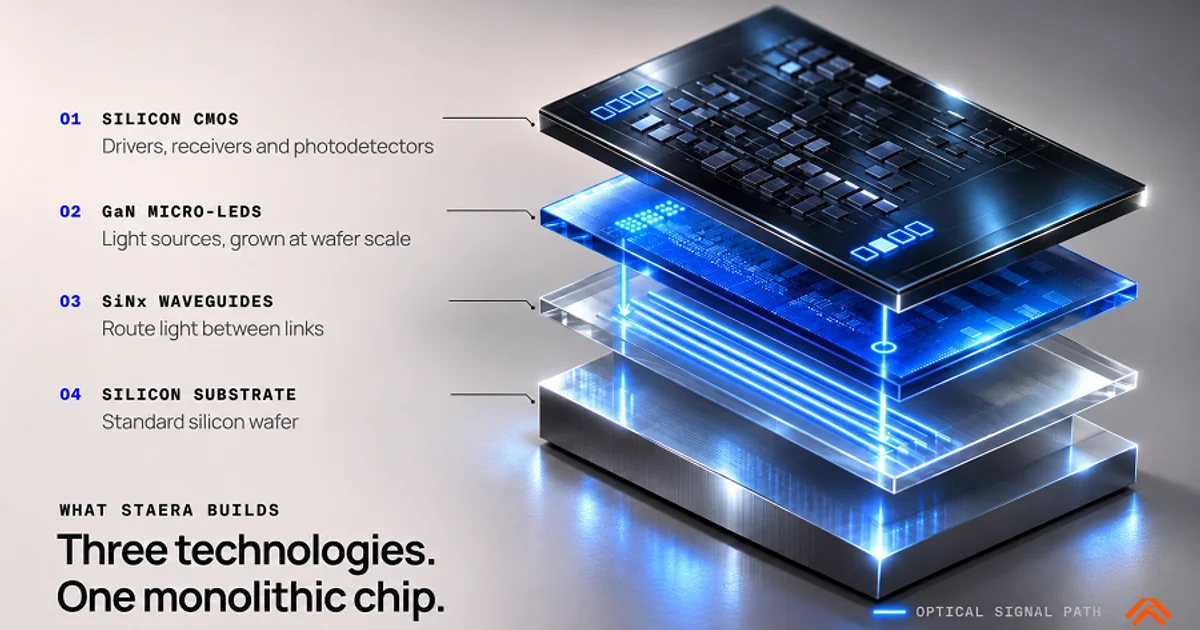
- 3.Staera’s first product, Lightwire, uses silicon-nitride waveguides and generates light with miniature LEDs.
- 4.Staera says Lightwire can transfer data between chiplets at up to 8 Gb/s and accommodate more than 600 optical links per square millimeter. The report describes a potential 24 Tb/s for an HBM4 memory stack using the technology, versus 2.8 Tb/s with current technology; the source does not provide independent test results for that comparison.
- 5.The funding will support commercialization efforts. Staera hopes to begin commercial shipments in 2030.
Staera Semiconductor has launched with $4.6 million in pre-seed funding to develop optical connections between chiplets in AI accelerators. It aims to use light in place of copper wiring for those connections, but independent performance results have not been disclosed.
Key Developments and Technical Context
Singapore-based Openspace Capital led Staera’s $4.6 million pre-seed round.
Staera aims to replace copper wiring that carries data between chiplets with optical links. The company says the approach can increase speed and reduce power use.
Staera’s first product, Lightwire, uses silicon-nitride waveguides and generates light with miniature LEDs.
Staera says Lightwire can transfer data between chiplets at up to 8 Gb/s and accommodate more than 600 optical links per square millimeter. The report describes a potential 24 Tb/s for an HBM4 memory stack using the technology, versus 2.8 Tb/s with current technology; the source does not provide independent test results for that comparison.
The funding will support commercialization efforts. Staera hopes to begin commercial shipments in 2030.
Strategic Analysis and Industry Implications
If Lightwire achieves its stated link density, it could increase data transfer within a given chip area. The 24 Tb/s HBM4 figure will be more useful for assessing its prospects once measurements from a complete system are available.
The 2030 shipment target indicates that Staera still needs to move its interconnect design into production before customers can use it at scale.
Outlook and Key Factors to Watch
The source provides no independent measurements of Lightwire’s speed, power use or reliability in a complete AI accelerator.
It is unclear whether Staera has secured customers or manufacturing partners for its planned 2030 shipments.